
How to Account for the Spread in Forex When Opening and Closing Trades
 Hello, friends! This video lesson will be devoted to beginner forex traders who, in their rush to earn millions, forget about the important details that make up trading in the Forex currency market. And we will talk about the spread, why you see two prices (Bid and Ask) when opening a trade, and most importantly, how to take the spread size into account when opening and closing orders in forex.
Sometimes beginners get indignant and write to the broker's support service: "Why did I open a trade and it immediately ended up in the red? The price didn't move. Why?" Or: "My trade was triggered, a profit or stop loss was triggered, even though there was no such price on the chart, how can that be? Is someone deceiving me? What is going on?" Or: "A pending order was activated even though the price had not yet reached the pending order mark." The answers to all these questions lie in the concept of the spread.
WHAT IS A SPREAD?
Let's go directly to the trading terminal and in practice see what the spread is and how to account for it in trading. Suppose we have the euro-dollar chart. The currency pair is EurUSD. And on the chart we see the current price: 1.3293. If we click "open new order," then we will see that we have 2 prices: the price at which we can sell (this price is called Bid), and the price at which we can buy (this price is called Ask).
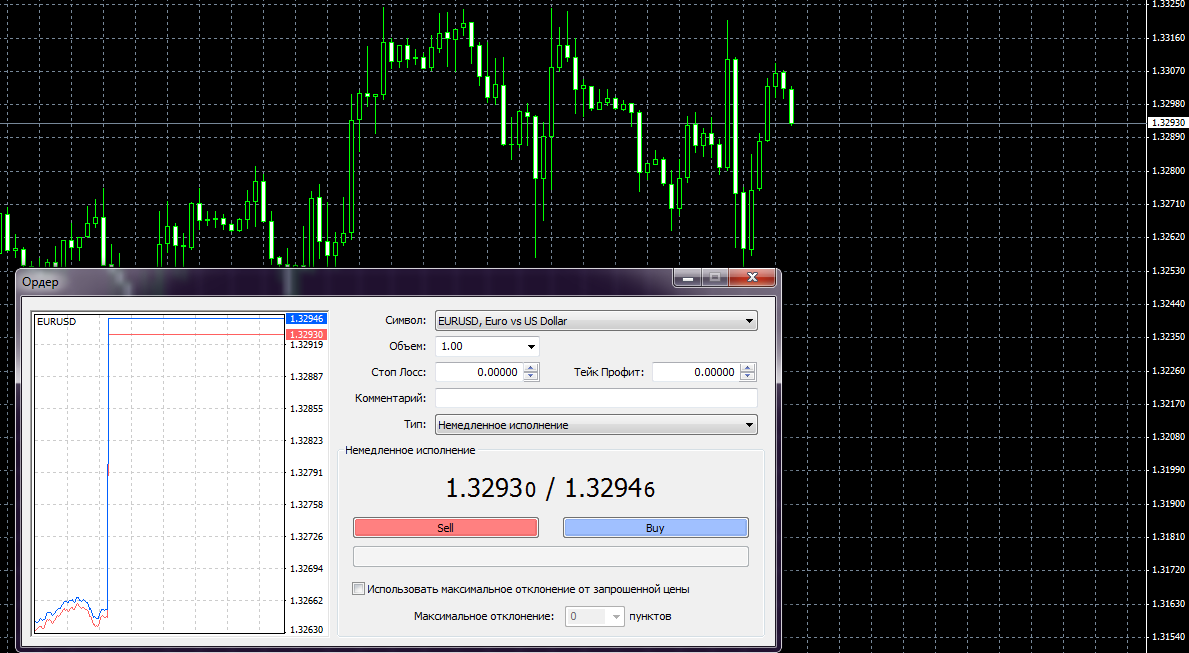
Why 2 prices when there is only one price on the chart? A comparison with a currency exchange office helps very well here. I think everyone has used the services of a currency exchange point at least once, exchanging rubles for dollars, euros for rubles, or some other currency. A bank always gives 2 prices. The price at which it can buy currency from you, and the price at which it can sell currency to you.
And the price at which a bank can buy currency from you is usually a little lower than the official Central Bank rate. And the price at which a bank can sell currency to you is a little higher than the official Central Bank rate. Why? Because the bank earns money on this difference. Every time it sells currency to you a little more expensively and buys it from you a little more cheaply than the official rate, the bank earns money for itself.
It is exactly the same in Forex. This difference between the prices at which you can sell and at which you can buy is nothing other than the spread. And this spread goes to your broker as a commission; the broker earns on the spread. If on each trade you can earn 40 points, lose 10, or earn 500 points (depending on what kind of forex strategy you have and how you trade), then the broker always earns a fixed amount on each of your trades.
BROKER'S EARNINGS
The spread depends on the currency pair. On some currency pairs it is smaller, on the same euro-dollar, because this currency pair is very popular and has high liquidity. On some exotic currency pairs, such as the dollar-Russian ruble, the spread will naturally be much higher, since the demand and liquidity of such currency pairs are much lower.
Every time you open or close a trade, the broker earns on the spread from a fraction of a point to several points. When you buy, the broker earns at the moment the trade is opened, because you buy at a price slightly higher than the market price. When you sell, the broker earns at the moment the trade is closed.
Please note that as soon as you open a buy trade, it is already at a small loss. This is because we bought at a price slightly higher than the market price. The same applies to sales, but there the spread is taken at the moment the trade is closed (see below)
THE SPREAD WHEN BUYING AND SELLING
Accordingly, as soon as we close the trade, we will either earn something or lose something. And the broker has already earned at the moment the trade was opened, because he allowed us to buy the currency pair slightly more expensively than the market price and, accordingly, put the difference in his own pocket. And our task is to earn our own points. And their amount will depend on your trading, on your style and strategy.
Please note that we sell at the price shown on the chart (it is the same as the Bid price). But we will close the position at market, at the Ask price. So we will pay the spread in any case. It's just that when opening buys, the spread is charged at the moment the trade is opened, while in the case of sales, the spread is charged when we close the trade.
THE SPREAD WHEN SETTING TAKE PROFIT AND STOP LOSS: BUYS
If you have large targets, large stop losses, large profits of 100-200 points and above, then you may pay no attention to the spread at all. Because it is too small a share of the price movement compared to your targets. If you trade on daily charts and have large takes and large stops, then you can completely ignore the spread. It will not make a noticeable difference to you. But if you have small targets, you trade intraday, and your take profits are 10-20 points, then the spread is worth paying attention to.
First, let's look at buys. For buys, everything is quite simple. It should be taken into account that we buy not at the price that was on the chart, but a little more expensively. And if you have some signal on the chart according to your system, then you measure your targets not from the signal itself (for example, a take profit of 20 points), but from the point at which you bought, that is, a little higher on the chart.
Thus, when setting a take profit on buys, we add our take profit plus the spread to the point where our signal appeared. For the euro-dollar pair, the spread is completely insignificant, often less than 1 point. It can be disregarded. But on pairs where the spread is higher, 2-3 points, those 2-3 points should be added to the take profit.
And if you set aside some distance from the point where the signal appeared for the target, then it will not be 20 points but 21, for example, that is, you add the size of the spread to your target. You count the stop loss from the point where your signal appeared by N points corresponding to your stop loss (for example, 20 points). And that price value at which your stop loss should be is what you set.
As you can see, everything is simple with buys. Please note that if you place a buy stop pending order, your pending order will trigger a little earlier than the price reaches that level on the chart by which you set the buy stop value.
A Buy Stop is activated a little earlier than the price reaches the pending order level on the chart (by the size of the spread, since we always buy at a price higher than on the chart). And when the price on the chart comes within a spread's distance of the level of our pending order, the order will be activated. This should be taken into account.
THE SPREAD WHEN SETTING TAKE PROFIT AND STOP LOSS: SELLS
Now let's look at sales. When we sell, it is beneficial for us if the price goes down. We must limit our possible losses with a stop loss level.
Please note that our stop loss in the case of sales is activated a little earlier than the price reaches this line. Why? It is all the same as with a pending order for buys. We buy, and when closing sales, we actually buy at the Ask price, at the price that is slightly higher than the market price. Therefore, when the price falls just short of our stop loss by the spread distance, it will be activated.
Take this into account. If you do not want your stop loss on sell trades to be triggered because of the spread, then when placing a stop loss on sell trades you should set it slightly higher (by the distance of the spread). We add the spread value to the stop loss and place it a little higher: by half a point, by 2–3 points, if the spread on a certain currency pair is that value.
What about take profit? So, we place the take profit below the market price level, because we are selling. Our take profit for sell trades is triggered slightly below the take-profit line that you see on the chart. After all, the price at which the order will close is the Ask, and it is slightly higher than the current price on the chart.
The sell order will close at the ask price, it will close at the price at which we can buy. Therefore, our take profit will trigger slightly below our take-profit line (by the distance of the spread). For your sell trade, the current price is the current price + spread. It is greater by the amount of the spread. And when the price on the chart reaches this line, it will still need to move another half point by the spread distance in order for the take profit on your sell trade to be activated.
If you place a pending sell order sell stop below the current price, it will trigger when the price moves past the level of your placed pending order by the amount of the spread. This should also be taken into account.
SPREAD WIDENING
It is also necessary to take into account that if you have an ECN account, spread widening is possible on it. Most of the time spreads are low, which is an advantage of accounts of this type, but when economic news is released spreads widen, and your stop loss, take profit, or pending order may trigger even though the price did not reach it because of the spread widening. This is worth understanding, this is worth taking into account. To put it more simply, do not trade during the news and everything will be fine.
SUMMARY
At the Bid price, the following orders are executed: Sell / Sell, Sell limit / Sell limit, Sell stop / Sell stop, Stop loss / Stop loss, and Take profit / Take profit for a buy position.
At the Ask price, the following orders are triggered: Buy / Buy, pending orders Buy limit / Buy limit, Buy stop / Buy stop, Stop Loss and Take Profit for a sell position.
Best regards, Pavel Vlasov Tlap.io