
How the Forex Market Works

Hello, trader friends! We all know that Forex is an interbank, decentralized market regulated by practically no one. But how is everything actually arranged? In this article, we will go over the main aspects: market participants, sources of quotes, the reason Forex became accessible to ordinary mortals, we will examine the operating models of brokers and what we should do with all of this.
Market structure
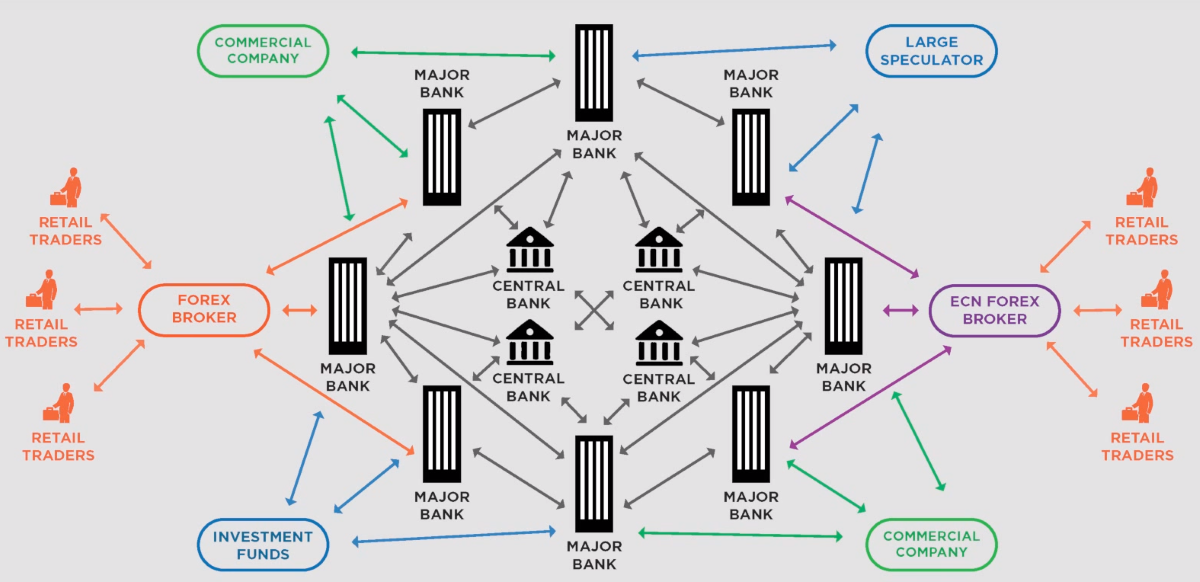
Why is the Forex market called "interbank"? It is very simple, because originally there was no one on it except banks.
Forex was originally conceived as a means for developing commerce and trade between countries. An American company buys parts, for example, in Japan. Accordingly, the company needs yen. And if it is a very large company, then it needs a lot of yen. And where can it get them? Buy them through a bank. And where will the bank get them? It will buy them from colleagues through Forex and sell them to the company at a slightly less favorable rate, taking a spread for its services.
If you come to a bank to exchange dollars or rubles for some other currency, you will see that the rates are fixed. They do not change during the day.
Thanks to a deeper understanding of the market, a bank can fix quotes: take on the obligation to carry out an operation at the current rate, in other words, conduct hedging, until a client appears on the market who is ready to buy at that price. This process allowed banks to significantly increase their net profit. The sad consequences were that liquidity could be redistributed in such a way that sometimes it was not possible to complete certain financial operations.
It was for this reason, and only for this reason, that the market eventually had to be opened to non-bank participants. Banks wanted to have a greater number of orders in the market; thus, a) they could profit from less experienced participants, and b) less experienced participants could provide better liquidity distribution for carrying out international business hedge operations. Initially, only hedge funds with large capital were allowed into currency transactions, such as the Soros fund and others, but after some time retail brokerage firms and ECNs began to be allowed into currency operations.
The entire Forex market is essentially a large and multi-level system of electronic orders to buy and sell currency. The prices you see are only the best offers from liquidity providers.
Why does the FX market remain so weakly regulated? One reason is the unwillingness of countries to interfere with international trade, which is needed like air for the healthy functioning of the economy.
Market participants
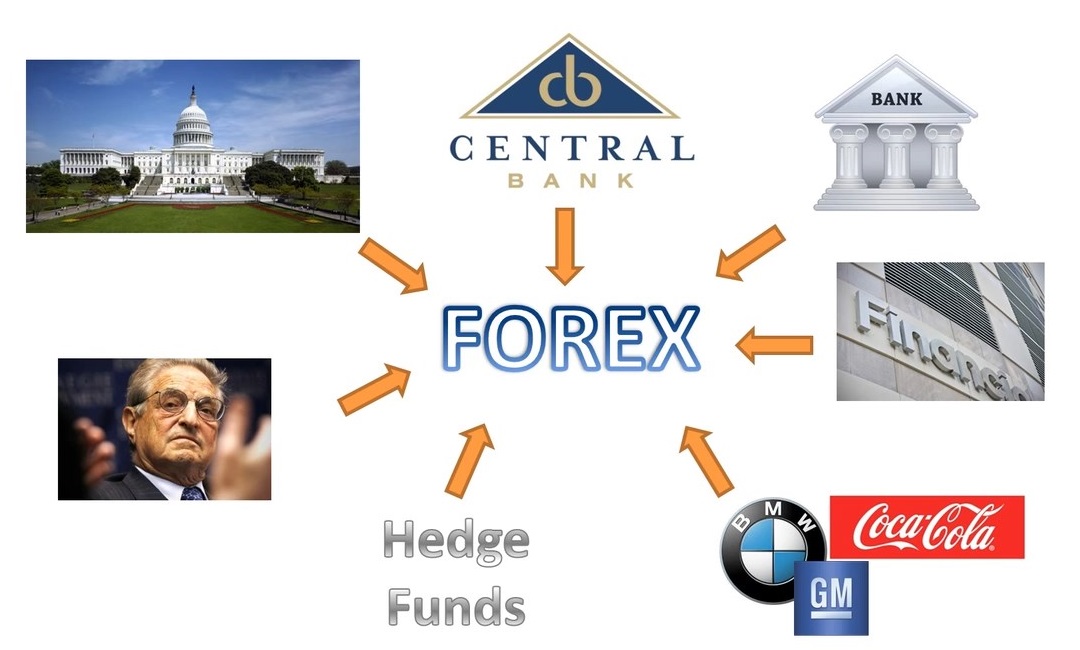
Participants in the currency market are:
- Large banks
- Commercial corporations
- Central banks
- Governments
- Hedge funds
- Speculators
Quotes
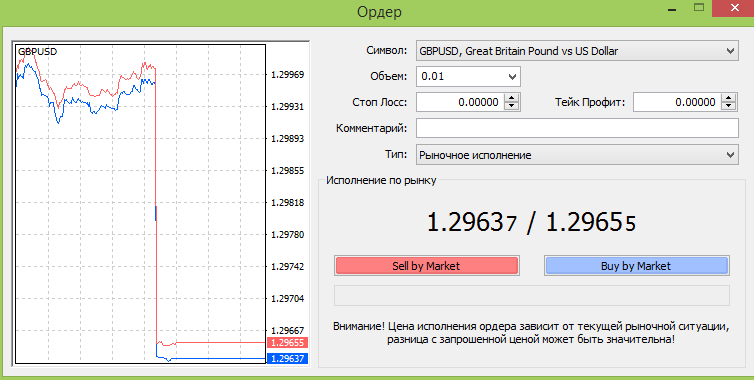
Primary sources of quotes
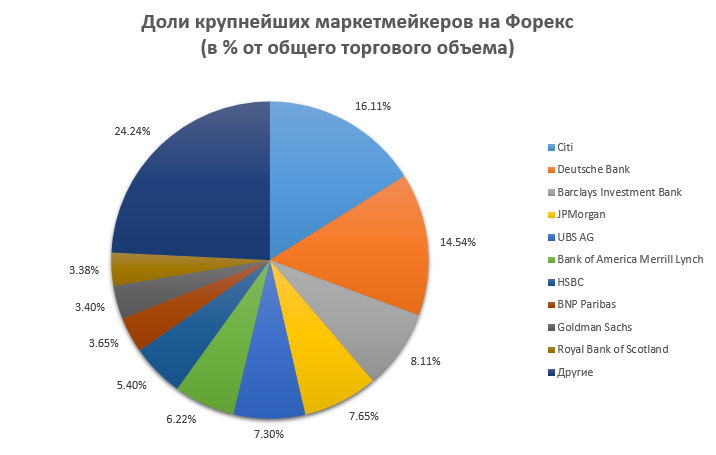
The Forex market is interbank, and banks provide the main liquidity in Forex. At the same time, among the world's largest banks, only a few provide retail Forex services. Nearly a third of global trading turnover belongs to Citi and Deutsche Bank.
The question of a fair price in the Forex market is quite delicate, since there is no concept of a single price in the currency market, nor of the true value of a currency. The decentralization of the market makes it possible to carry out trades at different quotes at the same time, often invisible to other market participants. The emergence of aggregators such as Integral, Currenex, LMAX, and so on not only contributed to the development of retail Forex, but also later made it possible to make this business more transparent.
Forex is a decentralized currency market; market quotes are formed based on supply and demand and are provided by major market participants, liquidity providers. Each participant offers its own price, and the best of them enter the platform. Differences in prices are the norm, since it is impossible to achieve absolute price unity when there are many counterparties.
Almost always, the rates provided by banks are indicative and do not mean a one hundred percent ability to execute trades at the offered price. The actual cost of a contract may depend on many factors, including client status, order size, value date, trading delays, and so on. At the same time, the execution of your orders can be significantly improved by adding a certain markup to the trade price, that is, intentionally worsening the price. The less competitive the prices you offer, the closer to real quotes you get. As a result, an attempt to trade at the best prices in the Forex market is almost always associated with the risk of partial execution or a reject, meaning order cancellation.
In essence, all Forex quotes are indicative in nature, except perhaps ECN client liquidity. If ECN liquidity were to grow enough to cover the needs of all clients at least within one broker, it would become possible to get rid of the concept of indicative quotes altogether.
Banks and hedge funds exchange quotes through specialized intermediaries in the form of information systems such as Reuters, Bloomberg, Tenfor, DBC, and so on. At the same time, quotes received from information systems do not mean the fact of a transaction at one price or another, and the results of some real transactions may not get there at all.
Liquidity aggregators

Compared with the stock exchange, the Forex market has much larger turnover and, accordingly, greater liquidity. This means that in the currency market you can buy or sell a particular currency as quickly as possible, regardless of volume, time, or the trading session.
Retail Forex brokers use the services of aggregators, connecting directly to liquidity providers (banks) via a specialized electronic communications protocol (FIX). The task of aggregators is to combine the largest banks, financial institutions, and funds into a single stream of quotes.
Using an aggregator's services provides major advantages, since it is obvious that it cannot offer prices worse than a separately chosen liquidity provider. Therefore, brokers and dealing centers usually either use the services of large aggregators or create their own. At the same time, some brokers, for example, may additionally provide their own quotes from client trades inside the company, thereby creating a certain likeness of dark pools.
Broker Operating Models
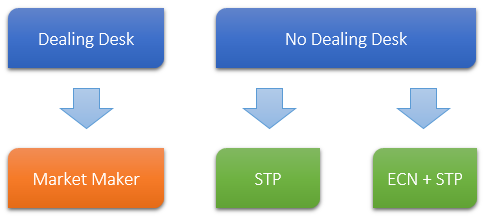
Market Making
A market maker is usually a broker or dealing center that takes direct part in executing trades. Its main task is to maintain two-sided buy and sell quotes that meet the requirements for spread size (the difference between the buy and sell quote prices) provided by the bank.
Brokers operating on the dealing principle (Dealing Desk) are simultaneously both buyers and sellers. Their main earnings in this case come from fixed spreads and clients' trading operations. Such brokers are commonly called dealing centers, or, as people say, bucket shops. Dealing center client orders are not sent to external counterparties and are usually executed against the broker's own opposite orders.
In this case, the broker itself is the counterparty and fully tracks and controls all of its clients' trading operations. Clients who make money play against the broker and, accordingly, bring it direct losses. Therefore, the activity of market makers implies the use of various schemes to limit profitability, including delays of trade orders, cancellation of transactions, and so on.
Today, pricing in the market is governed by algorithms. It is obvious that the task of an algorithm used by a market maker is to achieve the maximum difference between the blowup and the earnings of its clients. The presence of insider information contributes to improving MM algorithms, since banks know the current positions of their clients and how they traded before. At the same time, you too can become the owner of an MM algorithm. The main task does not change from this: to squeeze as much money as possible out of losing players.
Toxic Flow
Toxic flow (or toxics) in the Forex market refers to an undesirable stream of orders, or more precisely, any trading activity because of which a bank or broker starts losing money. This term is used by market makers, and practically 100% of toxic flow comes from algo traders who profit from inefficiencies in market-maker algorithms.
Because of this, it is not possible to create a pure interbank market. That is exactly why running an honest Forex business is possible only through masking toxics in the general flow of trade orders, which is helped by the use of modern ECN/STP aggregators. This makes it possible to create independent dark pools, where client orders can be matched with each other and become invisible to external counterparties.
ECN/STP
Unlike market makers, brokers operating on the principle of an intermediary between the client and the counterparty do not trade directly with the company's clients and do not profit from their losses or gains. Their main income comes from markups and commissions. Such brokers are further divided into two subtypes: STP (Straight Through Processing) and ECN (Electronic Communications Network) + STP. Fully independent ECN systems, however, do not yet exist.
The main feature of an STP broker is linking the client directly with the liquidity provider. As a rule, the provider is an aggregator, which can include many providers and thus offer better prices and increase liquidity. This type of broker offers a choice between a floating or fixed spread. Despite the fact that the main liquidity providers are large banks offering a fixed spread, the aggregator gets the ability to choose the best prices among all sell and buy offers. In some cases, this can lead to a zero or even negative spread.
The addition of an ECN system makes it possible for clients of one company to trade directly with each other. In effect, in this case the broker provides a venue where banks, market makers, and private traders can trade with each other directly, which sometimes makes it possible to execute trades at a better price than when using external counterparties. Moreover, this makes it possible to almost completely get rid of trading delays (latency) and rejects, which, given sufficient liquidity, provides nearly ideal execution. This is also beneficial to the broker, since it allows it to take the full commission from transactions without sharing with the main liquidity provider.
A-Book and B-Book Orders
"As soon as I started making money, my orders started getting executed worse! The broker started putting spokes in my wheels, Forex is a scam!" Such cries can be found online. So what really happened? Could brokers really have tracked your account?
In fact, everything is very simple. Within one broker model (including ECN) there is automatic distribution: small orders of new and unprofitable traders are matched according to the B-book principle, inside the company, and are not sent anywhere. This makes it possible to get noticeably better execution. Large orders and the orders of consistently profitable traders are executed according to A-Book, sent to counterparties. This causes delays in execution, slippage, and so on.
So, if execution got worse after you started making money, that is normal. It simply means your orders became closer to that very same "interbank" market.
Conclusions
 The Forex market is indeed huge. It cannot be said unambiguously whether it is bad or good, you simply need to know the nuances and the rules of the game in order to come out of it a winner.
As for broker operating models, it is important to understand that the main factor in choosing which model to work with is the profitability of the trading system, not the nuances of order execution. At the same time, the market-maker model has its advantages, since it can provide better execution. On the other hand, the ECN/STP model gives better prices. At the same time, this model is definitely more transparent, and by using markup you can significantly improve execution as well.
Our recommendations on choosing an account type can be viewed here.
Respectfully, Pavel Vlasov TradeLikeaPro.ru
