
How Much Time Is Needed for Successful Forex Trading?

Hello, friends!
How much time do you usually need to spend studying charts and watching the currency markets? I am sure that many of you, at the beginning of your trading career, literally stuck to computer screens all day long, obsessing over charts, drinking large amounts of coffee, and constantly placing orders throughout the day, but is this the only real approach available to us?
In this article, I will show you an alternative way to track your charts, using various methods and tools to develop a much more efficient, calm, and productive approach to trading. I will demonstrate to you that you should not get stuck in front of your computer screens all day long, while still using your time rationally.
Timeframes and Currency Pairs

Timeframes that you use in the trading process determine how often you check the charts. Thus, it goes without saying that if you trade on a 5-minute chart, you have to evaluate the charts much more often than if you traded on the daily timeframe.
Personally, I am not interested in working on any timeframe below D1, and all my trading is based on the daily timeframe. I had a period when I traded on 4-hour and even hourly charts, but I am not ready to devote that much time to Forex.
Your workload is also affected by the number of currency pairs you will trade, that is, the greater the number of currency pairs you use for trading, the greater the number of charts you must analyze. This does not mean that you cannot work with 20 or more currency pairs at the same time, it simply means that you must have a ready system with the help of which you could effectively monitor each currency pair. For example, when trading on M15 it is hard to watch 20 currency pairs, but when working on D1 it is quite convenient.
You can also resort to various tricks: for example, signal systems that track the appearance of setups and notify you.
Analysis

Over time, you develop your own experience and confidence in the ability to analyze markets consistently and quickly. Knowing where and when to "hunt" for trades and when to correctly use lower timeframes will help you save a huge amount of time on chart viewing. Having a clear idea of where you will look for price signals to open positions will allow you to plan ahead and choose desired positions, and will also prevent you from having to constantly monitor the markets.
On the other hand, traders who carefully monitor the markets for long uninterrupted periods of time can become victims, opening positions that they would probably usually consider unjustified, this may be because traders feel pressure: they NEED to open a position to justify their sitting in front of the monitor.
So, you need to know where and when to look for trading signals. For example, you trade the crossing of the 200 moving average, naturally, if the price is very far from this average, you understand that there is no point in looking at the terminal for the next ten candles or so. And you do not waste your time and attention.
Price Alerts and Pending Orders

Price alerts play a huge role in saving the time needed to analyze charts.
The principle of their operation is very simple: as soon as you have analyzed each currency pair on which you plan to trade, you can set an alert at the price level that you consider good for opening a position on each specific currency pair. When the price reaches the desired level, a price alert is triggered, the notification of which you receive by e-mail or as a text message, after which you can check the pair for any price action signals.
Trading alerts also play a role in position management: you can set alerts for the stop-loss level, the entry level, profit taking, etc. ... this means that you can leave your position and make changes to it only when the price reaches your set targets.
Alerts in MT4 are set quite simply:
1) Move the mouse over the chart to the price level you are interested in, upon reaching which you want to receive a signal.
2) Press the right mouse button, choose ->Trade->Alert
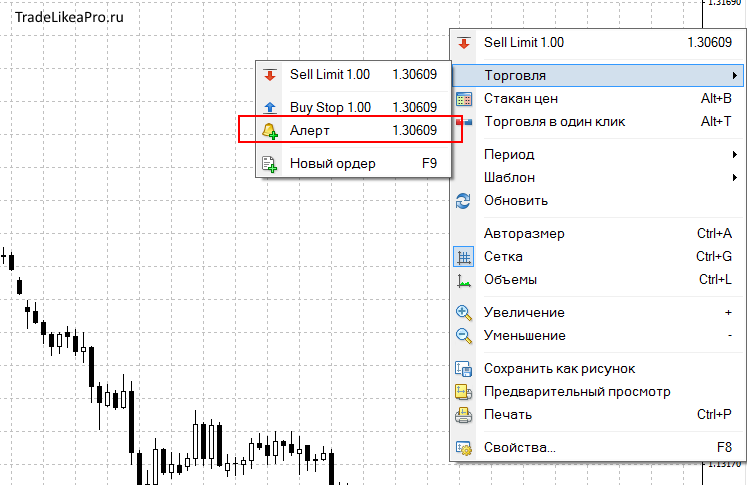
3) A red dotted line will appear on the chart at the selected price level. If you click on it twice with the mouse, you will be able to edit the alert, choose the notification method, set the expiration time, etc.
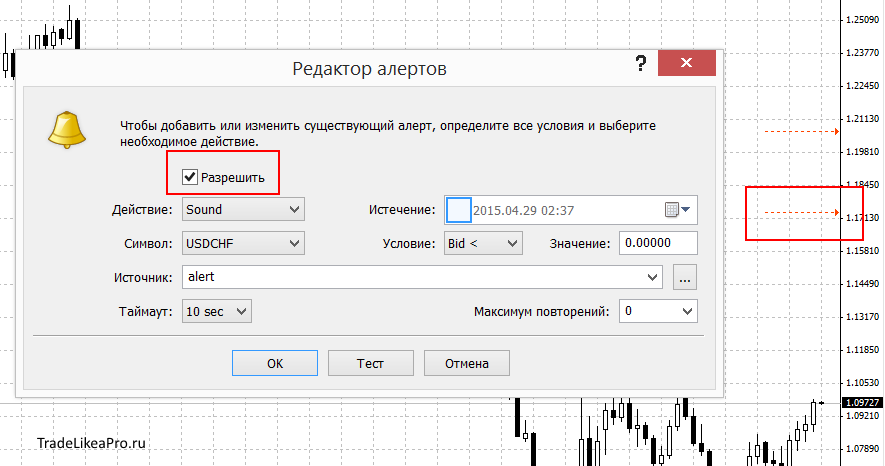
Trading alerts give you the opportunity to step away from the markets confident that you are still constantly monitoring them and because they simply help you save a huge amount of time.
Pending orders also help save time, read about them here.
Trading on the Go

Before the advent of smartphones and tablets, trading on the go did not seem possible to us, nevertheless, modern technology and means of communication make trading on the go actually very, very easy to carry out. The ability to open and close positions or reduce stop-losses, wherever you are, generally means that for trading you do not have to stick to computer screens. As a result, this has led to the fact that traders can now trade almost everywhere they like.
Receiving all the latest information and staying up to date with the latest events and current market movements thanks to technological advances and widespread Internet access has freed traders from screens and given them a certain degree of freedom, which we all strive for so much.
Due to the fact that every broker offers its own trading application, which you can download to your phone or tablet, trading has now become a fairly universal and accessible business that can be done everywhere.
See:
- Metatrader 4 Review for Smartphones
- Metatrader 4 Review for iPad
Have a Trading Routine
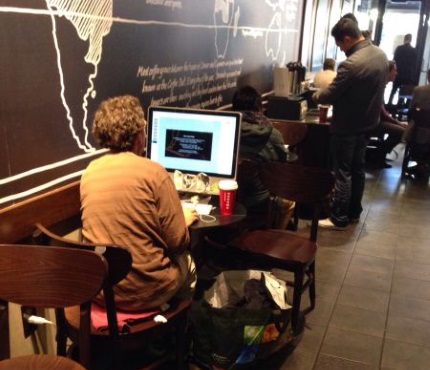
If you treat trading like a real business, you will understand that an established routine and corresponding working hours are an important and necessary matter, as well as understanding when to work and when to rest. It is very easy to get drawn into the markets and feel as if you have to monitor charts 24/7 so as not to miss a single trade. This is a dangerous habit that can be developed, because too active involvement in the markets will very easily burn you out and exhaust you.
If you find that the markets are beginning to dictate your lifestyle to you (a classic example is when you stay awake all night just to catch a convenient moment to enter the market), then you have immersed yourself too deeply in trading. You should know when to disconnect from trading, be able to turn off the charts, and get a good night's sleep.
Be sensible, set your working hours and stick to them, even if trading is your main occupation, devote a certain period of time to trading every day during which you would work in the markets and try to follow it consistently.
Take a Day Off

Once a week it is necessary to arrange for yourself a day of rest from trading. Do not read forums, do not study strategies, do not look through charts, do not test advisors. Absolutely nothing connected with trading.
The best thing would be to go out into nature, take a walk in an unfamiliar place, read a fiction book, visit the theater, spend time with family or friends.
Such " unloading days " help our brain rest, process the accumulated information and experience, so as to work with greater productivity in the future.
Do You Spend Too Much Time Analyzing Charts?
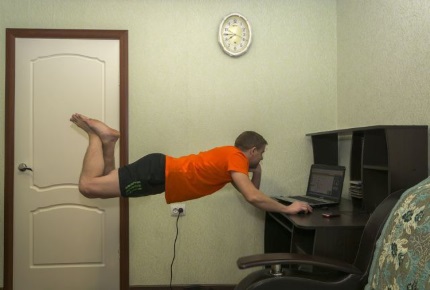
The purpose of this article is to show you how flexible trading can be and that you are not at all obliged to stick to your computer monitor, working in 24/7 mode, in order to achieve results. Even if trading is your main occupation, it can be planned in parallel with your other types of activity. This should not look like an "all or nothing" situation, because the Forex market allows us to choose when to trade, so you can build your trading hours accordingly in a way that would satisfy your own needs.
You cannot get around the fact that in order to carry out effective trading you need to spend a huge amount of time constantly studying the aspects of trading in the Forex market, but once you have accumulated the necessary skills and trust in your own abilities, you will actually need a significantly smaller amount of time required for trading itself.
Trading may even seem to you to be something boring, but this happens only because you simply understand and accept what the markets really are, understanding that this is not a game, but merely a business.
The main goal that attracts people to trading is the promise of financial freedom and an attractive lifestyle, but trading can produce the opposite effect and can sometimes become an obsession that completely exhausts the trader. You should know when to work and when to play.
Putting an established routine/trading hours in place brings into your daily life the order that every trader needs to maintain a healthy and productive workload.
Time is a very valuable commodity, in our modern life the day is already full to the brim with a large number of other obligations and tasks, and managing it wisely is a key factor for success.
So, if you find that you spend too much time on charts, there are things you can do to reduce your trading workload, this will give you the freedom to step away from your screens. These factors include the following:
- Using price alerts and pending orders, which are probably the most important time-saving factor.
- Focusing on higher (daily) timeframes, while carefully using lower timeframes at the same time (depends on your strategy)
- Having an established trading-hours schedule that you should stick to.
- Using trading applications that give you the opportunity to stay connected while away from the computer.
Applying these recommendations in trading will allow you to stay in contact with the markets without physically sitting in front of charts all day long. What is the point of looking at charts if currency-pair prices are not in the zone where you are waiting for a signal? Why spend your time watching price movement if you are not going to trade in the near future anyway?
Instead, let price do its job, and when the occasion arises, enter the market in the area where you are waiting for a signal, this is exactly the time when you should switch to the charts and hunt for pips.
Remember that it is you who are the main figure (not the markets!) and it is you who maintains a consistent and strict trading procedure, be patient.
Price alerts and pending orders play a huge role in saving the time needed to analyze charts.
Thanks to modern technology and communications, modern traders can trade almost everywhere that is convenient for them.
If you treat trading like a real business, you will understand the need for an established routine and corresponding working hours, knowing when you should work and when you should rest.
Respectfully, Pavel Vlasov
TradeLikeaPro.ru