
How Forex Orders Are Executed

Hello, fellow Forex traders! Today we will discuss very important, yet often overlooked by traders, principles of order execution in Forex. We will talk about in which cases orders are routed to the interbank market, what the order book is, at what prices pending, market, stop-loss, and take-profit orders are executed, and also a little about liquidity aggregators.
How FX Works

To begin with, imagine an ordinary market. When buying something at a market, you have two options: buy the goods at the price the seller offers, or try to bargain to bring the price down. In the first case, you are guaranteed to get the goods at the stated price. In the second case, you may get the goods at a better price, but you may also walk away with nothing. In principle, order execution in the Forex market is no different.
Essentially, a trader only needs to distinguish between two types of orders: with slippage limitation and without it. In the first case, you express a desire to buy only at the stated price or better. In the second case, you are literally telling the broker that you are ready to buy the stated volume at any price currently available.
In MT4 terms, these are the analogues of Instant Execution and Market Execution. When an order is executed at a price different from the stated one, slippage occurs. That is, slippage is understood as the difference between the price set in the order and the actual price at which the order was executed. As a result, your order may either be executed exactly at the stated price, or with some slippage in one direction or the other.
Order Book
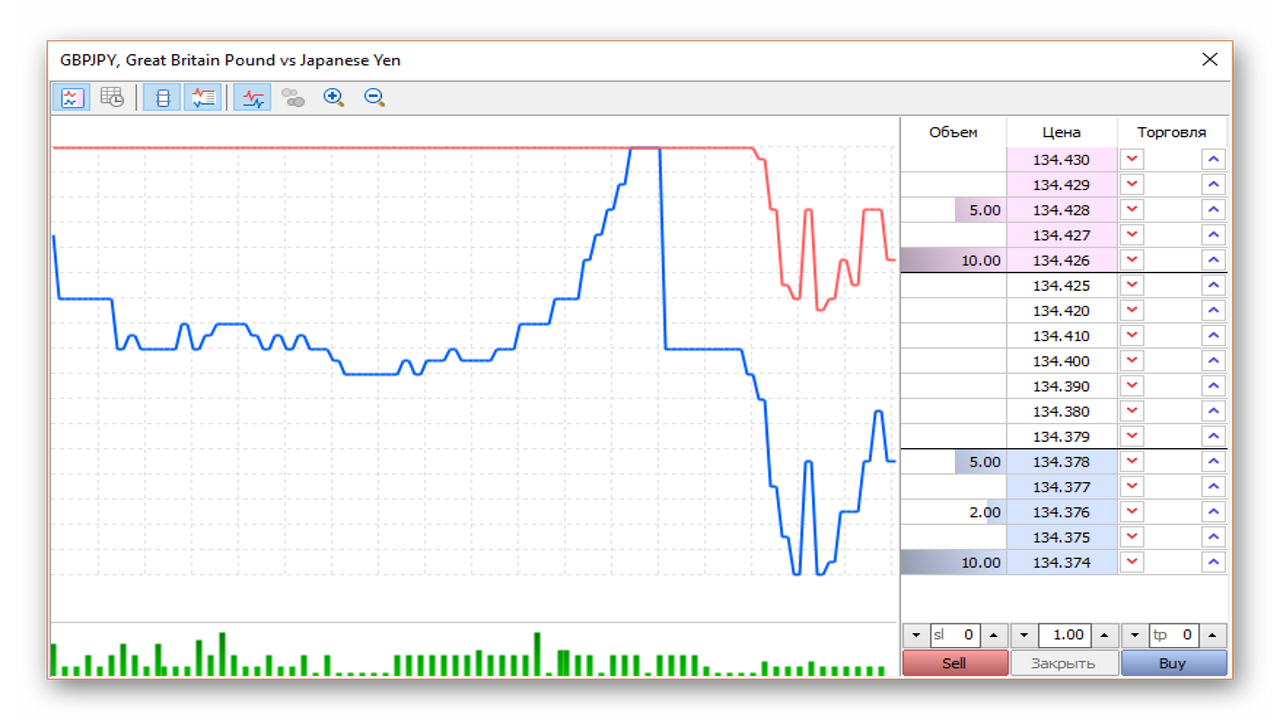
 In simple terms, the Forex order book is a table containing current buy and sell orders from different liquidity providers. The book is unique for each financial instrument and contains bid-side (Bids) and ask-side (Asks) orders. Spread is the difference between the best Bid and Ask price. Market sell orders are always executed at the best Bid price, and buy orders at the best Ask price.
Each price in the book corresponds to a certain volume. Suppose you sent a buy order for 20 lots, but at the best price at the moment there are only 10 lots available. In this case, part of the order will be executed at the best price, part at the next one after it, and so on until the entire volume specified in the order is filled. In this case, the trader will receive slippage, and the opening price will equal the average execution price in the book.
In simple terms, the Forex order book is a table containing current buy and sell orders from different liquidity providers. The book is unique for each financial instrument and contains bid-side (Bids) and ask-side (Asks) orders. Spread is the difference between the best Bid and Ask price. Market sell orders are always executed at the best Bid price, and buy orders at the best Ask price.
Each price in the book corresponds to a certain volume. Suppose you sent a buy order for 20 lots, but at the best price at the moment there are only 10 lots available. In this case, part of the order will be executed at the best price, part at the next one after it, and so on until the entire volume specified in the order is filled. In this case, the trader will receive slippage, and the opening price will equal the average execution price in the book.
Aggregators and Slippage

Let us look at an example of how the simplest liquidity aggregator works. Every broker works with several counterparties (liquidity providers). Each counterparty provides quotes at which it may be willing to make a deal. By sorting quotes from the best price to the worst, the broker forms an order book (a market snapshot), where each counterparty is represented by two prices: buy and sell.
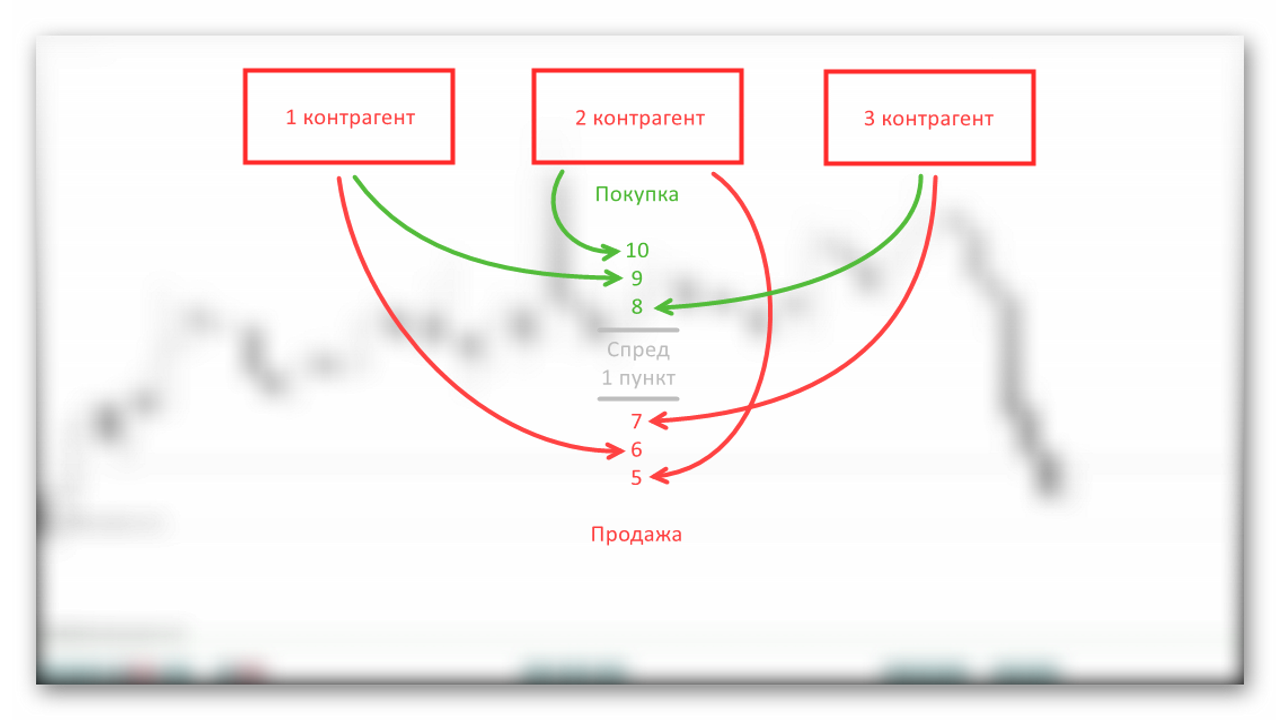
On the chart in MetaTrader and in the market watch window, you always see only the best prices, in this case, 8 to buy and 7 to sell. As can be seen from the example, the second counterparty has the widest spread, which means it will receive far fewer orders from clients. Thus, to gather as much client liquidity as possible, providers compete for the best places in the book by narrowing the spread.
Why then do orders slip? To begin with, all pending orders are stored on the broker's server, or on the server of the company acting as the aggregator. The broker cannot know in advance which provider the order will be sent to, so at the moment of activation the request is sent to the provider with the best price available at that moment.
Suppose we placed a buy stop order at the price of 9. On the next tick, the order is activated, and the broker sends the liquidity provider a request to open a position of the specified volume at the best price currently available.
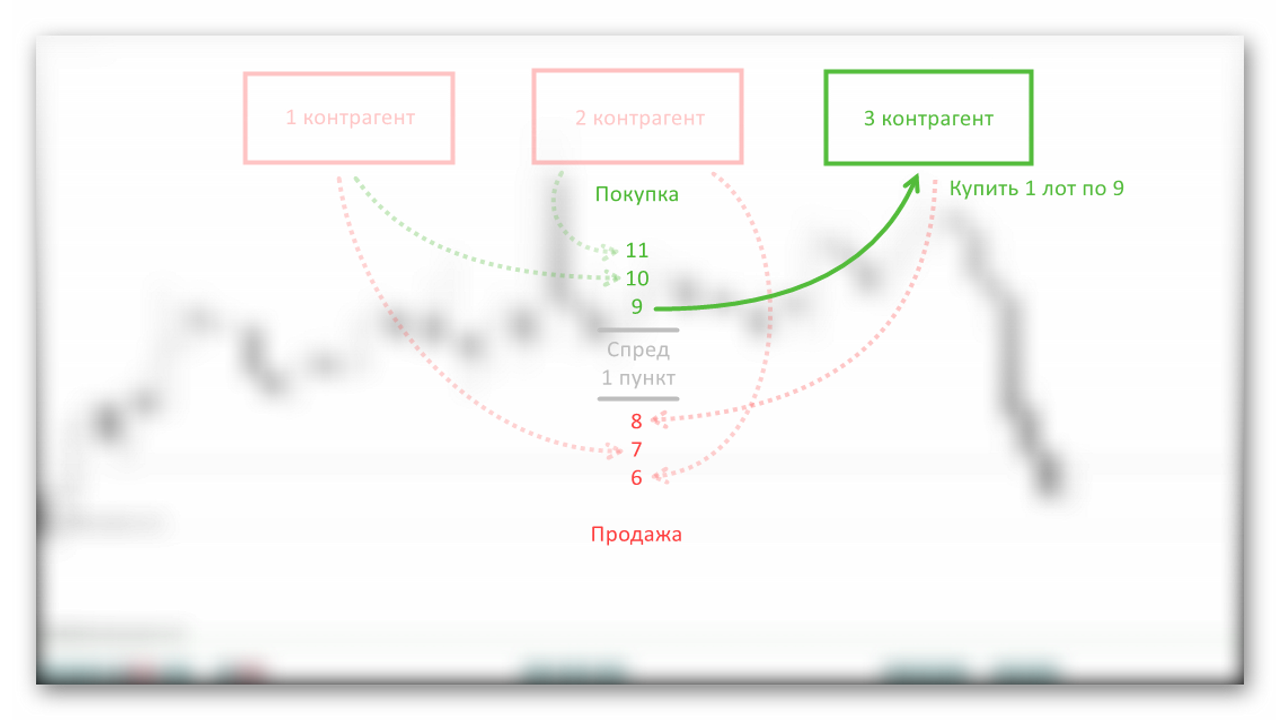
But the thing is that while the request reaches the provider, which takes fractions of a second, the price may change. Suppose the price jumped upward and it is no longer possible to buy at 9, then the provider may execute the order at the price of 11. After that, in the terminal the trader will see an open buy stop order with 2 points of slippage (9 is the stated price, 11 is the execution price).
What Instant Execution Is

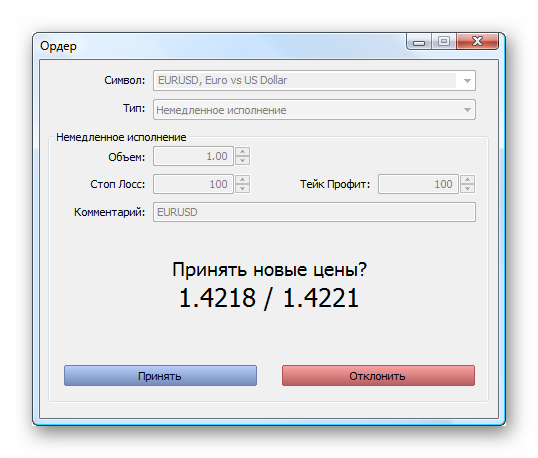
Under the term Instant Execution, so that you understand, the same limit order is implied. That is, such an order will never be executed at a price worse than the stated one. When a trader sends a request to a broker, the broker receives an order in the form of the client-specified price and the current price of the instrument. If the broker agrees to execute the order exactly at the specified price, it executes it. If the conditions do not suit it, the broker offers the trader its own price, with guaranteed execution (requote). At that point, the trader has the option to accept the terms or refuse.
To increase the probability of execution, you can specify the maximum permissible slippage size in the order. Such an order says that you are ready to make a trade at a price no worse than ten points away from the stated one (five-digit quotes).
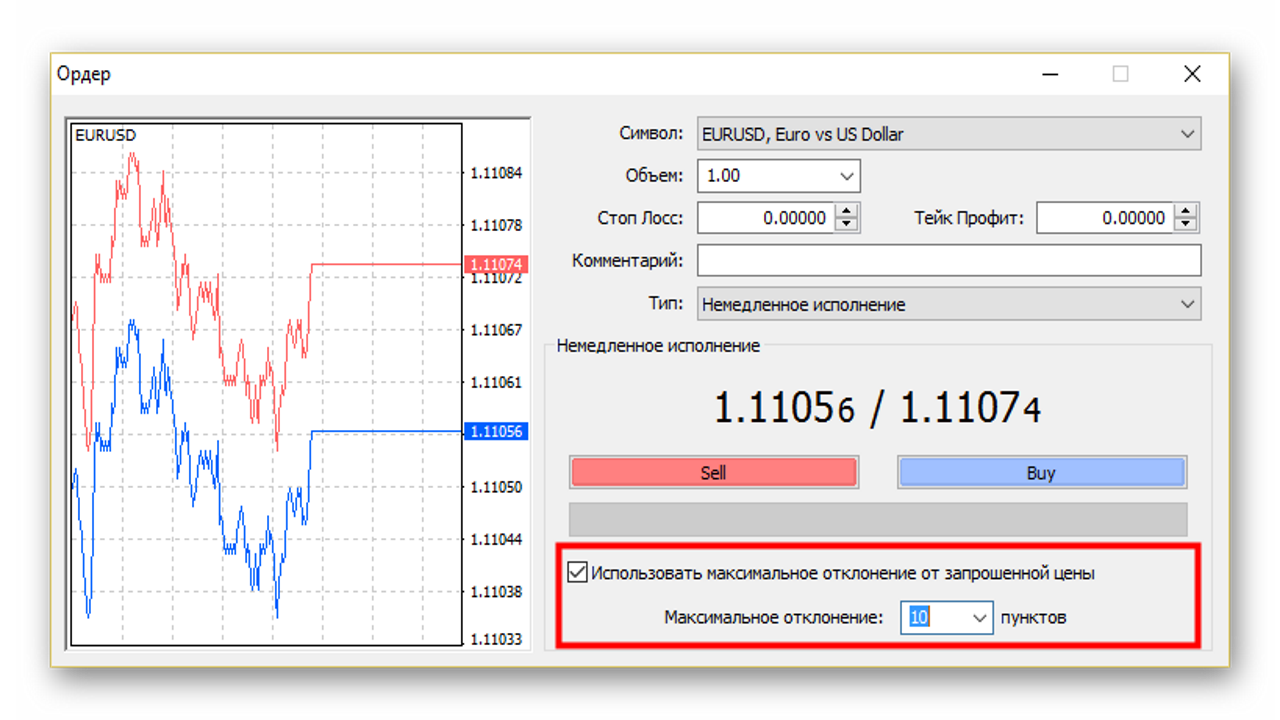
If the real price differs from the stated price by more than 10 points, the broker may reject the order and offer to execute it at another price. In this case, you have a few seconds to accept the new terms.
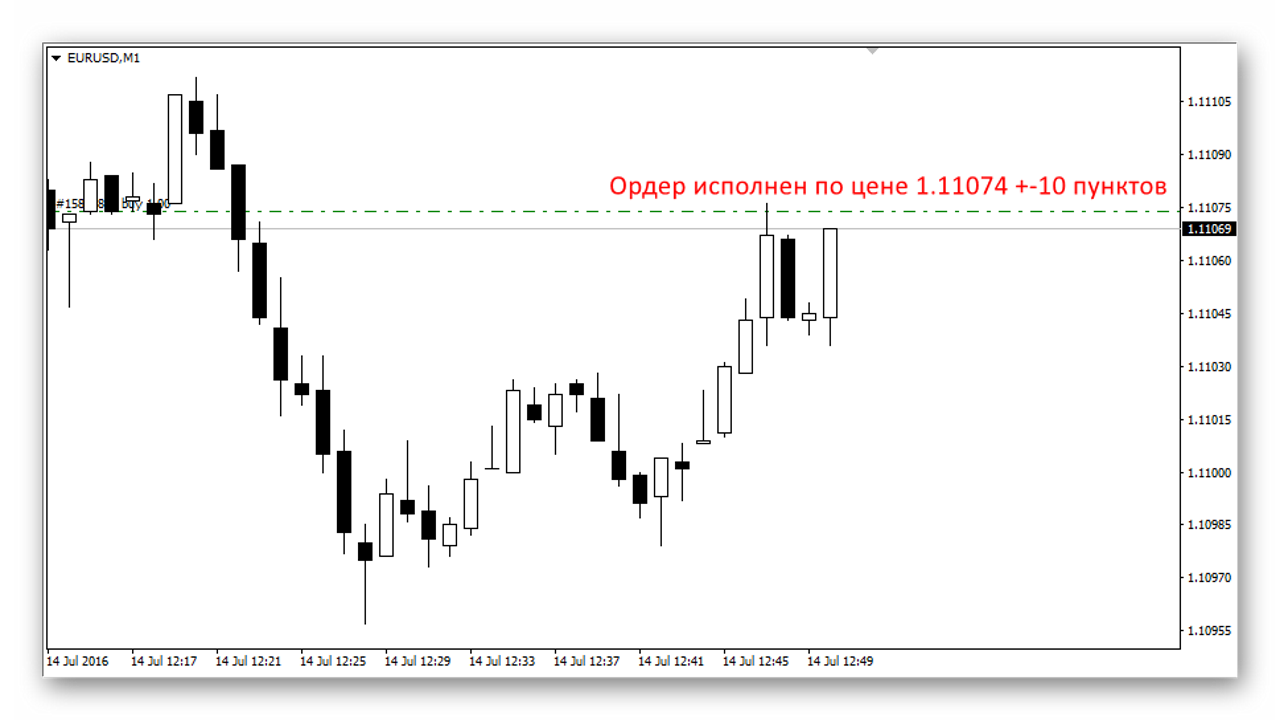
If the broker approves the order, it will appear on the chart.
What Is Market Execution

With market execution, by sending an order to the server you agree in advance to any price the broker offers. This warning is located in the lower part of the new order opening form.
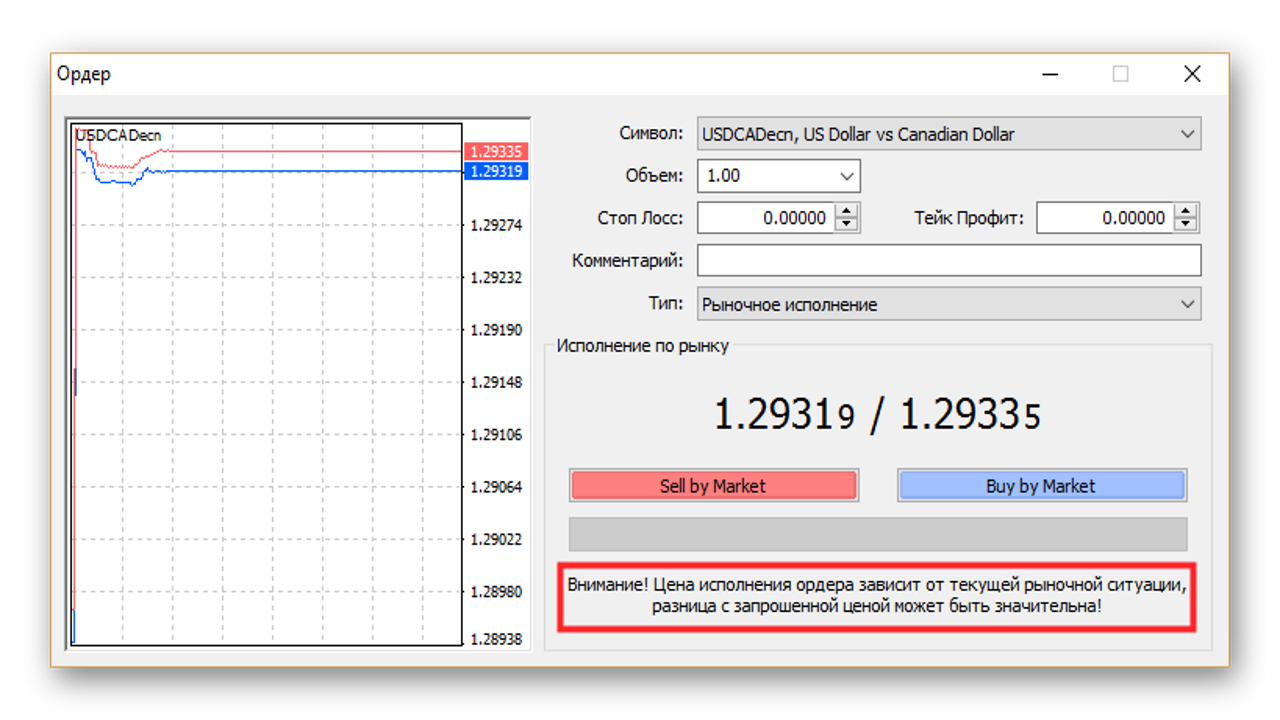
In other words, your order will be executed with almost a 100% guarantee, but at the price the provider can fill. The downside is that in this case the trader has no control at all over the amount of slippage. Therefore, some brokers began offering their own order execution add-ons so traders could set the maximum slippage size in advance. If implemented properly, this can even be better than standard Instant Execution.
To sum up, market execution, provided additional settings are available, offers much greater possibilities for execution tuning. The main difference is that in the event of a sharp move, with instant execution you will get a requote, while with market execution you will get slippage. Today there is no fundamental difference for the trader; as a rule, in both cases it is possible to configure the maximum slippage size.
A Book and B Book Orders

By the method of execution, orders in the order book are divided into A booking and B booking. Client orders from the A book category are redirected to external counterparties (the interbank market), while B book orders are executed by the broker itself through internal clearing. There are brokers that practice exclusively A booking or B booking, or operate under a hybrid scheme (most often).
The hybrid model increases the profitability of an already profitable MM algorithm. By identifying large and consistently profitable clients, the broker tries to offset their orders with positions at counterparties, while leaving most losing clients' orders inside the company. In turn, for an ECN broker, B Book means the orders of the company's own clients, which can be matched (executed) automatically provided there is an opposite order from another client. That is, if the broker has sufficient liquidity within the company, you have a non-zero chance of being matched with another trader's opposite order. This scheme is also profitable for the broker, since it allows it not to share commission with liquidity providers, operating on the exchange principle.
Orders from the B book are executed the fastest. In the case of A book, additional time is added to send the order to the counterparty and receive a response from them. Therefore, when a dealing center starts routing orders to the interbank market, traders may feel a noticeable deterioration in execution speed.
Pending Orders

All pending orders are ordinary market or limit orders with delayed activation. You leave the broker a request to open an order, and when the price reaches the specified price level, the broker sends a request to the provider.
There are 2 main types of orders in MetaTrader: a stop order (the same Buy Stop and Sell Stop) and a limit order (Buy Limit, Sell Limit). When a stop order is activated, the broker sends the provider a regular market request without a slippage limit. When a limit order is activated, the broker sends the provider a limit request that can be executed only at the set price or a better one.
A stop-loss also belongs to stop orders, but a stop-loss is always tied to a specific trade. When the price reaches the loss-limiting level, the broker sends the provider an order for market execution. Accordingly, if the prices are already outdated or the level falls into a gap (price gap), the order will be executed at the first price that is available, and the actual execution price may differ greatly from the set one. A buy stop order is always placed only above the current price level, and a sell stop order only below the price.
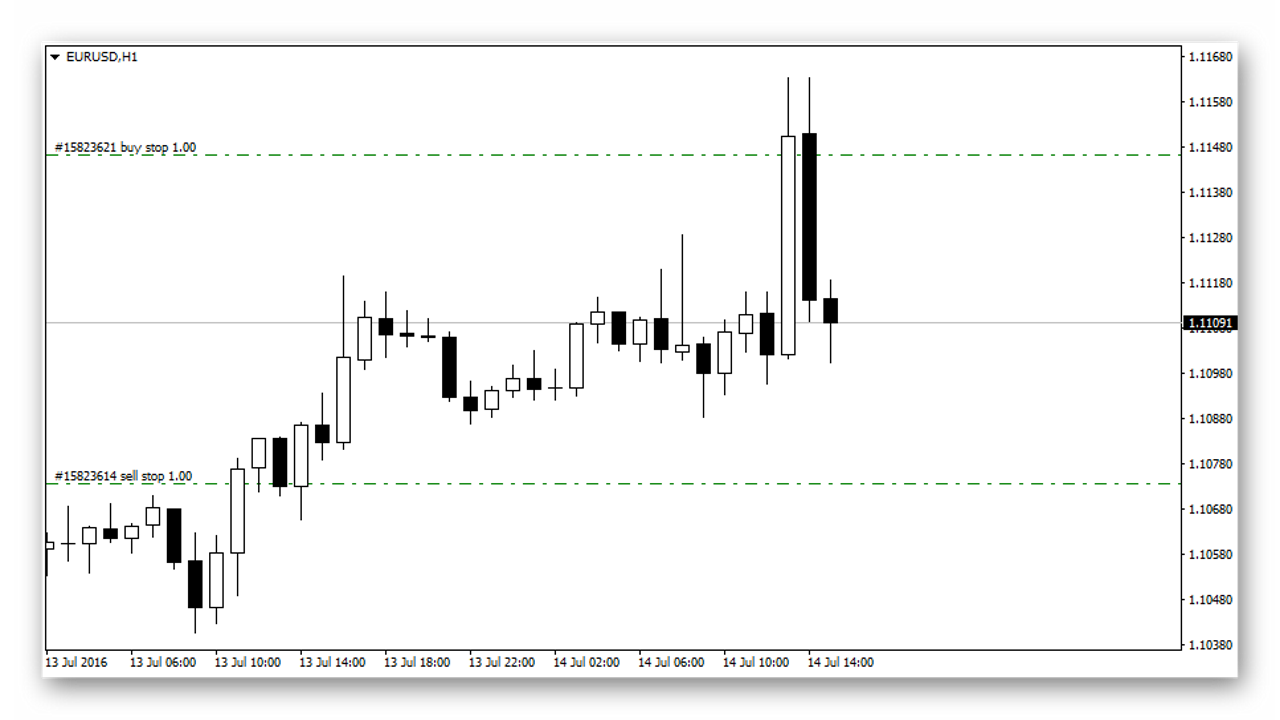
Limit orders differ in that slippage on them can only be in the positive direction. Limit orders guarantee execution at the price set in the request, but do not guarantee that the order will necessarily be executed. On the real interbank market, you can open a limit order at a price slightly worse than the stated one, and then the probability of execution will increase. In the MetaTrader terminal, you can set market limits either above the price in the case of Sell Limit, or below the price in the case of Buy Limit.
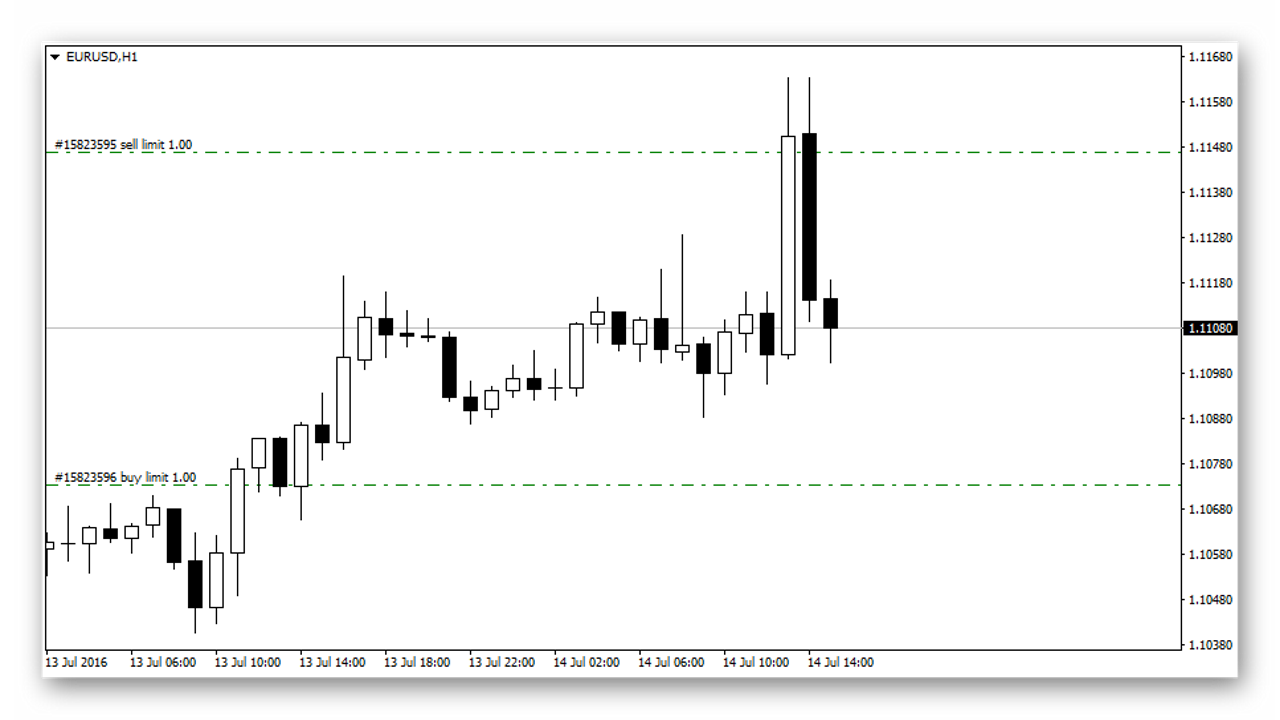
The Take Profit level is analogous to a limit order and will be executed only at the stated price or a more favorable one. That is, slippage is possible only in the positive direction. The order may fail to close at Take Profit even if the price in the terminal reaches the level.
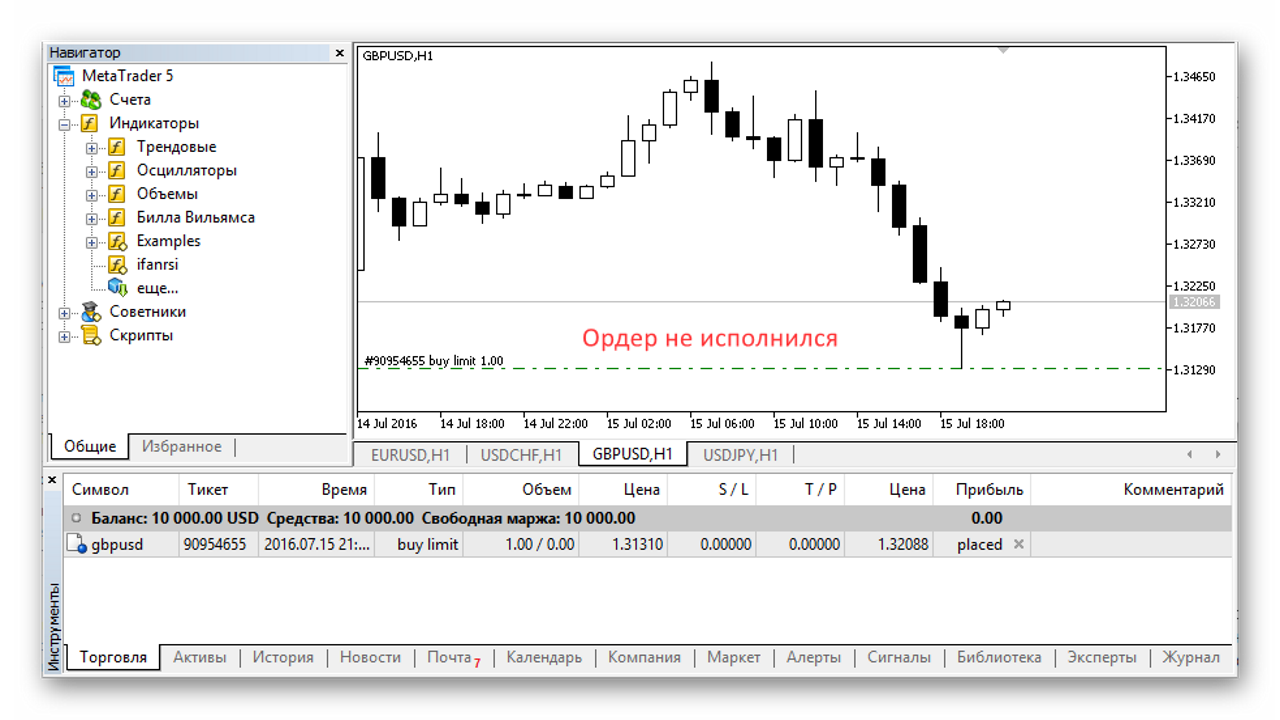
Thus, the liquidity provider may receive either a market order or a limit order. A situation may quite well occur where the broker receives a quote and sends the provider a request, to which the latter responds that there are no longer any offers at that price and the order is not executed, although the chart will clearly show a touch of the level. The absence of an execution guarantee is a cost of the over-the-counter market.
Conclusion

When choosing an order type, one usually chooses one of two extremes: either order execution exactly at the specified price, but not guaranteed; or guaranteed execution, but at any available price. Scalpers and those for whom high entry precision matters usually work with limit orders. Traders for whom it is important to build sufficient volume for a long-term position usually use markets, namely market and stop orders.
Forum Thread
Best regards, Pavel Vlasov TradeLikeaPro.ru
