
Gold Returns to a Two-Month High as ETF Demand Revives
Tlapchik

Intro

📈 Why softer inflation matters for gold
Gold does not pay interest, so its appeal often improves when investors expect borrowing costs or inflation-adjusted yields to decline. Softer consumer inflation reduces the immediate pressure on the Federal Reserve to tighten policy or maintain an aggressively restrictive message. That does not guarantee a rate cut, but it gives policymakers more room to wait, and markets tend to value that room before any official decision arrives. The reaction in gold therefore reflects a change in the balance of risks rather than a completed shift in monetary policy. If inflation continues to cool, traders can price a less threatening path for interest rates, weakening one of the main arguments against holding the metal. The dollar and bond yields also matter, but the essential mechanism is straightforward: a smaller expected return advantage for cash and government debt makes a non-yielding defensive asset more competitive. At 4,427 USD and a daily gain of 0.40%, gold is showing resilience rather than an explosive speculative jump. Holding above $4,400 is important because it suggests buyers are willing to defend the breakout area instead of merely chasing a brief headline. The market, in other words, has opened the door to a friendlier rate environment, but it has not yet handed gold the keys.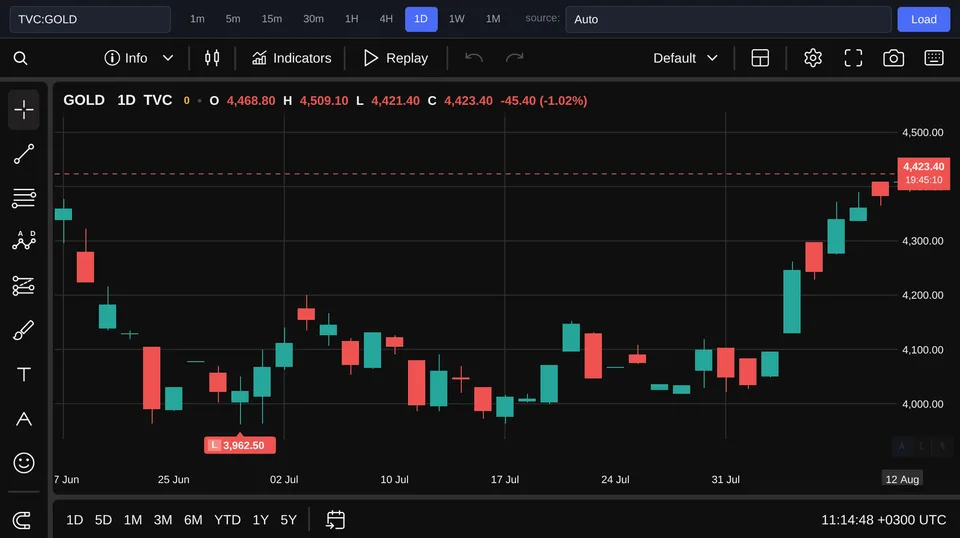
💰 ETF inflows strengthen the demand story
The return of inflows into GLD and other gold ETFs is a particularly useful confirmation signal. These products provide a convenient route into bullion for Western institutional and retail investors, so sustained inflows indicate that demand is broadening beyond futures trading, central-bank purchases, or short-term positioning. Renewed ETF buying suggests that the advance is being supported by fresh investment demand, not only by traders covering bearish positions. That distinction matters because ETF flows can reinforce price momentum over a longer period. Rising prices attract portfolio attention, new allocations increase the need for physical backing, and the resulting demand can help prices remain elevated. It is a constructive cycle, although hardly a perpetual-motion machine: flows can reverse quickly if yields rise, the dollar strengthens, or inflation data revive expectations of a tougher Federal Reserve. For now, the combination of softer inflation anxiety and renewed fund demand makes the latest advance more convincing than a rally driven by macroeconomic hope alone. Price action supplies the headline, but flows provide the supporting paperwork. Investors should watch whether inflows persist after the initial breakout, because several consecutive periods of buying would offer stronger evidence than a single lively session.⚖️ Silver’s decline reveals a selective rally
Silver is not confirming gold’s strength. GMC:XAGUSD is trading at 64.74 USD, down 1.25% for the day, while gold is positive. That divergence indicates that investors are not indiscriminately buying every precious metal; the demand appears concentrated in gold and in the specific monetary and defensive qualities associated with it. Silver has a hybrid identity because it is both a precious metal and an industrial input. Its price can therefore respond to manufacturing expectations, cyclical risk appetite, and sector-specific positioning in ways that differ from gold. A weaker silver session does not invalidate gold’s breakout, but it does argue against describing the move as a uniform surge across the entire precious-metals complex. The split can even make the gold signal more informative. Investors appear to be choosing the asset most directly linked to interest-rate expectations, portfolio hedging, and ETF allocation rather than purchasing the sector as one broad trade. Still, persistent weakness in silver would be worth monitoring: wider participation normally makes a metals rally healthier, whereas prolonged divergence can reveal that enthusiasm remains narrow and potentially more sensitive to macroeconomic surprises.🎯 What would be required for gold to reach $5,000
Forecasts of gold reaching $5,000 by year-end are beginning to circulate, but that level should be treated as a conditional target rather than a baseline promise.Conclusion
Gold’s return to a two-month high is supported by a coherent combination of softer inflation concerns and renewed Western ETF demand. The current price of 4,427 USD, up 0.40% for the day, shows that the metal is maintaining its position above $4,400, while silver’s decline to 64.74 USD, down 1.25%, confirms that the rally is selective rather than sector-wide. The outlook remains constructive, but the next phase depends on evidence: favorable PPI data, a continued pause in Federal Reserve pressure, sustained ETF inflows, and defense of the recent breakout. Those conditions could support a move toward $5,000 by year-end; without them, that figure should remain a scenario rather than a conclusion.#gold two-month high#gold ETF inflows#GLD inflows#gold price forecast 5000#gold and Federal Reserve rates