
Forex Strategy Spring - Feel Like a Market Maker

The trading system is not suitable for beginners and traders with an unstable psyche!
Hello, ladies and gentlemen, fellow forex traders!
Today we will talk about a strategy called Spring. The strategy is based on the moments that market makers use in their trading. At the same time, when speaking about market makers, I do not mean those very all-seeing and all-powerful Puppet Masters that you have probably imagined right now. We are talking about those who earn on the spread, that is, create the market by acting as the opposite side of the trade. We, in turn, will try to use the nuances they rely on to gain our own benefit.
TS Characteristics
Platform: MetaTrader 4
Currency pairs: GBPUSD, GBPAUD, GBPCAD, GBPJPY, EURUSD, EURGBP, EURAUD, EURCAD, EURJPY, AUDUSD, AUDNZD, AUDCAD, AUDJPY, NZDUSD, NZDCAD, USDCAD, USDJPY
Timeframe: W1 (weekly candles)
Trading time: From market open on Monday until trades are closed
Recommended brokers: RoboForex, Forex4You, FortFS
Reference Section
- How to install an indicator in MT4
- How to install an expert advisor in MT4
- What set files are
Attention! The strategy uses an averaging tactic through a grid of orders. Strict money management compliance is required!
TS Foundation

First of all, I would like to thank user Old Oleg, who shared the strategy on our forum. The strategy is based on the good old Va-Bank, one of the most popular systems on the site, but with some changes.
The essence of the Va-Bank strategy is as follows: if the size of the weekly candle is very large, that is, the pair has covered a great distance over the week, then at the beginning of the next week a pullback in the opposite direction is expected, at least 50 points.
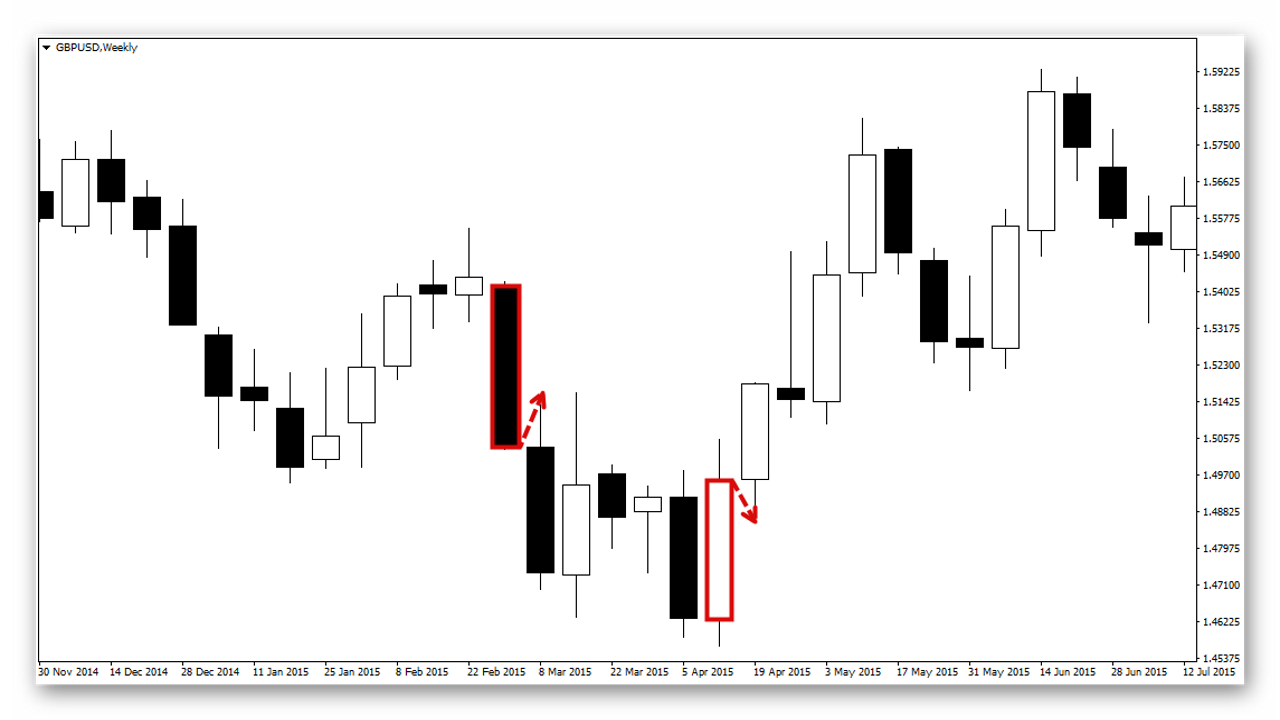 This rule works quite often, but there are situations when the pullback is delayed or insufficient. As a result, the position is closed by the stop. It is precisely this dilemma that the Spring system tries to handle.
A Bit of Theory

In the market, besides retail players, hedge funds, reptiles, masons, and others, there are market makers, those who earn on the spread by covering our and your orders. Since at any time you can place a buy order at price X and that order is executed.
At the same time, there might not have been any offers to sell at that price, that is, anyone who would act as the second side of the trade. The question is, what will the market maker do with the order that they have already sold and earned on the spread? The market maker takes on risks because they know that the price will most likely return. That is, they can hold the position for a long time, knowing that in the end it will return anyway. If the price does not return, they will still earn quite well on the excitement caused by some strong trends.
As an analogy, you can imagine exchange offices that buy/sell dollars and euros, exchanging them for rubles. So, when there is a strong rise in the ruble or dollar exchange rate, naturally, they still have some amount of rubles and some amount of dollars. They take on risks by selling you a dollar, and you give them rubles. After that, the dollar rate can rise sharply, but the exchange office will still earn on the difference between the selling and buying price.
What lesson can we take from this business? We can take risks in exactly the same way up to certain levels, knowing that in the long run we will still earn more on pullbacks. The Spring strategy uses the same approach. We will trade without stops, using averaging. It sounds scary, of course, and the strategy was not created for beginners. With good money management and competent risk control, it turns almost into a holy grail, one might say it becomes loss-free.
TS Rules

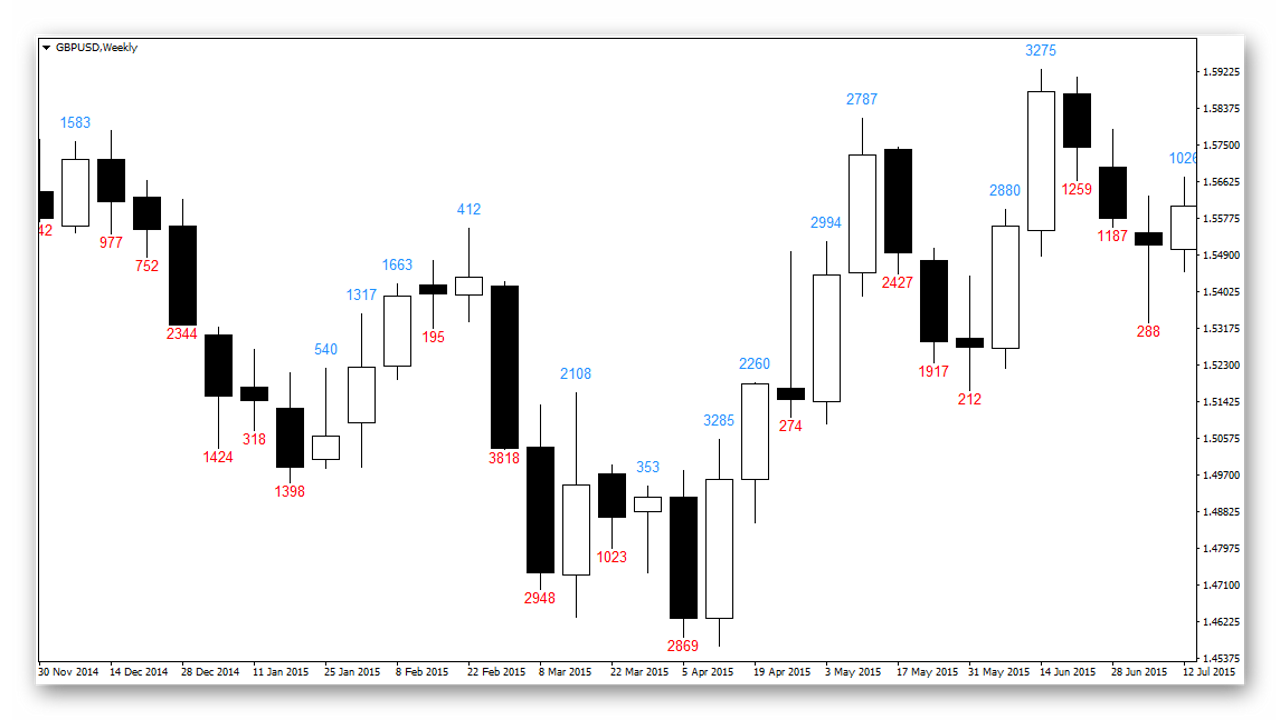
On the weekend, before the market opens, we look for a weekly candle with a body of 200 points (4 digits). This can be done using the “candle_body_size” indicator. This indicator displays the body value of each candle on the chart, so it will need to be attached to all traded pairs.
 A more advanced option is the indicator from Va-Bank. The only thing is that in the parameters you will need to enter the required currency pairs. On the chart, the indicator displays information for all pairs at once, where you can also compare the results of the previous week.
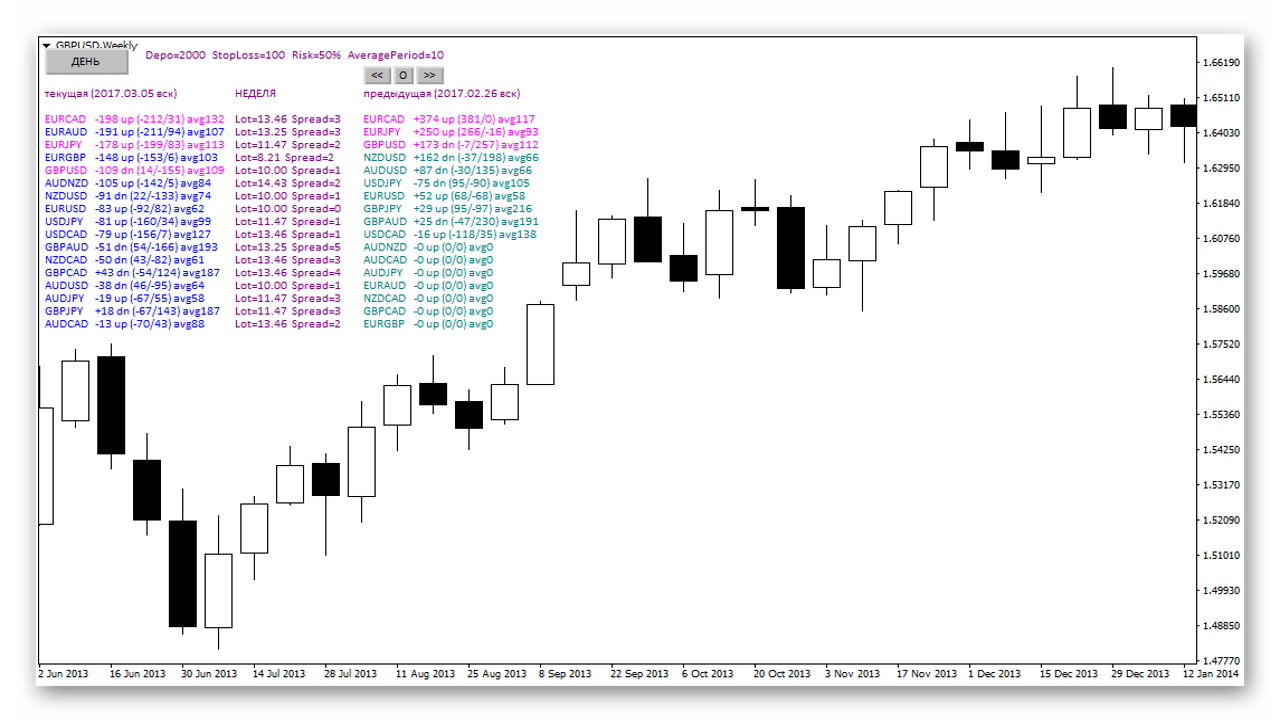 This is how we find a pair where the candle has moved 200 points or more. At the market open on Monday, we enter against the weekly candle. That is, if there was an up candle, we sell; if the candle was down, we buy.
Take profit is 50 points, just like in Va-Bank. But there are no stops. We average in if the take profit does not trigger. We enter with the same lot, every 100 points. When opening the second order, the overall take profit is moved to the opening point of the first order. Thus, if the price returns to our entry point, we get 100 points of profit.
So, the weekly candle closed with a body of 200 points. At the market open we enter a sell without a stop loss and set take profit at 50 points.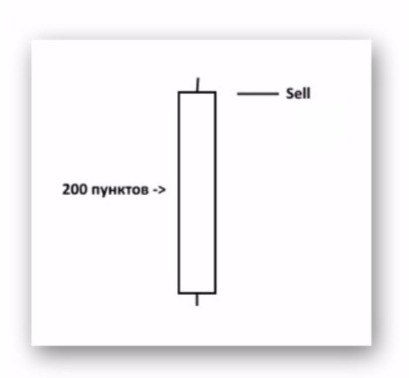 Then the price moves another 100 points up. At the 100-point level, we open an additional order of the same volume and direction. Thus, our breakeven level will be exactly between the two orders. At this level, the first order will have a loss of -50 points, and the second a profit of +50.
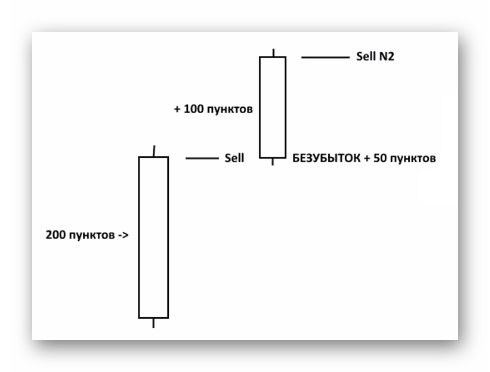
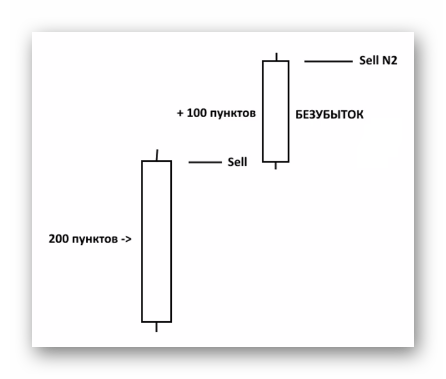 But we want to make a profit, so we set profit at the breakeven level + 50 points. This wording will be useful when setting up the auxiliary expert advisor. In essence, in this case, the take profit of both orders needs to be moved to the opening level of the first order. When the price returns, we get a profit equal to the take profit from the first order.
 In the event that the price rises another 100 points, we open one more order. Breakeven is now at the opening level of the second order, and breakeven + 50 points is roughly between the first and second orders. It turns out that on the third order we have +150 points, on the second +50 points, and on the first -50 points. Thus, at the breakeven + 50 point level we will have +150 points of profit.
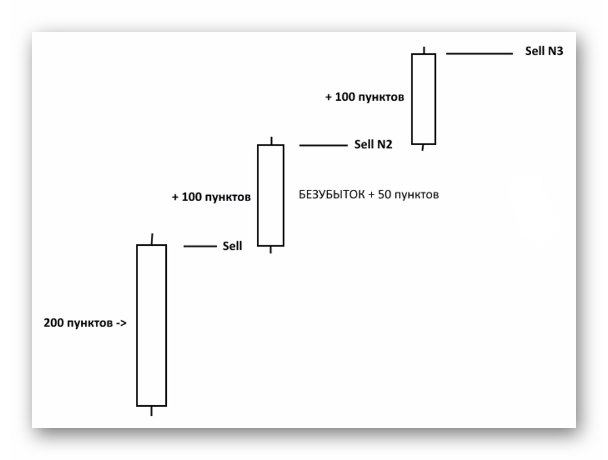 And so on until the positions are closed in profit. Our goal is not just to achieve breakeven, but also to come out in profit
Automation of Routine Processes
The auxiliary expert advisor Argo Averager will help us automate the process of averaging a position so that we do not have to do all the calculations manually.
You open the first order manually, and the expert advisor will place all additional orders with the required TP levels. You only need to attach it to the chart and configure it correctly.
You can configure the advisor either manually or by loading a special .set file from the archive at the end of the article. Do not forget to set the lot size appropriate for your deposit size (see the table below).
Screenshot of the advisor settings:
Practical Tips

There is a rule concerning gaps. If at the market open there is a gap in the direction of opening the position (more than 15 points), we cancel the trade. That is, if the price has already moved in our favor at the open, we skip such a trade. For example, see how this rule worked on EURCAD.
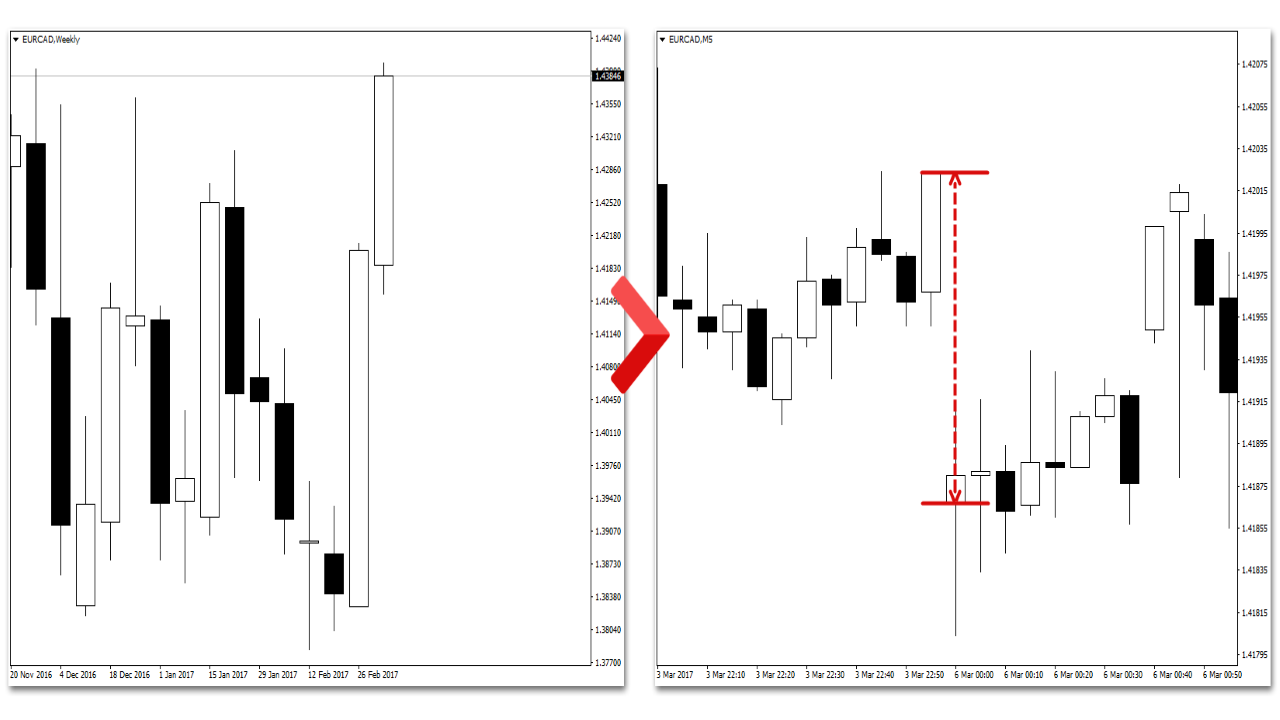 Also, according to the Va-Bank rule, if there is no profit within 48 hours, move the take profit to the breakeven level. In principle, if the situation is difficult and many legs have accumulated, move the take profits of all orders to breakeven.
The author of the strategy posts weekly trade reports in the thread on the forum. Accordingly, the information may be interesting. There, one of the forum members also provided an interesting analysis of different pairs for 2016. GBPAUD turned out to be the most dangerous pair, so it can be excluded from trading.
Money Management
Given that additional orders will be opened and entries without stops will be used, drawdowns can be noticeable. That is why the most important part of the strategy is money management. Our task is to make drawdowns less noticeable while preserving profitability.
According to the latest research by our forum members, the optimal level will be as follows: 0.01 lots per 3000 units of deposit, or 0.1 per 30000 units of deposit. With such money management, the drawdown should not exceed 20% of the deposit, which I consider the norm in forex, and this is regarded as moderate risk. Returns are about 100% per year or more.
This does not mean at all that you need to deposit $3000 or $30000 into the account. It is enough to open a cent account. There is an opinion that cent accounts are created for those who do not even have enough money for a bottle of beer. But such accounts are also used for advisors based on martingale, and for all similar strategies that use averaging. And all of this is for complying with money management. For example, if you have $100 in a standard account, in a cent account it turns into 10000 units of deposit.
Following a simple calculation, we conclude that for trading 0.1 lots you need $300, and for trading 0.01 lots only $30 is enough. Thus, if you do not have the necessary amount in a standard account, use cent accounts. For example, good cent accounts are available at Roboforex and Forex4You.
For clarity, below we have compiled a table with lot sizes, deposit amounts, and the corresponding account type.
Conclusion

Overall, the strategy is worthwhile and, at the very least, a couple of ideas can be taken from it for developing your own trading systems and applying them in trading. In principle, this system can even be called break-even. Study the original thread on the forum, where there are reports on real trades, not just theoretical calculations. That is all, thank you for your attention and until next time!
Download the Spring Strategy Files

Respectfully, Pavel Vlasov
TradeLikeaPro.ru