
Forex During the New Year Holidays

New Year is approaching, and with it come the long-awaited long holidays. Thoughts of feasts, celebrations, and so on are already keeping office workers from sleeping peacefully at work. But what about forex? When should you switch off your EAs and stop manual trading?
When Should You Stop Trading?

It is worth mentioning that in America and other Catholic countries the main holiday is Christmas, December 25, rather than New Year itself, as in Russia. Therefore, it is on December 25 itself (or rather, even on the 24th), without waiting for the 31st, that you should stop trading. Many investment funds and banks close positions as early as the 19th-20th, but overall business activity, though less dynamic, is still seen right up to Catholic Christmas itself.
I usually keep positions on daily charts until around noon on December 24. If the 24th falls on a weekend, then on December 23, without waiting for the evening, it is worth closing all positions and leaving the market. Be careful: on the 24th the market will close earlier than usual. Your broker will send you the exact closing time.
After December 25 and right up to New Year itself, there is nothing to do in the market: forex is open, but movements are minimal and hard to predict. December 31 is usually a short day (if the 31st falls on a weekend, then the short day will be the 30th or 29th), while in the first days of the new year Forex does not work. Your broker will definitely send you the exact holiday market schedule.
Pay Attention to Spreads
Please note that brokerage firms may widen spreads for the holiday period. Over the last 7 years this practice has almost disappeared, but in the first days of January, before opening a position, check the spread. If it exceeds normal weekday values, it is better not to trade yet.
When Can You Trade Again?
So when does normal activity return to the market? All kinds of analysts like to ramble and shout that there is nothing to do in the market almost until the end of February. Nonsense. I have many times seen major moves that began at the very start of January and delivered hundreds of points on daily charts. Technical analysis signals are still respected, and if spreads are not inflated, then you can absolutely open positions.
Many also like to sound clever by saying that the market is thin after the holidays and trading is dangerous. What does that mean in practice? Trading volumes are small, and there are no powerful moves. If there are no powerful moves, then what is the danger? You simply should not set large targets when trading intraday (up to about 16 points) and, accordingly, should not use large stops. Reduce the stop-loss and take-profit in your system proportionally, and you can trade just fine. On daily charts, as I already said, no anomalies are observed.
But all kinds of sensitive EAs (scalpers) are better turned off until mid-January. And not only scalpers: all ATS, strictly speaking, should be postponed until the market stabilizes. But in the RoboTest section, we do not turn anything off.
Are There Any Patterns in Currency Moves During the Holidays?

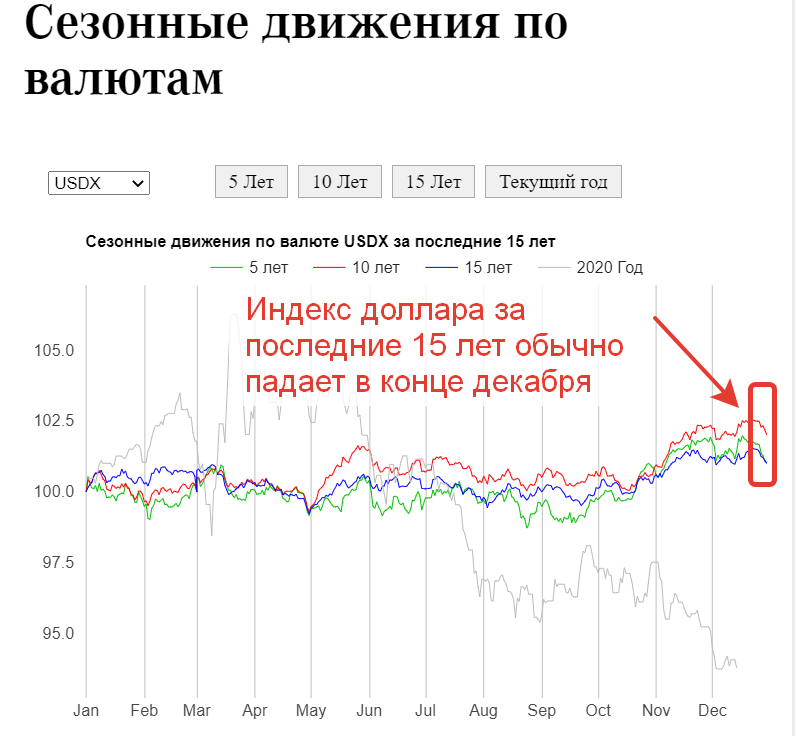
Yes, there are some interesting moments that can be seen in our seasonality service.
In the last week of December, the dollar usually falls, and that means pairs like EURUSD, AUDUSD, GBPUSD, and so on rise, while USDCHF and USDJPY fall.
Conclusion
So, to sum up:
- Close all positions on December 23;
- After January 4, you can trade quite normally;
- Until January 16, reduce take-profits and stops when trading intraday;
- Until January 16, do not use EAs;
- Trade daily charts as usual;
- Most importantly, watch for spread widening;
- In the last week of December, if you trade at all, then bet on a weaker dollar.
Taking this opportunity, I would like to congratulate all readers of the Tlap.io blog on the coming New Year and Christmas. I wish you all the very best and, of course, a favorable trend in the New Year! :)
Sincerely, Pavel Vlasov Tlap.io