
Forex in the USA - how brokers work "where we are not"
 Many of us have heard horror stories about the Forex market in the USA - some think that currency trading in the land of the stars-and-stripes is completely forbidden, while others, on the contrary, believe that "in America everything is definitely honest!". But how is it really?
Let us sort out the situation and find out how things stand with trading on the currency market in the capital of world evil, and using examples, see what restrictions and nuances typical Johns and Steves from the American prairies face.
After the financial crisis of 2008, the American government became seriously concerned with regulating the financial system, putting forward a number of tough restrictions and rules. All of this is supposed to stabilize the financial situation in the country and protect capital from a sharp market collapse. Some of these restrictions directly affect the forex market, making practically any operations on it illegal.
How things are for the bourgeois

Not without the influence of communist propaganda, a clear image of the typical bourgeois has remained in the minds of Soviet citizens, as a symbol of capitalism and the standard of permissiveness. The ritual of exchange trading is a real bacchanalia, where everyone is allowed everything, as long as they want it enough.
In reality, while you complain about how bad trading is on our side, among Western capitalists forex trading has already become a topic forbidden for discussion in decent society. The reason is harsh external policy, and an attempt to protect their own interests by devoting the lion's share of resources to developing financial contraceptives.
Sometimes such ideas reach absurdity, forcing one to doubt the original intentions of the interested parties. A vivid example is the national regulatory body of the USA, namely, the Commodity Futures Trading Commission. The commission's task is to regulate the actions of financial organizations, in theory protecting private traders from fraud and thereby creating a transparent competitive market.
A high-profile story happened quite recently, when the largest US broker FXCM was forever expelled from the national marketplace. The commission insists that, at least from 2009 to 2014, the company misled clients by claiming there was no conflict of interest, that is, by acting as an intermediary in passing orders to banks and other liquidity providers. The results of the investigation are reflected in the published document, which states that a substantial part of the liquidity was not identified in public reporting, in fact being the result of a market-making algorithm.
Thus, no forex broker operating in the USA is protected from such actions by the state, even if it is a company with huge turnover and an established brand. As a note, in December 2016 the company's share amounted to exactly one third of all retail forex in the USA. In this way the state shows its attitude to the decentralized currency market as a whole, campaigning for more traditional methods of investing on domestic exchanges.
Restrictions for traders

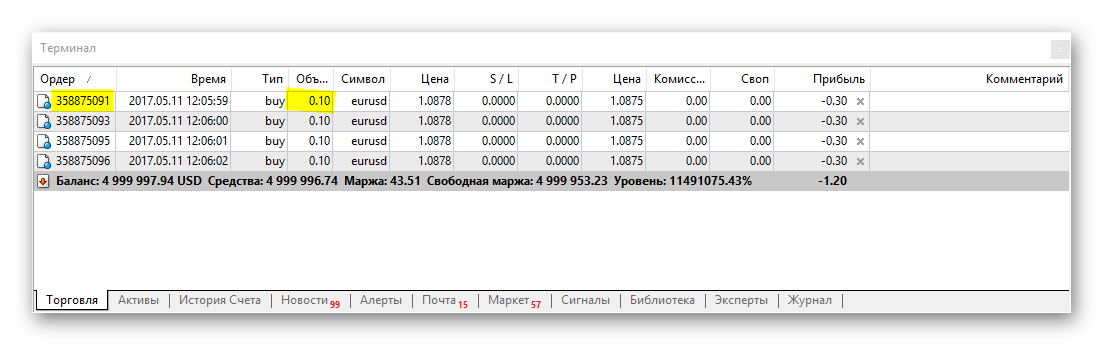
- Compliance with the FIFO rule (First In, First Out - first in, first out). According to the FIFO rule, the oldest positions opened in one currency pair must be closed first. If a trader tries to close a later position, they will receive a warning that earlier positions must be closed first.
For example, in this case, you can close only the first order in the list, whereas an attempt to close any other one will not succeed. Determining the oldest order is simple - it will have the smallest ticket value.
In this case, you can close either the first order, which is the oldest with a volume of 0.05, or the second one, opened earlier than the others with a volume of 0.10. The other two orders can be closed only after them.
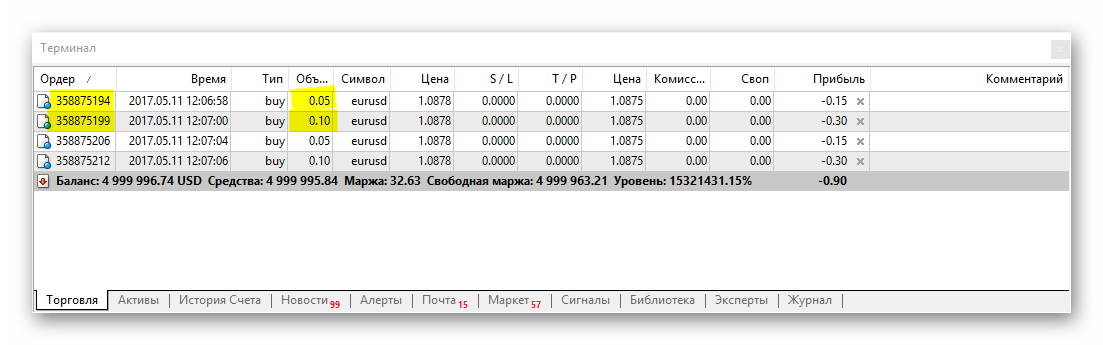
With a bit of ingenuity, this rule can be bypassed by splitting positions into parts with a difference of the minimum volume step. Naturally, such a method will not work with brokers that sum the volume of all orders for an instrument.
- A ban on hedging, that is, opening positions in opposite directions on one instrument. The regulator explains such a decision by the inexpediency of such tactics, therefore it will not be possible to lock a position in an account with an American broker.
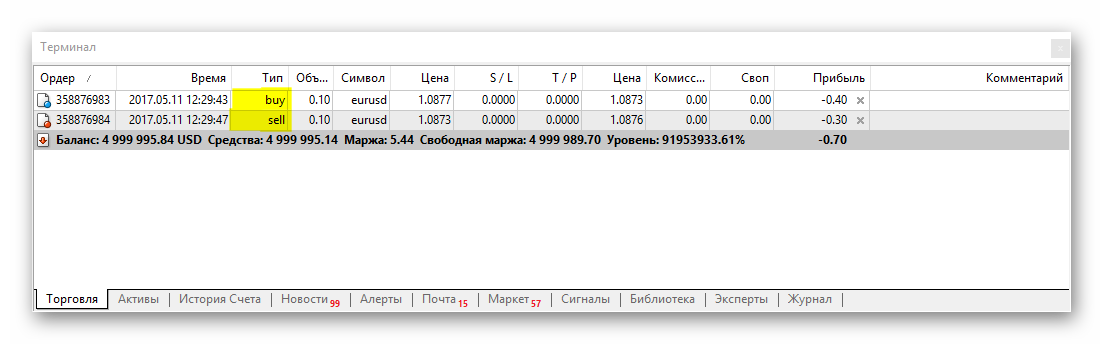
The regulator tells us outright like this - a lock is of the evil one, and only godlike figures, that is, large legal entities, may permit themselves such a sin.
- After 2008, the national regulator began taking tough measures regarding derivatives, completely banning the trading of CFD instruments in the USA.
The consequences of such decisions can be compared with the adoption of prohibition. Everyone seems to know that drinking is bad, and yet legalizing "derivative substances" gives far more advantages than completely banning them.
- A restriction on margin trading. The regulatory body decided to limit the maximum leverage size to 1:50 (in particular, for the major currency pairs) and to 1:20 for less liquid assets.
With all these restrictions taken into account, the trader receives no additional guarantees of preserving the deposit, while the companies remaining in the market are by default considered trusted.
The Dodd-Frank Act

In 2010, a new legislative act was adopted - The Dodd Frank Act, aimed, like most other post-crisis reforms, at reducing risks in the US financial system.
With the adoption of the new restrictions, most operations on the forex market become unlawful. Along with this, banks were forbidden to own hedge funds, as well as to invest depositors' funds in such structures. The precious metals market also fell under regulation, so all current positions are forcibly closed at the end of the day.
As a result, the majority of brokerage firms not registered in the USA were forced to leave the American market. Naturally, this strongly affected forex trading, as the choice of broker narrowed sharply to literally a few names.
With Trump's election, the situation in the forex sphere may change greatly. It is not yet clear what amendments the president will make, but most likely one should expect an easing of restrictions.
Conclusion

If you are a citizen of America and at the same time live outside its borders, you have a chance to bypass some of the regulator's restrictions. But for this, you will need to prove to your broker that you are located outside the States. Otherwise, all that remains is to look for other companies that accept traders from the USA. Unfortunately, these are usually small or extremely dubious outfits (for example, FXChoise). At present, American citizenship and full-fledged forex trading are incompatible things.
Best regards, Alexey Vergunov TradeLikeaPro.ru
