
Fed Rate Risk Returns: ISM and NFP Put September in Play
Intro
The Federal Reserve is once again making markets consider a possibility they had grown rather comfortable ignoring: another interest-rate increase in September. After Kevin Warsh delivered a hawkish message at Jackson Hole, traders raised the estimated probability of a hike to roughly 57–63%, while the yield on 2-year US Treasuries moved toward 4.35%. The repricing is meaningful, but it is not yet a settled verdict. With ISM due Tuesday and nonfarm payrolls arriving Friday, the next stage of the debate will be decided less by conference rhetoric and more by whether the US economy still refuses to cool on schedule.
🏦 Jackson Hole restores the tightening debate
The Jackson Hole signal changed the market conversation because it challenged the assumption that the next policy move would necessarily be easier rather than tighter. Warsh’s hawkish emphasis encouraged investors to reconsider whether persistent economic strength could force the Fed to extend its inflation fight, even after a long period of restrictive policy. The central shift is that a September rate increase has returned as a credible market scenario, with its estimated probability rising to approximately 57–63%. That range still reflects disagreement rather than certainty, but it is high enough to influence currencies, bonds, and equity valuations. Markets do not need unanimous conviction to move; they merely need enough participants to discover that their previously comfortable positioning has become slightly less comfortable. The important distinction is between a policy signal and a policy commitment. A hawkish speech can alter expectations, but officials will still assess incoming evidence before making a decision. For investors, Jackson Hole therefore serves as the opening argument, while the economic reports ahead will provide the evidence.
📈 Two-year Treasuries show where the pressure is concentrated
The movement of the 2-year Treasury yield toward 4.35% is particularly informative because short-dated government bonds are highly sensitive to expectations for the Fed’s policy path. When traders see a greater chance that rates will rise or remain restrictive, they generally demand a higher yield to hold securities whose returns are closely connected to near-term monetary policy. The move toward 4.35% indicates that the market is repricing the expected rate path, not merely reacting to an isolated headline. This matters beyond the Treasury market. Higher short-term yields can raise the relative appeal of safer dollar assets, tighten financial conditions, and increase the discount rate applied to future corporate earnings. That combination can be uncomfortable for richly valued equities and other risk-sensitive assets, especially if stronger data make the repricing look durable. Still, a single yield level does not guarantee a continued selloff in bonds. If upcoming reports weaken the case for tightening, short maturities could reverse quickly because the same sensitivity that drives yields upward also works in the opposite direction.
💵 DXY slips, but the dollar has not rejected the hawkish story
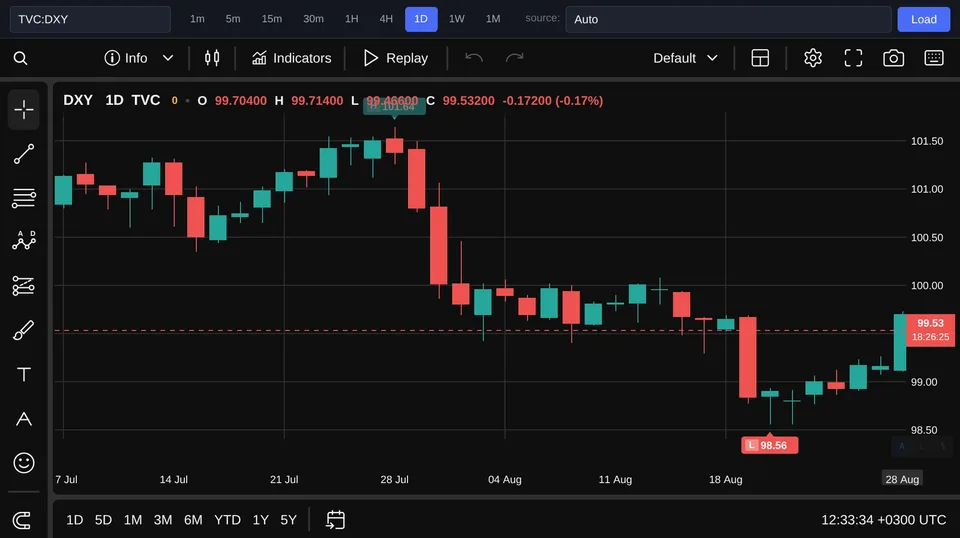
The dollar’s immediate performance adds useful nuance. At the time of writing, the TVC:DXY dollar index stands at 99.54 USD, down 0.16% for the day. That modest decline may appear inconsistent with rising expectations for a rate increase, but daily currency moves also reflect positioning, profit-taking, relative developments abroad, and uncertainty about whether the Fed will actually follow through. DXY at 99.54 USD with a daily change of −0.16% shows that the market has not reached a firm consensus, even as tighter policy expectations offer the dollar underlying support. In other words, the currency market has heard the hawkish message but has not signed the paperwork yet. If US data remain strong, higher expected rates and elevated short-term yields could make the dollar more attractive relative to currencies backed by less restrictive policy outlooks. If the data disappoint, the current support could fade as traders reduce the probability of a September move. The small daily decline should therefore be treated as evidence of hesitation, not as proof that the broader rate narrative has failed.
🗓️ ISM and NFP create the week’s decision point
Tuesday’s ISM release and Friday’s nonfarm payrolls report are the week’s main tests because they address complementary parts of the economic picture. ISM can reveal whether business activity is retaining momentum, while NFP will help investors judge whether labor demand remains strong enough to sustain wage and inflation pressure. A robust ISM reading followed by resilient payroll growth would strengthen the argument that the economy can absorb another increase. In that scenario, the estimated September probability could rise further, 2-year Treasury yields could face renewed upward pressure, and risk assets could struggle as investors adjust to a higher-for-longer policy path. The dollar could also regain momentum despite its current 0.16% daily decline.
Conclusion
The September decision is genuinely open rather than predetermined. Hawkish communication has lifted the market-implied probability of an increase to roughly 57–63%, and the 2-year Treasury yield near 4.35% confirms that investors are taking the risk seriously. At the same time, DXY at 99.54 USD and down 0.16% on the day demonstrates that conviction remains incomplete. Until ISM and NFP clarify the economy’s momentum, the dollar, short-term bonds, and stock indexes are likely to remain unusually sensitive to each macroeconomic signal. Investors should separate confirmed market data from conditional scenarios and prepare for repricing in either direction.