
The Fed Pause Did Not Calm Nerves: Market Awaits Jobs Report

Introduction
The Fed’s July decision to leave the rate in the 3.50-3.75% range looked like a pause, but not like an invitation for the market to calmly spread its paws over the keyboard. Three FOMC members wanted a hike at once, so traders quickly stopped discussing the hold itself and shifted to September. Now the week’s main trigger is Friday’s labor-market report: if employment and wages do not cool, the hike scenario may return to prices, along with pressure on long bonds and a test of strength for equities.
🏦 Fed: There Is a Pause, but No Pivot
Keeping the rate unchanged does not mean the Fed is already ready to move into an easier mode. The 3.50-3.75% range remains restrictive, and the desire of three FOMC members to raise the rate shows that there is a notable hawkish bloc inside the committee. The market is now trading not the July pause, but the probability of a September hike. This changes the whole meaning of the week: traders care not about yesterday’s Fed gesture, but about what arguments fresh macro data will provide. If payrolls come out strong, unemployment stays low, and wages show steady growth, supporters of a hike will get a clear line of defense. They will be able to say that labor demand is still firm, inflation risks have not been removed, and therefore it is premature to declare victory over price pressure. In that case, the July pause will look not like the start of a calm rate hold, but like a tactical stop before a new decision. The main risk for the market is a return of expectations for a tougher Fed path.
💵 The Dollar Holds Near an Important Zone
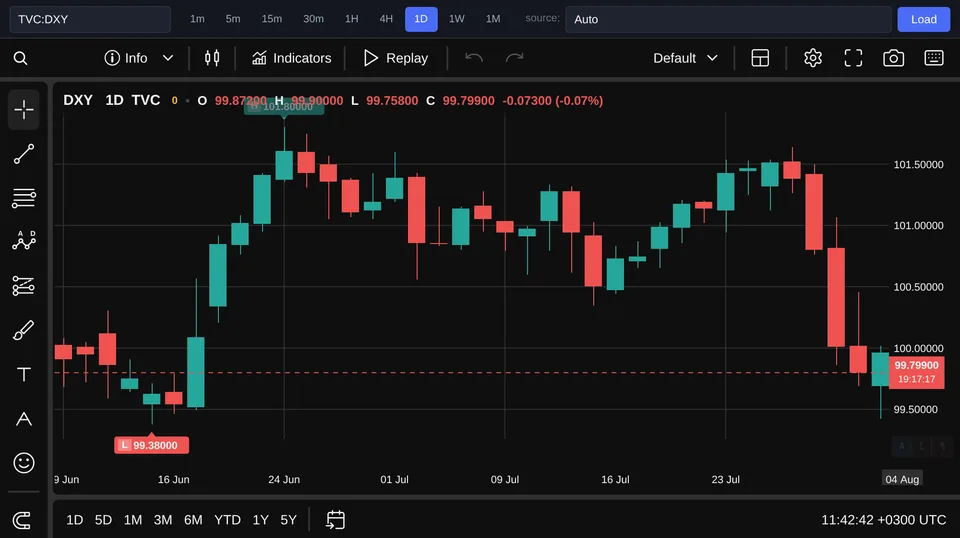
At the time of writing, the DXY dollar index is at 99.82 USD and is down -0.07% on the day. This does not look like an aggressive market bet on a September hike, but this move cannot be called a weak signal for the dollar either: the index remains near the psychologically important 100 zone. The currency market is now more likely waiting for confirmation than buying the hawkish scenario in advance. DXY near 99.82 USD shows caution, not dollar capitulation. A strong labor report could quickly restore demand for dollar yield, especially if wage growth points to sticky inflation pressure. Traders would then start to price the future rate path higher, and the dollar would get support without the need for additional loud Fed statements. If employment and wages turn out softer than expected, it will be harder for the dollar to keep its premium for tight policy. In that case, the market will get a reason to lower the probability of a September hike and view the pause more calmly as a continuation of wait-and-see mode.
📉 Long Treasuries Remain the Pain Point
The most sensitive part of this story is the long end of the U.S. Treasury market. If Friday’s data show that the labor market is not cooling, investors will have to account not only for the risk of one more rate hike, but also for the likelihood of a longer period of tight financial conditions. For long-dated securities this is especially unpleasant, because their prices depend more on expectations for real rates and the horizon of restrictive policy. For Treasuries, the danger is not one Fed step, but the signal of “higher for longer.” With strong payrolls and resilient wages, long-bond yields may get another upward impulse, as it will be harder for buyers to argue for imminent policy easing. The curve will start digesting a scenario in which the Fed keeps the economy under pressure for longer, even if formally it did not raise anything in July. A cooler report, on the contrary, would remove part of the burden from the long end and allow the market to discuss a managed slowdown. The whole combination of data matters here: employment, unemployment, and wages together, not one attractive headline in the first line of the release.
📈 Stocks Are Buying the Pause, but with a Condition
The stock market is so far choosing an optimistic reading of events. The S&P 500 is at 7 737 USD and is up +1.79% on the day, showing live risk appetite while a September hike has not become the base case. Investors are effectively betting that the Fed can wait while the economy does not fall into a sharp slowdown. The S&P 500 rally rests on a thin balance between a strong economy and a patient Fed. The problem is that this balance can easily be spoiled by overly strong labor data. Firm employment supports consumer demand and corporate profits, but faster wage growth can again raise concerns about inflation and yields. For expensive stocks this is critical: the higher the discount rate, the more strictly the market looks at future profits. If the report is moderate, stocks will get a chance to extend the risk-on mood; if the data are hot, the S&P 500’s +1.79% daily gain could quickly turn from an argument of strength into a reason to take profits.
Conclusion
The main takeaway of the day: the Fed’s July pause did not close the question on rates, but only moved it into the realm of fresh statistics. The key risk of the week is Friday’s labor-market report, not the decision itself to keep the 3.50-3.75% range. Strong employment and wages will support the September hike scenario, strengthen the dollar rate story, and may pressure long Treasuries along with expensive stocks. Cooler data will reduce the probability of a new hike and give the market grounds to extend the optimistic interpretation of the pause. The reaction should be judged by the combination of payrolls, unemployment, and wages, because it is this trio that will show whether the Fed has room for patience.