
The Fed Launches Quantitative Tightening: How Will It Affect Currencies, Stocks, and Crypto?

Most Forex traders, stock market investors, and cryptocurrency investors trade according to strategies created under the conditions of the long-term QE (quantitative easing) program of the Federal Reserve of the United States. In the current year, the American regulator adopted the directly opposite QT (quantitative tightening) program.
The Fed's new monetary policy course is designed for the next three years. The article provides forecasts of QT's impact on the financial markets, including cryptocurrencies, in order to warn our readers about the possible need to revise long-term trading and investment strategies.
Investors may be interested in historical analogies in the stock market. It should be acknowledged that QT will be a difficult period for cryptocurrencies, which grew under the favorable conditions of QE and low inflation.
The Federal Reserve's Quantitative Easing Program: What Is It?

The large-scale economic crisis of 2008 forced the U.S. Federal Reserve to launch the QE (Quantitative easing) program in order to avoid the "liquidity trap" that arises when the discount rate reaches zero.
It so happened that since 2006 the financial regulator had consistently pursued a loose monetary policy. The mortgage crisis forced the Fed to sharply cut the rate in order to support the financial markets.
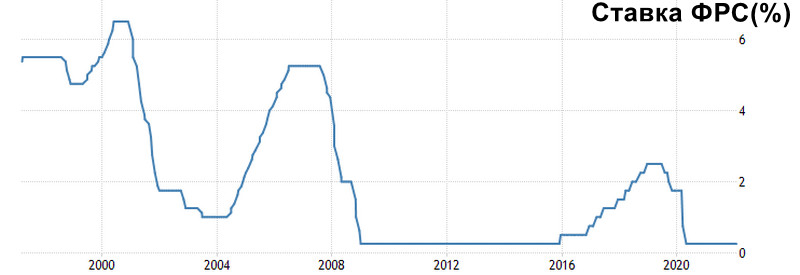
The stimulus was not enough, and the Fed launched QE, the purchase of long-term mortgage and government bonds without reference to the interest rate, literally "flooding" the economy with excess liquidity.
The financial regulator expected GDP growth to outpace money supply growth, while accelerating inflation to the level of 2-2.5%. In the event of greater inflation growth, the Fed planned to move to tighter monetary policy by raising the discount rate.
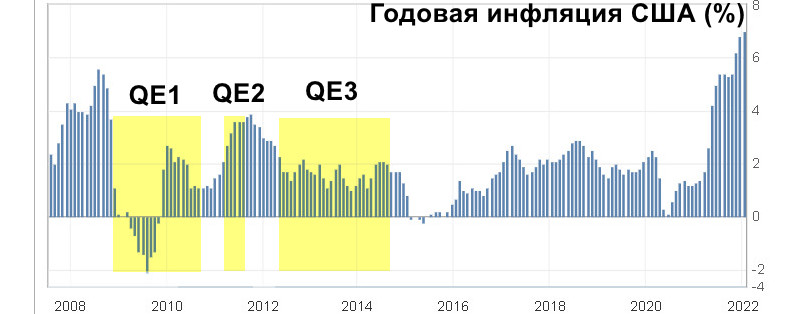
The first round of QE1 started in the crisis year 2008 and ended in 2010. Inflation rose to 2.6%, but after the cancellation of quantitative easing it fell to one percent, so the Fed decided to launch QE2 in November of the same year.
The second QE cycle was completed in June 2011, when the Fed managed to "accelerate" inflation to 3.6%. Deprived of stimulus, the U.S. economy once again slipped below the target level of 2%, which did not make it possible to begin raising the Fed's discount rate.
In September 2012, the financial regulator returned to the QE instrument, no longer setting deadlines. The third cycle did not lead to inflation growth, but greatly inflated the Fed's balance sheet, which was buying and holding long-term government bonds in its accounts.
Inflation returned to the zero level in 2014, meaning the three cycles of quantitative easing failed to accelerate the American economy. In October 2014, the Fed decided not only to abandon QE, but also for the first time in history to launch the QT quantitative tightening program.
Once again, the economic crisis of 2020 forced the financial regulator to return to bond purchases, aggravated by the consequences of mass Covid-19 infection. The airborne spread of the coronavirus made it necessary to introduce lockdowns, depriving businesses and the population of income.
QE4 was unprecedented in the scale of liquidity injections, violating the main rule of this instrument's functioning. The market received $1.5 trillion through REPO operations, and $750 billion went to bond purchases. For comparison, it is worth citing the total figure of the first three QE rounds, equal to $1.2 trillion.
The U.S. economy could not "digest" the increase in issuance with its growth; business suffered from lockdowns and could not effectively absorb the money received in the form of loans, as it had done before. As a result, a gigantic inflation spike occurred, described in many economics textbooks that study the side effects of QE.
Why QT Is the Only Option for the U.S. Federal Reserve

The fourth, "coronavirus" QE cycle inflated the Fed's balance sheet to $8.8 trillion as of the beginning of January 2021. The excess cash issued ("printed," essentially) through the purchase of bonds amounts to 36% of the country's GDP, whose growth does not cover such a volume of free money supply.
The Fed's balance sheet continued to grow by $60 billion in January and $30 billion in February, and even if QE stops in March the U.S. economy will not have time to accelerate, which will lead to double-digit inflation growth, threatening falling consumer demand, incomes, and economic stagnation. The financial regulator cannot allow such a situation, so it will press "all the buttons".
In March, the rate-hike cycle starts, followed in the summer by bond sales. Fed Chair Jerome Powell promised a "significant reduction" of the balance sheet at the January press conference.
Analysts at Goldman Sachs shared insider information suggesting the withdrawal of $2-2.5 billion of printed dollars over the next three years. The QT target levels are $6 billion for the balance sheet or 20% of GDP.
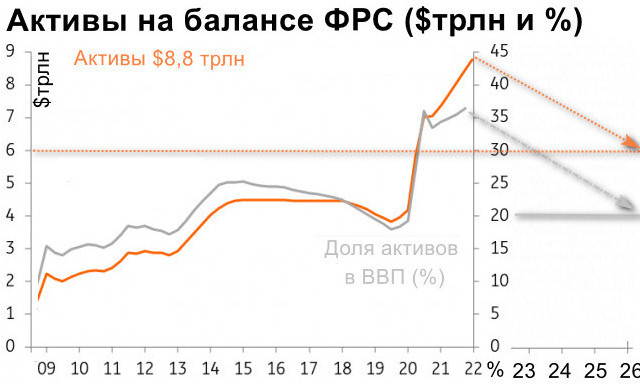
Simplified calculations show that U.S. economic growth at the level of 5-6% and a discount rate within two percent will be enough for inflation to begin a sharp decline over the next few years. However, the Fed will have to pump out $100 billion monthly, and Forex traders can expect "beautiful candles" on the charts after each regulator auction.
How Did the Launch of QT Affect the Forex Market?

Pumping dollars out of the financial system is called by the elegant macroeconomic term the sterilization of the money supply. The Fed resorted to such operations only once; the only large-scale bond sell-off in Forex market history occurred in 2017-2018.
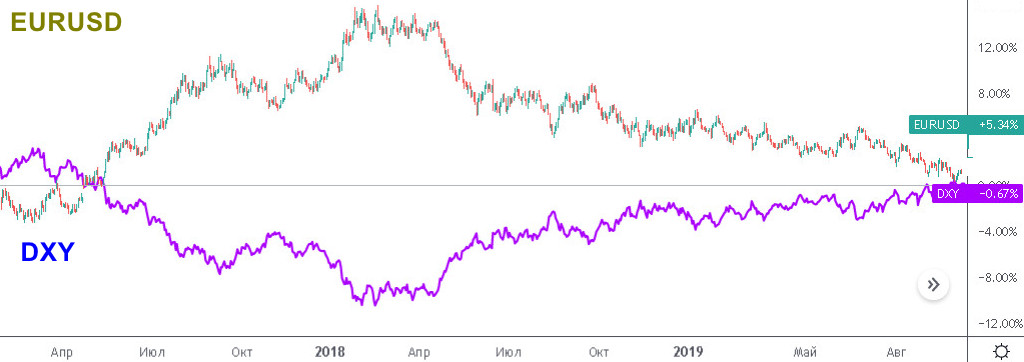
The financial regulator immediately defined one of the main goals of QT1 as the strengthening of the dollar exchange rate in order to increase the competitiveness of local manufacturers by stimulating domestic demand. The launch of quantitative tightening in October 2017 was combined with a rate increase, which made it possible to stop and reverse the rising trend in EURUSD. As can be seen on the chart, the Fed's policy froze the weakening of the dollar index (DXY).
Overall, the amounts of money supply withdrawal at the start were negligible, but they kept increasing by +$10 billion every month. Forex traders were not concerned about QT exactly until the moment when the "vacuum cleaner" began removing $30 billion from the market at a time at the beginning of 2018.
As a result of steady withdrawals, a steady upward trend developed on Forex in the DXY dollar index. All major currencies suffered from the strengthening of the dollar, but Jerome Powell was forced to abandon the program under pressure from Donald Trump. The newly elected president was not concerned with stimulating domestic demand; he needed stock market growth.
The QT program and the stock market

The stock market and economic indicators became the hallmark of all Donald Trump's speeches. The US president cut taxes for corporations and revised budget policy, which led to record growth in stock prices, especially for technology companies.
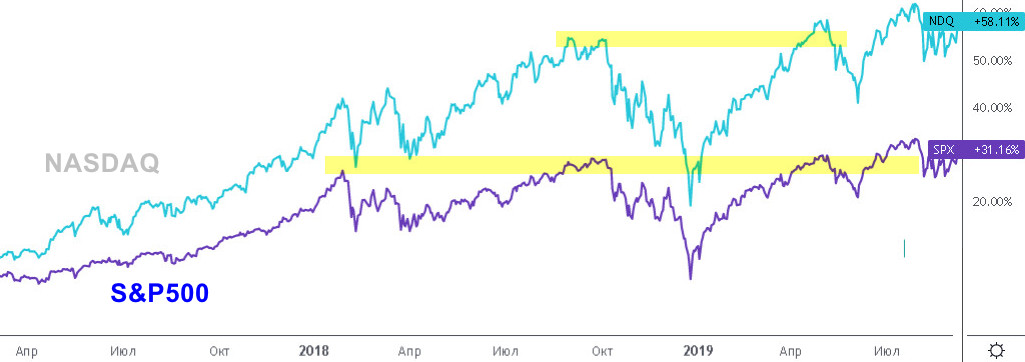
However, the trade war with China led to a decline in the indices; S&P500 and NASDAQ managed to renew their 2018 highs before heavy sell-offs began, coinciding with the anniversary of the launch of QT1. By that time, the level of money supply sterilization had reached $50 billion per month.
The indices were able to return to their highs only after the complete cancellation of QT1. In general, the dynamics of 2018-2019 can be described as a sideways range with false breakouts of the upper boundary of the flat.
The crypto winter of 2018 - a coincidence with QT or chance?
In 2017, Bitcoin rose to $20 thousand, only to fall 80% in 2018. At that moment, it was the seventh case of a crushing collapse in the short history of the cryptocurrency market. However, the decline, familiar for digital currency, was hyped by the world press, attracted by BTC's strong growth in 2017.
Prompted by journalists, 2018 was called the "crypto winter," which is now used to scare novice traders in this market.
QT1 affected the cryptocurrency market because of Bitcoin's traditional negative reaction:
IMF research recorded an increase in Bitcoin's correlation with stock indices starting in 2018. Cryptocurrencies probably get a share of the liquidity spread around by central banks, or part of the speculative profits from stocks went into holding various tokens, altcoins, and buying BTC.
However, it is worth recalling the objective reasons for the crypto winter of 2018, which had a specific impact on this industry:
What should we expect from the launch of QT2?

The quantitative tightening program is scheduled for the summer of 2022. The currency market will react to QT2 after its actual launch; until that moment, trends are determined by other fundamental factors and economic indicators.
If Jerome Powell decides to start with $100 billion of sterilization per month, then quite soon on Forex a sharp strengthening of the dollar index will continue, lasting until parity with the euro is reached. The ECB will simply have nothing to oppose to the Fed's "vacuum cleaner." Christine Lagarde is inclined toward soft monetary policy and reducing the balance sheet of the European Central Bank naturally as the purchased bonds mature.
The long-term trend will make it possible to profit from martingale and grid strategies. Building a positive pyramid of currency trades would be justified, but such tactics are almost never found on Forex.
The stock market is at attractive levels after a large-scale correction at the end of the year. Bloomberg analysts believe that another wave of stock declines to the 2021 level awaits us.
If stock indices end up there by the time QT launches, then for some time a rebound will offset the negative effect of the destruction of monetary policy. This trend will set a maximum that may become a limiter on growth for many years. At the same time, volatility will become another problem, prematurely knocking out the "usual" stops, so it is worth considering risk management tactics that calculate loss and profit limits based on the range of market fluctuations.
The cryptocurrency rate largely depends on the success of code implementation, the scale of adoption, and the potential advantages of the blockchain of individual altcoins. These factors will allow traders to always find a theme for earning "x's" (a unit of measurement equal to 100% profit).
At the same time, Bitcoin and the largest cryptocurrencies directly depend on stock prices and the dollar. QT may cause their value to fall by 80%, after which the path back to the highs may drag on for several years.
Conclusion

Quantitative tightening, QT, is one of the new monetary policy measures, the need for which is due to the failure of the opposite QE program. The Fed needed to unload the balance sheet by $2.2 trillion back in 2019 to avoid today's inflation spike, which is capable of halting the post-crisis economic recovery.
Donald Trump interfered in the decisions made by Jerome Powell because he needed market growth for political purposes. Now the head of the Fed may once again come under pressure from the president. Joe Biden plans to seek re-election in two years, and it is completely inconvenient for him to run a campaign against the backdrop of a plunging economy.
QT2 will probably end earlier, like QT1, which will once again prove the stability and advantages of the cryptocurrency ecosystem, where the rules are "dictated" by open code, for the modification of which it is necessary to reach broad consensus with miners or validators scattered around the world.
Respectfully, Ivan Petrov
Tlap.io
