
The Fed Is Silent, the Market Counts for Itself: September Has Again Become a Risk Point

Introduction
The day turned out to be rare: the Fed did not raise anything, but anxiety in the market increased. Kevin Warsh left the rate in the 3.5-3.75% range, yet three FOMC members were already voting for a 25 bp hike, and this turned a formal pause into a signal with character. After the rejection of familiar forward guidance, traders have to assemble the picture themselves from oil, inflation, expectations ahead of Jackson Hole, and the behavior of long Treasuries. The navigation lights were switched off, no map was issued, and the market still has to steer the ship on schedule.
🏦 A Fed Pause Without a Calming Effect
The main news looks simple: the rate stayed at 3.5-3.75%. But inside the decision there is an important detail because of which the market did not take the meeting as a calm stop along the way: three FOMC participants voted for a 25 bp hike, which means the camp of tightening supporters no longer looks decorative. The market received not a pause with a promise of calm, but a pause without instructions. For traders, this changes the meaning of the September meeting: it becomes not a formality, but a full-fledged point for repricing expectations. If new data confirm persistent inflation or pressure from oil, the argument for a hike will already be on the table, rather than appearing from scratch. It is also important that the Fed effectively made clear: there is no longer an automatic scenario. When the committee already has three votes for +25 bp, the market starts counting not only the base forecast, but also the speed at which the minority can become more influential. In such an environment, even an unchanged rate works as a source of volatility, because the regulator's silence has become too meaningful.
🧭 Without Forward Guidance, Data Become the Main Conductor
The rejection of forward guidance sharply raises the weight of every new indicator. Previously, the market tried to read where the Fed was gently steering expectations; now it has to look at incoming data and ask a tougher question: what exactly will force the regulator to act as early as September. Oil, inflation releases, and speeches around Jackson Hole remain at the center of attention. The September hike now lives in traders' expectations, even without a direct hint from the Fed. If oil keeps supporting headline inflation and core indicators do not show confident cooling, the probability of a hike may quickly rise in market prices. If the data become softer, part of the September risk premium may leave, but until then the market will keep a defensive position. In this setup, Jackson Hole turns not into a pretty conference for quotes, but into a potential trigger for rates and currencies. Any Warsh emphasis on inflation risks may push yields higher, especially at the short end of the curve. A more balanced tone, by contrast, will give the market a chance to breathe out, although it is unlikely to fully remove the September question.
💵 DXY Has Cooled, but the Dollar Story Has Not Broken
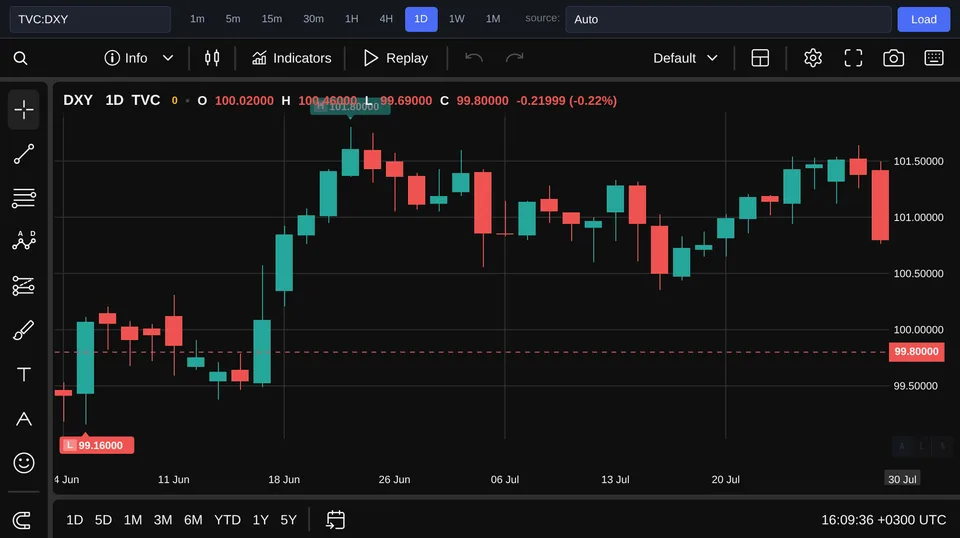
The DXY dollar index is now at 99.80 USD and is down -0.21% on the day. At first glance this looks like dollar weakness, but in the current context the move looks more like a cautious breather after a repricing of rates. The market is not rejecting the September hike scenario, but is waiting for confirmations before buying the dollar more aggressively again. DXY at 99.80 USD with a daily change of -0.21% shows a pause, not a capitulation by dollar bulls. For the currency market, the key question now is whether the September hike becomes the base expectation or remains an insurance premium in prices. The difference matters: in the first case the dollar gets steady support from rates, while in the second any soft inflation number can quickly knock out this support. If oil continues to pressure inflation expectations and Fed rhetoric before Jackson Hole is tough, the dollar may regain demand even after today's decline. But if the data show cooling and the regulator does not push the market toward tightening, DXY risks getting stuck near current levels. For a trader, this is not a moment for pretty slogans, but a mode of careful waiting at the data bowl.
📉 Long Treasuries Keep Risk Under Pressure
The most unpleasant part of the picture is not in the rate decision itself, but at the long end of the Treasury curve. When long bonds remain under pressure, equities, credit, and high-duration stories lose their usual cushion: the hope that an economic slowdown will automatically bring lower yields and easier financial conditions. Pressure in long Treasuries remains the main channel through which a silent Fed presses on risk assets. Even if the current rate has not changed, a high or nervous far end of the curve affects company valuations, the cost of capital, and appetite for risky trades. That is why investors are watching not only the FOMC, but also how the bond market digests the absence of clear hints. For equities, a mild decline in DXY to 99.80 USD by -0.21% may be a small relief, but it is not enough if long Treasury yields continue to obstruct multiple expansion. The credit market will also be cautious: the longer rate uncertainty persists, the higher the price of an error in risk premiums. As a result, September becomes a test not only for the Fed, but also for the whole construction of “cheaper money later.”
Conclusion
The day's bottom line is simple: the Fed did not raise the rate, but made the market less confident about the route. The 3.5-3.75% range, three votes for +25 bp, and the rejection of forward guidance force traders to build the September scenario themselves using oil, inflation, Jackson Hole, and the Treasury curve. DXY at 99.80 USD with a daily decline of -0.21% gives a local breather, but does not cancel the tension. As long as long Treasuries remain under pressure, risk assets will react not only to facts, but also to the probability that the September hike will turn from a market rumor into a working plan.