
Elder's Three Screens
 Good day, fellow traders. Forex beginners quite often ask about the more than well-known Three Screens strategy by Alexander Elder, which is mentioned in the book "How to Play and Win at the Stock Market". At readers' request, a video lesson was recorded where this trading system is broken down and considered in its most classic form.
The author of the Three Screens strategy is Alexander Elder. The strategy became known to a wide circle of traders in 1986 and since then has not ceased to be popular and, in one variation or another, it is used by many traders to this day.
The essence of the Three Screens system is to conduct a triple check for trades: at one of the stages, many possible positions will be filtered out. We identify long-term, medium-term, and short-term trends and enter the market only in the direction of the major "current."
Indicators
The Three Screens strategy uses a combination of trend indicators and oscillators.
There are no rigid restrictions on the indicators used. The point is to determine the trend on the larger timeframe with the help of a trend indicator and find an entry point with the help of an oscillator on the main scale. Therefore, you can apply the trend indicators and oscillators that you personally like and that suit you.
Timeframes
We need to determine: long-term, medium-term, and short-term trends.
Our main timeframe is the second screen.
A timeframe one order higher is the first screen (we use it to determine the long-term trend)
A timeframe one order lower (relative to the main one) will be the third screen
A factor of 5 is used for scaling. Approximately is acceptable.
Examples:
- If the main timeframe is H1, then the long-term trend will be H4, and the short-term trend will be M15.
- If the main timeframe is M5, then the long-term trend will be M30, and the short-term trend will be M1.
First Screen
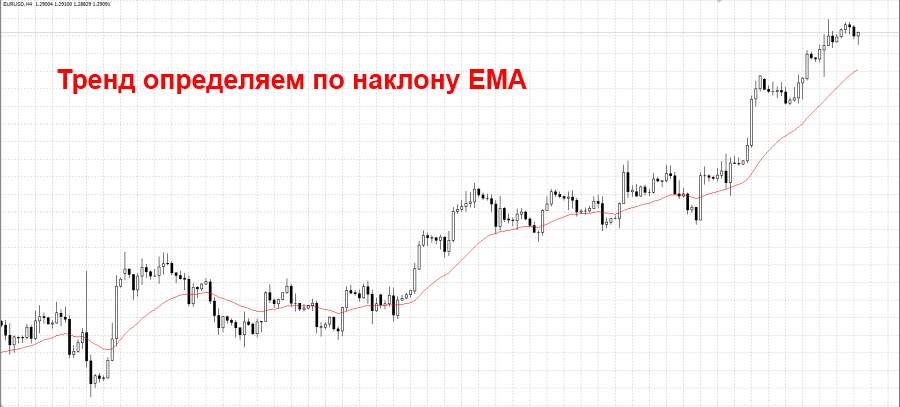
We determine the long-term trend using a trend indicator, for example an EMA with a period of 26.
Second Screen
- Open trades only in the direction of the long-term trend!
- Use an oscillator to enter the market, for example the stochastic.
Third screen
2 options are possible:
- Enter when the movement momentum is in our favor. We do not actually even open the third chart. This option is more suitable for beginners, so as not to get confused.
- Use the third screen for a more precise market entry based on technical analysis. On the plus side, it is often possible to set a smaller stop-loss. A more difficult option for experienced traders.
Entry Rules
- If the trend on the first screen is up, and on the second the oscillator is in the oversold zone, place a BUY STOP order a couple of points above the High point of the last closed candle on the second screen. If the order does not trigger, move it slightly above the high of the next closed candle. Continue moving the order (if it has not triggered) until the trend on the first screen changes to bearish.
- If the trend on the first screen is down, and on the second the oscillator is in the overbought zone, place a SELL STOP order a couple of points below the Low point of the last closed candle on the second screen. If the order does not trigger, move it slightly below the low of the next closed candle. Continue moving the order (if it has not triggered) until the trend on the first screen changes to bullish.
Reference material:
How to trade with pending orders
Stop Loss
Set Stop-Loss orders slightly below/above the nearest local minimum/maximum.
Take Profit
- We exit the position when the oscillator on the second screen enters the overbought zone (exit from buys) or the oversold zone (exit from sells).
- It is possible to use any other criteria for exit.
Moving the Stop
We move the order to breakeven (move the stop-loss to the position entry price) after reaching approximately half of the planned profit.
Conclusion
Alexander Elder's "Three Screens" system can serve as a very good foundation for building your own trading strategy in forex. The main thing worth taking from it is checking trades in several stages, while following only the long-term trend. Applying the three screens in a "bare" form, with only one indicator on each chart, will be a low-profit endeavor; after all, forex is a complex market that requires a thoughtful approach. Therefore, this strategy in its classic form (as it is presented in our forex blog) requires additional filtering.
A very good filter can be the use of the three screens strategy in combination with the methods of Price Action trading. As a result, you will get a very powerful trading system.