
The Dollar Weakens, the Yen Gets Nervous: EUR/USD Looks at 1.1600

Introduction
The currency market today is trading not only current quotes, but also expectations around the next macro data. The dollar is slipping cautiously because traders are already trying on a scenario of cooling in the U.S. labor market, EUR/USD is getting support and stretching toward the 1.1600 area, while USD/JPY remains a nervous pair: officials are trying to hold the yen with official signals, but the market is still looking at rates. This makes it a day where every headline is first weighed, then checked again for durability.
💵 Dollar: Weaker, but Not Broken Yet
The main line of the day is moderate pressure on the dollar. The market is pricing in the chance that fresh U.S. employment signals will show economic cooling, and that could reduce room for hawkish Fed rhetoric. Key point: traders are now trading not the fact, but the expectation of the fact. That is why the move looks convincing in terms of sentiment, but remains vulnerable to strong statistics. If U.S. labor market data turns out firm, the dollar will quickly get a chance to rebound, because the theme of high yields on U.S. assets has not gone anywhere. If employment and wage pressure confirm a slowdown, pressure on the dollar may become more sustainable. For now this is not capitulation by dollar buyers, but rather fatigue after a long period of rate advantage. The market has narrowed its eyes a little, like a cat at a terminal before an important candle, but it is keeping its paw on the button carefully.
🇪🇺 EUR/USD: The Euro Gets Help from a Weak Dollar
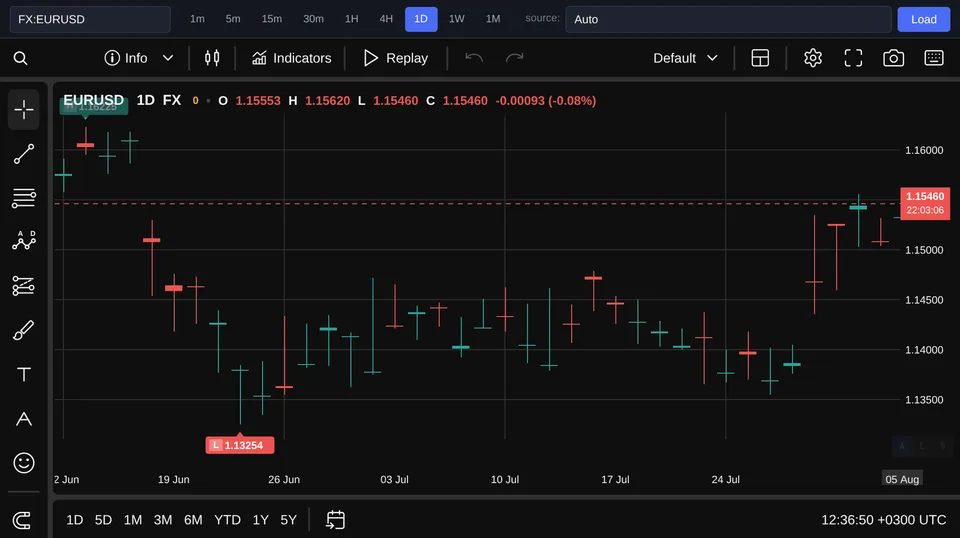
EUR/USD is using dollar weakness as its main source of support. At the time of writing, the pair is trading at 1.15 USD, the daily change is +0.12%, and this move looks small in size but noticeable in market sentiment. Buyers are again looking toward 1.1600, because this area has become the nearest test: whether the euro has room to run, or whether the market is simply removing part of the dollar premium. The rise in EUR/USD right now is primarily a story about the dollar, not about suddenly perfect Europe. This matters for risk assessment. When a pair rises because of weakness in the second currency, rather than because of a strong driver of its own, it needs external fuel: soft U.S. data, lower yields, or less hawkish Fed expectations. The 1.1600 area remains psychologically and technically visible, but the path to it requires confirmation from macro statistics. If the U.S. labor market shows cooling, EUR/USD may continue testing the upper part of the range; if the statistics turn yields upward, the pair will quickly remember that the last points before round levels are usually the most temperamental.
🇯🇵 USD/JPY: The Yen on an Intervention Leash
USD/JPY lives by a more nervous logic than EUR/USD. The pair is at 157.8 JPY, the daily change is +0.10%, meaning the yen is not showing confident strengthening even after joint signals from the U.S. and Japan about the need to stabilize the currency situation. These statements matter, because the market understands that officials are watching the exchange rate closely. But one look is not enough when the interest-rate gap continues to work against the yen. Verbal interventions can slow the move, but they do not replace real policy tightening by the Bank of Japan. That is exactly why dealers warn that without tougher action from the Japanese regulator, the yen's rebound may prove short-lived. As long as U.S. yields remain attractive relative to Japanese yields, traders keep an incentive to buy the dollar on dips. Official comments can trigger a sharp pullback in USD/JPY, but without continuation in the form of policy or direct action, the market may quickly return to its old logic. For USD/JPY now, not only general dollar weakness matters, but also confidence in the Japanese side. If the Bank of Japan gives clearer signals of readiness to raise rates or narrow the gap with the U.S., the yen will receive stronger support. If rhetoric remains the main tool, the pair may keep jerking on headlines without forming a sustainable reversal. This is the case where the market hears the warning, but still checks whether there is a real mechanism behind it.
📊 What Traders Should Watch Next
The nearest focus is U.S. labor market data and the reaction of yields. Weak employment will strengthen the argument for a less hawkish Fed, and therefore may support EUR/USD and keep pressure on the dollar. Strong figures, by contrast, will bring back the discussion about the resilience of the U.S. economy and may quickly cool the euro's attempt to settle closer to 1.1600. For EUR/USD, the main driver of the day is expectations for the dollar and U.S. rates. For USD/JPY, the list of triggers is wider. Here it is necessary to watch comments from Japanese authorities, Bank of Japan signals, the dynamics of U.S. Treasury yields, and signs of whether verbal pressure is turning into practical action. The pair at 157.8 JPY with a daily change of +0.10% shows that the market has not yet believed in sustainable yen strengthening. Therefore short-term moves may be sharp, but their quality will depend on whether Japan gets not only tone, but also an interest-rate base.
Conclusion
The day's bottom line is fairly direct: the dollar is under cautious pressure, and this helps EUR/USD hold near 1.15 USD with a daily rise of +0.12% and interest in the 1.1600 area. But USD/JPY remains a separate story: the pair stands at 157.8 JPY and adds +0.10%, showing that joint signals from the U.S. and Japan have not yet become a sufficient basis for sustainable yen strengthening. Next, the market needs confirmation: U.S. employment data, Fed rhetoric, Bank of Japan signals, and clarity on whether statements around the yen will remain a warning or turn into real action. Until then, moves in both pairs may remain dependent on headlines, yields, and a rapid repricing of expectations.