
Dollar at a Crossroads: Sanctions Support Meets US Fiscal Doubts

Intro

The dollar entered the day with two competing stories pulling in opposite directions. New US measures against Iran encouraged demand for defensive liquidity and settlement currency, while concerns about America’s debt trajectory continued to cloud the longer-term appeal of dollar assets. The result is less a clean rally than a selective repricing: the dollar is receiving support where immediate transaction risks matter, but the wider market still wants evidence before declaring a durable trend.
🛡️ Why sanctions can generate immediate dollar demand
Fresh restrictions involving Iran can raise demand for dollars even before their full commercial impact becomes visible. Banks, commodity traders and corporate counterparties may purchase USD in advance to secure liquidity, complete permitted settlements or reduce the risk that future compliance changes leave them short of the currency required for payments. This is partly a defensive response: when rules become less predictable, institutions tend to hold more of the asset that sits at the centre of global funding and invoicing. That mechanism does not require investors to become structurally optimistic about the US economy. It can emerge from operational necessity, tighter risk limits and a preference for immediately available liquidity. In other words, the first wave of buying may come from treasury desks and compliance-sensitive counterparties rather than from macro funds making a grand call on American exceptionalism. The sanctions story therefore offers the dollar credible short-term support, but it does not by itself establish a lasting bullish cycle.
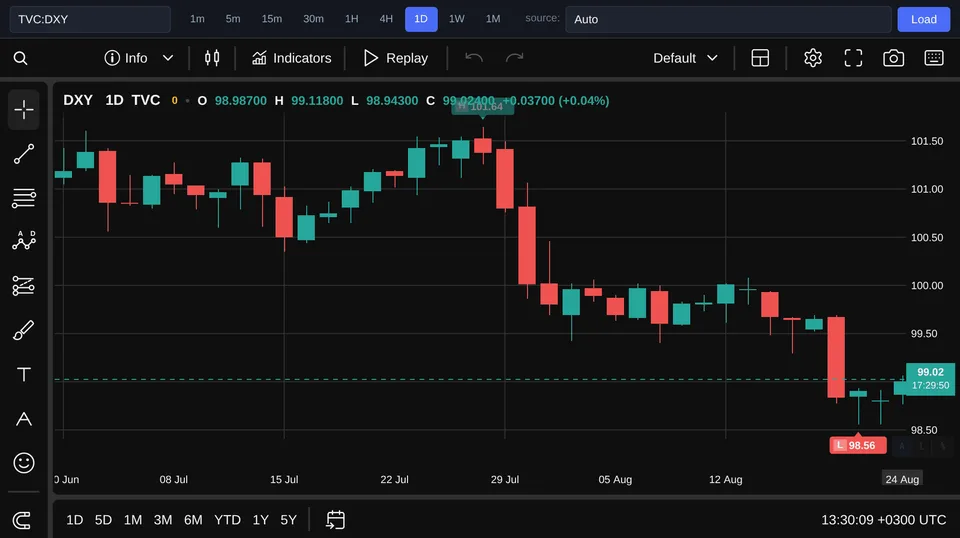
📊 DXY is flat, while USD/JPY tells a more active story
The market data underline how uneven the move remains. The US Dollar Index, TVC:DXY, stands at 99.00 USD with a daily change of +0.00%, showing that the dollar has not gained broadly against the basket used by the index. That neutral reading matters because a genuine market-wide rush into USD would normally be expected to lift several major crosses and produce visible progress in DXY, rather than merely generate headlines about a weekly high. USD/JPY presents a different picture: the pair is at 159.3 JPY and is up +0.25% for the day. This indicates clearer dollar strength against the yen, but it cannot automatically be treated as proof of universal USD demand because the pair also reflects Japan-specific yields, monetary-policy expectations and positioning. The dollar, for now, appears to have found one open window rather than acquired the keys to the entire building. The divergence between DXY at 99.00 and USD/JPY at 159.3 argues for a selective move, not yet a synchronized dollar breakout. Traders looking for confirmation should watch whether strength spreads beyond the yen pair and whether DXY can hold above recent levels instead of briefly touching them and retreating.
🏛️ US debt keeps the bullish case under supervision
The counterweight is the US fiscal outlook. A large debt burden and doubts about the future budget path can increase the term premium investors demand for holding longer-dated Treasuries, particularly if markets expect heavy issuance to persist. Higher yields can sometimes support the dollar by improving its nominal return, but that relationship becomes less reliable when yields rise because investors are demanding compensation for fiscal risk rather than responding to stronger growth. This distinction is central to the currency outlook. If Treasury yields rise alongside confidence in economic activity and controlled inflation, foreign demand for US assets may reinforce the dollar. If they rise because buyers question supply absorption, fiscal discipline or the stability of long-term purchasing power, the currency may receive little benefit and could even face diversification pressure. The bond market can therefore send the same numerical signal—higher yields—with two very different messages for USD. Fiscal anxiety also makes sanctions-driven rallies more fragile. Short-term demand may push the dollar higher, but investors with longer horizons must still decide whether the expected return compensates them for policy uncertainty and expanding sovereign financing needs. A sustainable USD advance requires supportive yields without a simultaneous deterioration in confidence toward US public finances.
🔄 Treasury buybacks are a signal to interpret, not a shortcut
Buybacks of longer-dated Treasuries add another layer to the analysis. Such operations can improve market functioning by allowing less liquid securities to be exchanged and by supporting liquidity across parts of the curve, but they should not be described as an automatic mechanism for weakening the dollar. Their currency effect depends on how investors interpret the operation, how it changes liquidity and term premiums, and whether it eases or intensifies concerns about the broader issuance programme. If buybacks reduce market frictions and reassure participants that the Treasury market can absorb supply smoothly, they may help preserve the appeal of dollar assets. If investors instead view them through the lens of mounting financing pressure, the operation may do little to calm fiscal concerns.
Conclusion
The day’s evidence supports a cautious interpretation. New measures against Iran can create real precautionary and transactional demand for dollars, yet DXY at 99.00 with +0.00% does not confirm a broad advance, even as USD/JPY reaches 159.3 JPY with a +0.25% daily gain. Until dollar strength expands across currencies and the long-term Treasury market shows that fiscal concerns remain contained, uneven and nervous trading is more likely than a stable one-way rally.