
Dollar Near Highs, Yen Under Pressure: Market Again Looks to the Fed and Bank of Japan

Introduction
The currency market today is again trading an old but workable combination: oil, geopolitical premium, and expectations for the Fed. The dollar is not flying vertically upward, but remains in a strong position, while the yen again looks as if the market is testing the patience of Japanese authorities for strength. The main intrigue of the day is not in one sharp move, but in why market participants are still in no hurry to reverse the dollar story.

💵 The Dollar Holds Its Altitude
The DXY dollar index at the time of writing is at 101.4 USD and shows a daily change of -0.06%. Formally, this is a small decline, but the context matters more than one figure: the daily DXY drawdown does not cancel the strong dollar backdrop. The dollar remains near three-week highs because the market continues to keep protection against uncertainty in portfolios. Support comes from several sides at once: a more nervous oil backdrop, a geopolitical premium, and the expectation that the Fed will not rush with dovish signals. This is not a case where the dollar is bought at a celebration of optimism; rather, it is kept nearby as a convenient umbrella when the weather forecast looks suspiciously gloomy. As long as investors do not see a convincing reason to sell the dollar aggressively, its pullbacks remain limited.
🛢️ Oil and Risk Again Help Defensive Currencies
Oil matters for the currency market not by itself, but through inflation expectations and central bank behavior. If energy becomes more expensive or the market prices in the risk of disruptions, the Fed has less room for overly relaxed rhetoric. For the dollar, this creates basic support, even if the intraday dynamics of DXY remain calm. Geopolitical uncertainty adds demand for liquid reserve assets, and the dollar traditionally ends up first on the list here. The market is buying not so much dollar growth as an option on safety and flexibility. Therefore, the DXY decline of -0.06% at 101.4 USD looks more like a pause near the upper boundary of the recent range than a full-fledged reversal in sentiment.

🏦 The Fed Remains the Main Filter for the Dollar Story
For traders, the key question is the same: how quickly the Fed is ready to move from caution to real easing. If the market decides that the US regulator will keep a tight stance for longer, yields in the US will remain relatively attractive. This helps the dollar against currencies where central banks look softer or policy normalization is moving more slowly. That is why the DXY move to 101.4 USD with a change of -0.06% cannot be read as an independent signal of weakness. A modest daily pullback is not equal to a trend break as long as rate expectations have not turned convincingly. Dollar sellers now need not just buyer fatigue, but a clear macro argument: cooling inflation risks, dovish Fed signals, or a noticeable decline in demand for defensive assets.

🇯🇵 The Yen Is Near a Zone of Multi-Year Weakness
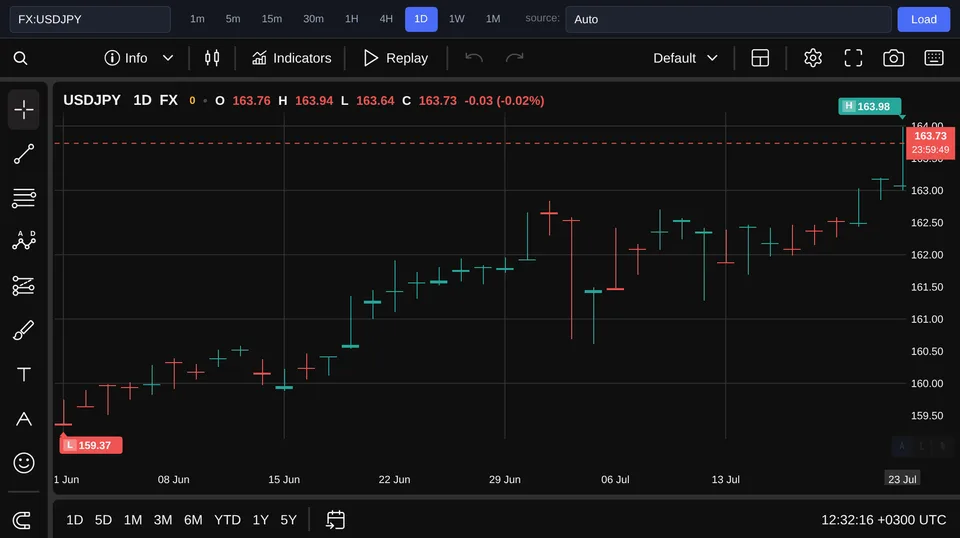
The USD/JPY pair is trading near 163.7 JPY and is adding +0.40% on the day, holding near extremely weak levels for the yen. Here the chart already stops being only a chart: USD/JPY remains a level where the market starts waiting not only for price, but also for the regulator's reaction. The higher the pair goes, the more closely traders watch the Bank of Japan and statements from financial authorities. The main reason for pressure on the yen remains clear: the difference in yields and the pace of monetary policy is still working against the Japanese currency. The Bank of Japan is normalizing policy carefully, while the dollar receives support from expectations of a more restrained Fed. At the same time, the very probability of verbal interventions, faster normalization, or coordination with the authorities may cool the market's desire to buy USD/JPY too aggressively. For traders, this is a zone of increased discipline. The potential for upward pressure remains, but the risk of sharp corrections on official comments becomes higher. The yen is now not only under a market spotlight, but also under a politically sensitive one, and such spotlights sometimes turn on suddenly and very brightly.
Conclusion
The day's bottom line is simple: the dollar maintains its advantage until the market sees a clear reversal in expectations for the Fed or a noticeable decline in demand for defensive assets. DXY at 101.4 USD with a daily change of -0.06% shows a pause, but does not cancel the strong backdrop. USD/JPY at 163.7 JPY and +0.40% confirms that the yen remains the most vulnerable element of the day's currency picture, although proximity to sensitive levels raises the risk of sharp moves on signals from Japan. Practical conclusion for a Forex trader: the rule must be tested on a demo account, written into the trading plan, and applied the same way before every trade. Practical conclusion for a Forex trader: the rule must be tested on a demo account, written into the trading plan, and applied the same way before every trade. Practical conclusion for a Forex trader: the rule must be tested on a demo account, written into the trading plan, and applied the same way before every trade.