
Dollar Ahead of NFP: Crossroads for USD/JPY and EUR/USD


Introduction
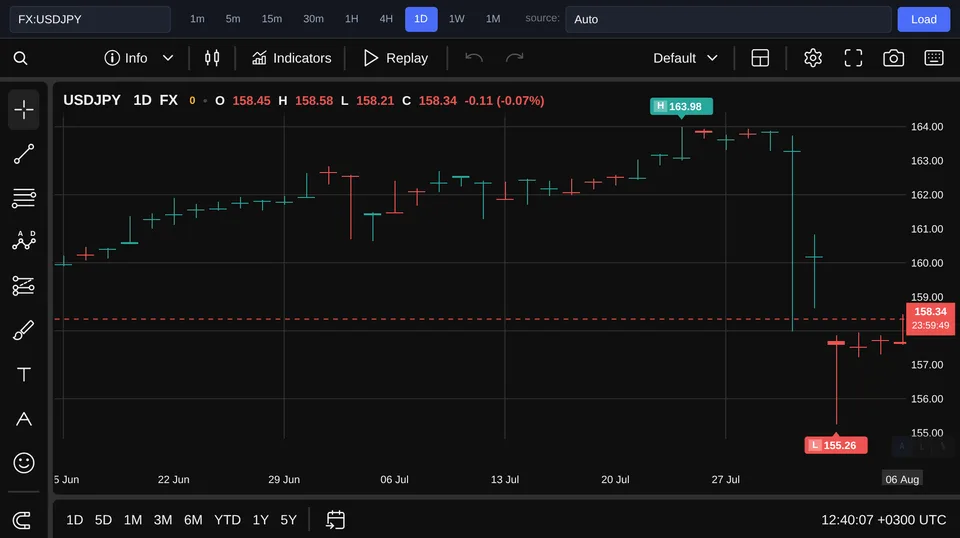
The currency market has entered its familiar pre-NFP waiting mode: prices are moving, but participants are in no hurry to turn cautious positions into big bets. The WSJ Dollar Index gained 0.24%, indicating moderate demand for the US currency, although this does not yet confirm the start of a sustained rally. USD/JPY rose to 158.3 JPY, while EUR/USD slipped toward 1.15 USD—for now, the dollar has the advantage. The main test will be the US employment report and its effect on expectations for the Federal Reserve's interest rate. At the same time, traders must consider the threat of currency intervention by Japan and technical resistance preventing the euro from extending its recovery. The market seems to be holding its breath, yet it still checks the price screen every few seconds.
📊 NFP Will Test the Dollar's Strength
The WSJ Dollar Index's 0.24% rise shows that capital is leaning moderately toward the dollar ahead of the data release. Nevertheless, the move looks more like cautious positioning than a confident bet in one direction. The key question is whether NFP will reinforce expectations that US rates will remain high for longer or bring anticipated Fed policy easing closer. A strong report usually supports US bond yields and the appeal of dollar assets, especially if employment and other components confirm the economy's resilience. Weak figures, by contrast, could strengthen expectations of a rate cut and reduce the dollar's interest-rate advantage. At the same time, the reaction depends not only on the headline number of new jobs: the market will assess the report's entire structure and its significance for the regulator's future decisions. The initial price impulse after the release may prove to be.
🇺🇸 Interest Rates Remain the Main Driver
Employment statistics affect currencies not by themselves, but through monetary policy forecasts. If the US economy remains strong, the Fed has more room to avoid rushing into easing, while higher yields on US instruments support demand for the dollar. If the labor market cools noticeably, the logic changes: the likelihood of looser policy increases, while the yield advantage narrows. This mechanism is important for both USD/JPY and EUR/USD, although each pair has its own risk factors. For the yen, the difference between US and Japanese rates is crucial, while the euro also depends on the comparative outlook for the US and European economies. The dollar's current strengthening will continue only if the data convincingly confirm the advantage of US rates. Existing positions should also be considered. Traders who bought the dollar in advance may take profits.
🇯🇵 USD/JPY: Yields Versus Intervention Risk
USD/JPY is trading at 158.3 JPY and is up 0.47% for the day. The pair's rise reflects expectations that the interest-rate gap between the US and Japan will remain wide or increase, preserving the appeal of dollar assets compared with the yen. If the threat of intervention weakens and the interest-rate differential widens, USD/JPY may once again try to continue moving higher. For now, this is merely a scenario discussed by currency desks, not a confirmed outcome. Warnings from Japanese authorities restrain one-sided dollar buying because possible intervention could trigger a sharp strengthening of the yen and painful position closures. Even without actual intervention, sufficiently firm statements may force participants to reduce leverage and cut the size of their bets. As a result, the pair is caught between two opposing forces. Yields support the dollar, while risk creates pressure.
🇪🇺 EUR/USD Still Has to Prove the Rebound Is Sustainable
EUR/USD is near 1.15 USD and is down 0.24% for the day, consistent with the overall picture of moderate dollar strengthening. Participants identify the 1.1560–1.1565 zone above the current price as the main technical reference point. Until the pair breaks through and consolidates above this area, the euro's recovery remains fragile. Merely touching resistance will not yet be a full-fledged signal. A rapid rise to the zone followed by a pullback will show that sellers retain control, while sustained trading above 1.1565 will strengthen the case for a more prolonged euro recovery. The current price of 1.15 USD and the 0.24% decline indicate that buyers have not yet seized the initiative. NFP could significantly change the probability of a breakout. A weak US report may lower expected US yields and help EUR/USD approach 1.1560–1.1565, while strong data could strengthen the dollar and push the pair farther away.
Conclusion
The dollar approaches the NFP release with a moderate advantage: the WSJ Dollar Index rose 0.24%, USD/JPY reached 158.3 JPY after gaining 0.47% for the day, and EUR/USD fell 0.24% to 1.15 USD. These figures capture the current direction but do not yet determine the next sustained trend. Three signals will matter after the report: changes in expectations for Fed policy, the persistence of Japan's intervention threat, and EUR/USD's reaction to resistance at 1.1560–1.1565. Until they appear, it is reasonable to consider the dollar's current strength, but not to assume that the market's preliminary positioning has already guaranteed the final move.