
Cryptocurrency Crosses - What They Are and How to Trade Them

If you come to trade on a crypto exchange, for example the popular Exmo, then instead of the pairs combined with USD that are familiar from forex brokers, you will see the so-called crypto crosses - pairs ETHBTC, LTCBTC, etc. Because in the crypto world Bitcoin acts as the dollar, the main currency. Today we will figure out how to analyze and trade such pairs.
What Is a Crypto Cross

Most often, the value of cryptocurrencies is determined through the dollar, which is convenient for comparing their relative value. Crosses, however, give a clear picture of the direct relationships between cryptocurrencies, allowing completely different profit strategies to be used.
The value of any currency is always relative. By buying a currency pair, you always buy one unit of one currency for a certain amount of another, which is determined by the exchange rate. For example, the BTCUSD rate determines how many dollars 1 bitcoin costs.
Cryptocurrencies are usually traded paired with the US dollar, the main reserve currency in today's settlement system. This makes it convenient to compare the relative value of different cryptocurrencies, having a single reference point for all of them.
A cross rate, in essence, is a currency pair that does not contain the dollar. By the direct conversion rate of two cryptocurrencies, one can determine the degree of their relationship, as well as the stronger and weaker currency in the pair.
Cryptocurrency Correlation
 Correlation calculation is one of the numerical methods for assessing the strength of the relationship between two price series. A strong relationship means that the currencies move in concert most of the time: with a positive correlation coefficient the instruments move in the same direction, with a negative one they move in opposite directions.
Since the ratio of the value of two correlated currencies hardly changes, the exchange rate of the currency pair (the cross rate) in such a case will move sideways. That is, when you see a cross rate that stays in a horizontal channel almost all the time, you are dealing with interconnected currencies.
For many altcoins and the cryptocurrency market as a whole, Bitcoin has been and remains the main point of reference, one could say, the benchmark of possibilities. As we know, money drives the market, and Bitcoin ranks first in capitalization among all cryptocurrencies, so it has every right to set trends.
Take, for example, Litecoin, which brought nothing new or revolutionary to the world of cryptocurrencies and earned its fame only thanks to its early appearance. In essence, it is a simple fork of Bitcoin with some improvements designed to correct the fundamental shortcomings of the blockchain. It turns out that in this pair Bitcoin is the clear leader (the leading currency). If Bitcoin rises, then Litecoin will rise as well.
Besides Litecoin, many currencies in the top ten by capitalization have a strong connection with Bitcoin. The same Ripple and Ethereum move in the same direction as Bitcoin and the “silver” cryptocurrency, in particular.
From the correlation chart (the lower window) it is clear that the relationship between LTC and BTC is positive almost all the time (greater than zero). It follows that the investor environment of Bitcoin and Litecoin largely overlaps - capital is being mutually redistributed between the currencies. If Litecoin lags behind its big brother, it will certainly try to catch up by picking up the Bitcoin trend.
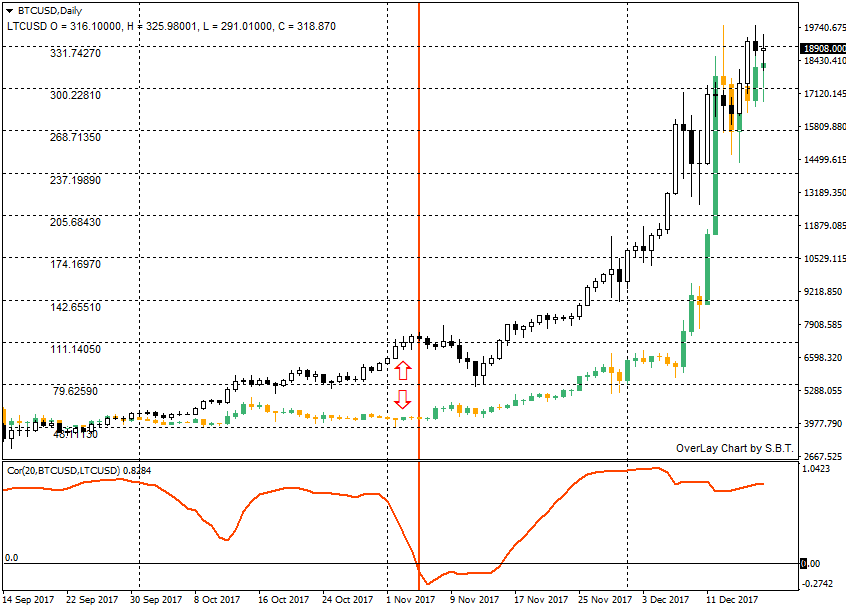 Knowing this, all that remains is to wait for the moment when the relationship between the two currencies is broken, that is, when the correlation coefficient begins to fall. On the chart it is visible how after another peak the correlation decreases. Bitcoin received upward momentum, but Litecoin has not reacted to this in any way yet - the spread of the two currencies is gradually widening.
The entry signal is the crossing of the zero mark, which means a complete absence of relationship according to the indicator reading. That's it, now LTCUSD is in the catching-up role, and the currency pair will have to make up for the missed upward trend. At this moment you can enter the market - buy LTC and sell BTC. That is, you need the LTCBTC cross. Because of the low price of the currency pair, you will also save on margin.
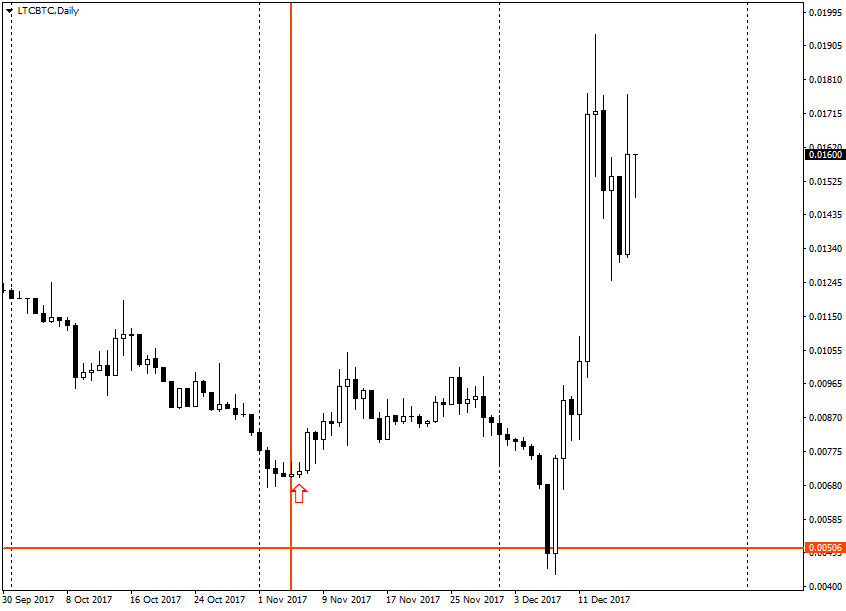 The cross rate is also useful because it helps determine possible obstacles to price movement that are invisible on dollar pairs. In this case, before finally turning around, the price decided to bounce off a long-term support level, which would have been difficult to identify on the separate pairs. Profit can be taken at the same levels on the cross rate, for example by stretching a Fibonacci grid from the previous significant move - we set profit at the 161.8% level.
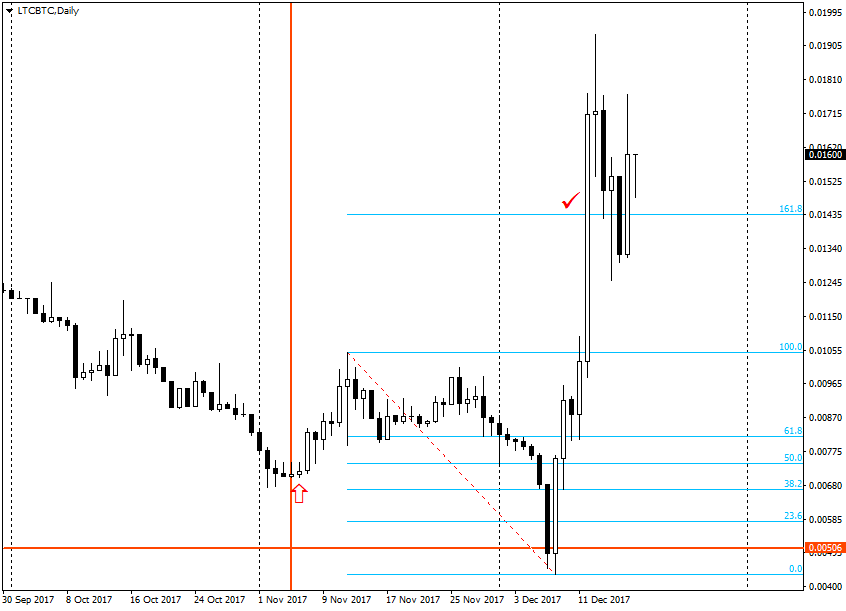 In this example we see that after the relationship is broken, the currencies can keep moving out of sync for some time. Also, when accounting for relationships, you need to consider the fundamental data on both projects. Cryptocurrency rates are driven by hype, so any significant event in their life can nullify all the careful analysis that was done. There is a convenient service for this coinradar.
Technical Analysis
 Certainly, news has a huge influence on cryptocurrency rates, however, fundamentals are an inexact science. Fundamental analysis helps determine the underlying trend, but for entering a trade directly it is better to use technical analysis.
On cryptocurrencies even the simplest chart analysis works - trend lines, horizontal key levels, and three-point reversal patterns. For example, to confirm a trend, a breakout of a horizontal level built from the previous price peak is enough. Of course, a breakout should be considered the closing of a candle beyond the level.
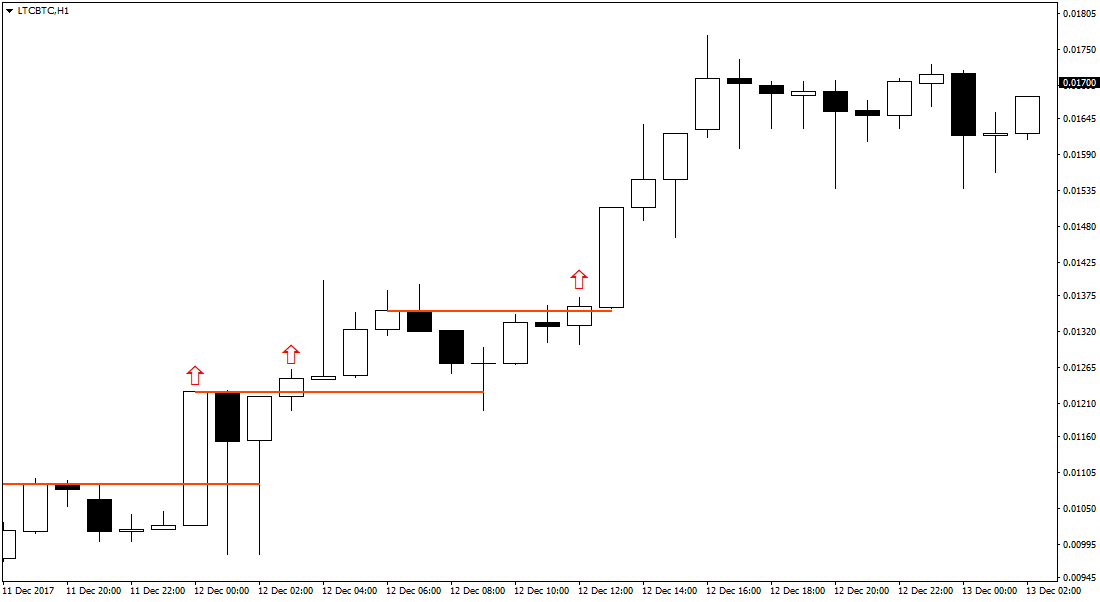 Cryptocurrencies are characterized by prolonged trends lasting two or three days in a row. Therefore, once you have caught a move, all that remains is to watch the further development of events.
A suitable moment to exit a trade can be determined by a decrease in volatility. For this, ATR or the width indicator of Bollinger Bands will do. The most reliable option is the presence of a divergence with some oscillator.
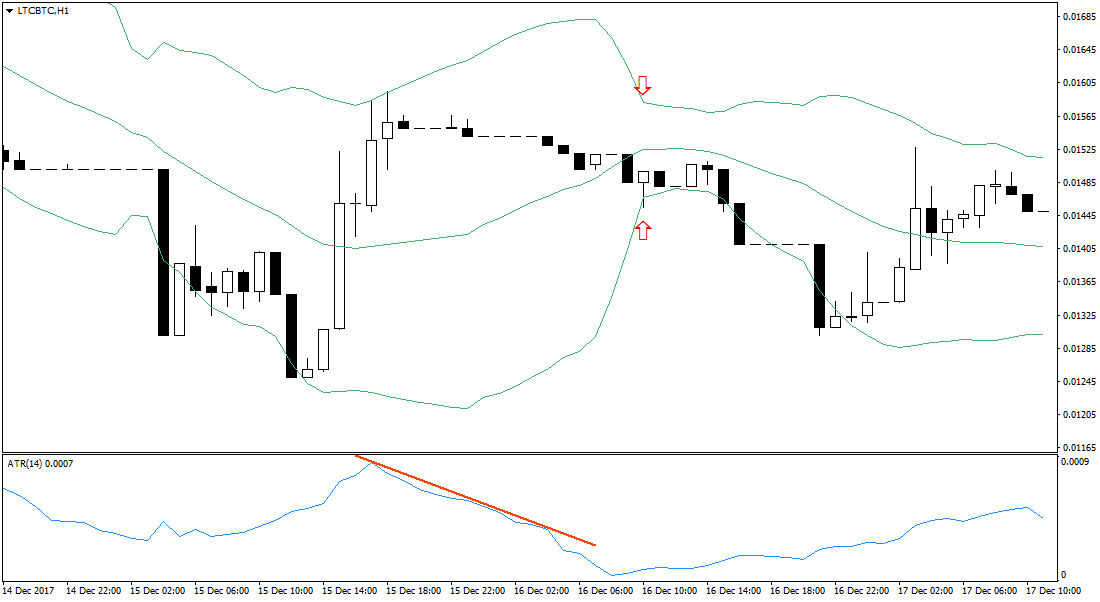 It is clear that as long as the impulse has not faded, volatility only keeps growing. As soon as the impulse fades, a correction begins and the price consolidates. As we know, when a pair starts moving sideways, two outcomes are possible next: either a continuation of the trend or a reversal. Therefore, when volatility starts to fade, it is better to lock in the current result and wait for the next signals. In this case, there is a divergence of price with the ATR indicator, pointing to a possible decline, which is a signal to exit long positions.
Direct Confrontation of Cryptocurrencies
 The exponential growth of the Bitcoin network led to a substantial degradation in transaction speed and the cost of overhead expenses. Today this is one of Bitcoin's main problems as a means of payment, and no unambiguous solution to the problem has yet been found.
A temporary solution, however, is to increase the block size, which would make the network more capable and reduce transaction costs. The solution has one serious drawback: it requires a hard fork, that is, a break in backward compatibility with the current version of the protocol.
Negotiations about Bitcoin's future led to a split in the community and the creation of a fork, Bitcoin Cash, where the block size was indeed increased from 1 to 8 megabytes. But as it turned out in reality, the story is much more complicated than it might have seemed, and resembles a cartel collusion by the largest ASIC miner manufacturer. The BCash pump ended back in November, peaking on the 12th, when the rate doubled in a day and then fell. Nevertheless, the currency has still not deflated and continues to grow.
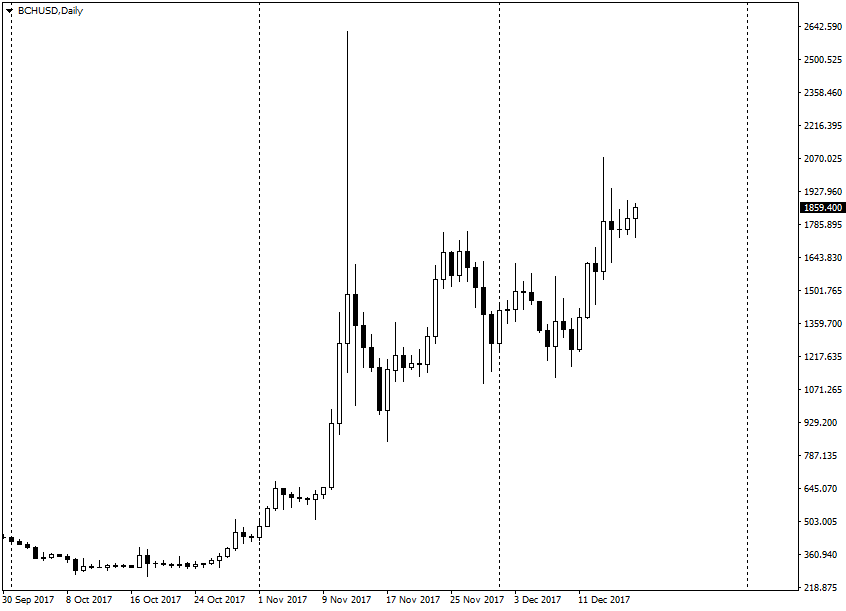 All this looks like a planned large-scale campaign to redistribute capital from Bitcoin into Bitcoin Cash, whose ultimate goal is to remove the original Bitcoin from the market. At the moment, Bitcoin Cash's capitalization has already reached 10% of Bitcoin's and continues to grow.
This story is an example of a direct confrontation between currencies, as a result of which new trend movements are created in cross rates. A similar situation now exists with the Ethereum and Ethereum Classic projects. There, in truth, the opposite situation occurred: as a result of the hard fork, the main project split off.
Conclusion
 Now, as the capitalization of cryptocurrencies is gradually catching up with traditional payment systems, trading crypto crosses is becoming more justified. The more capital is closed within the market, the more opportunities there are for arbitrage and, accordingly, opportunities to earn. By analyzing pairs and currency portfolios, one can find very interesting combinations and profit from analyzing the interrelationships of the closed cryptocurrency system.
Sincerely, Alexey Vergunov TradeLikeaPro.ru
