
Copper at a Record, Gold Holding Firm: Two Metals, Two Market Stories

Intro
Copper and gold are sending apparently conflicting signals. Copper has reached a historical high during a third consecutive rising session, while geopolitical escalation in the Middle East has not produced an equally dramatic move in the traditional defensive asset. Yet the latest supplied quote is important: gold (TVC:GOLD) stands at 4,436 USD, up 0.15% for the day. That does not confirm the earlier headline saying gold had fallen by more than 1%; the two figures most likely refer to different moments in the session or different market snapshots. Today’s market compass is pointing in two directions at once, but that is less contradictory than it looks.
🏭 Copper’s record is primarily a supply story
Copper’s new high is not simply a broad expression of optimism about the global economy. The stronger explanation is that traders are assigning a higher price to the risk of insufficient readily available supply, especially when inventories, mine output, refining capacity and delivery conditions cannot adjust quickly to changes in consumption. Because the metal is embedded in power grids, construction, transport, electronics and industrial equipment, even a modest mismatch between expected demand and accessible supply can have an outsized effect on price. A third consecutive rising session also introduces a momentum component. A record attracts trend-following capital, forces some bearish positions to close and can encourage buyers to secure material before prices climb further. Those flows may amplify the advance, but they do not automatically make the underlying constraint imaginary; futures positioning and physical tightness can reinforce one another for a time. The central message from copper is that the market is placing a premium on future availability. That signal should still be tested against warehouse stocks, treatment charges, production disruptions, import demand and physical-market premiums. A record price is evidence of intense competition for exposure or supply, not proof that every industrial sector is enjoying equally strong growth.
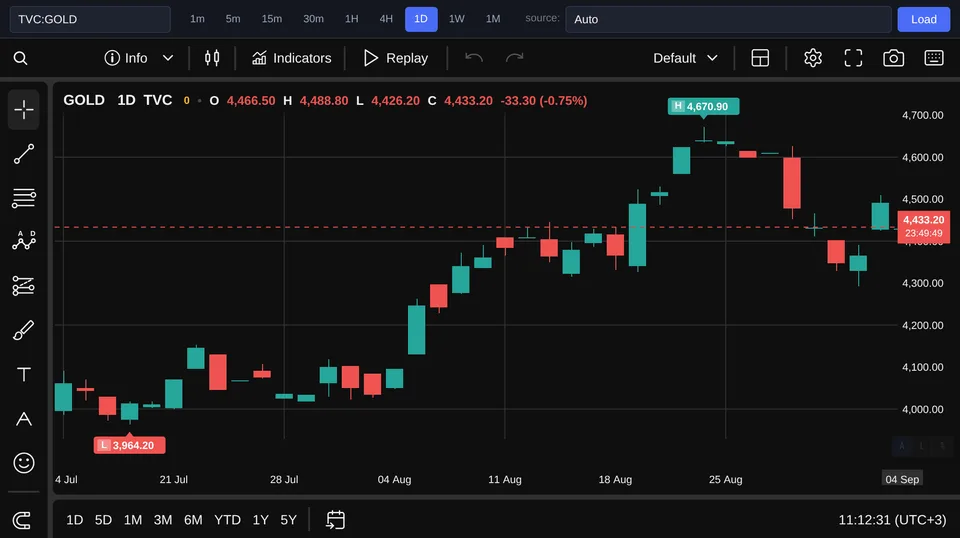
🛡️ Gold’s current quote changes the daily narrative
The claim that gold dropped by more than 1% may have accurately described an earlier phase of trading, but it cannot be presented as the current daily result alongside the supplied market data. At the time of writing, gold (TVC:GOLD) is quoted at 4,436 USD with a daily change of +0.15%. The responsible interpretation is therefore that gold recovered from, or moved beyond, the weaker snapshot rather than remaining under heavy pressure throughout the day. Gold’s restrained gain does not mean geopolitical risk has become irrelevant. The metal can receive safe-haven demand while simultaneously facing pressure from profit-taking after an earlier advance, changes in the dollar, moves in government-bond yields and shifting expectations for interest rates. When these forces offset one another, a serious geopolitical backdrop may produce stability instead of a vertical rally. This distinction matters for traders because headlines often freeze one moment of a fluid session. At 4,436 USD and +0.15%, gold is showing resilience, not the confirmed daily loss implied by the earlier headline. A nearly flat positive change can still conceal substantial intraday volatility, so the path taken by the price may be as informative as the closing percentage.
🇨🇳 China’s buying supports gold structurally, not minute by minute
China’s 22nd consecutive month of gold purchases strengthens the longer-term case for official-sector demand. Repeated buying can reduce the amount of metal available to other participants, diversify reserves and signal that gold continues to serve a strategic role outside the decisions of short-term speculative capital. It is an important floor beneath the broader investment thesis, particularly when reserve managers seek assets without conventional issuer credit risk. However, central-bank demand does not dictate every trading session. Official purchases can be gradual, anticipated by the market or too small relative to derivatives flows and currency moves to dominate the day’s price action. Meanwhile, leveraged traders react rapidly to yields, the dollar and changes in monetary-policy expectations, producing short-term moves that may appear inconsistent with the structural accumulation story. Twenty-two months of Chinese purchases are a source of persistent support, not a promise that gold must rise every day. The latest reading of 4,436 USD and +0.15% is compatible with that view: defensive demand appears intact, but it is being balanced by other macroeconomic and positioning forces. Separating the strategic buyer from the marginal daily trader prevents a useful long-term signal from becoming an unreliable short-term forecast.
📊 This is divergence, not a simple rotation
It is tempting to say investors have chosen copper instead of gold, but that framing gives one comparison more meaning than it can carry.
Conclusion
The day’s clearest conclusion is not that copper has defeated gold in a contest for investor attention. Copper’s historical high and third consecutive advance indicate that the market is assigning greater weight to physical scarcity and industrial demand, while gold at 4,436 USD and +0.15% indicates continued defensive support despite competing macroeconomic pressures. China’s 22-month buying streak reinforces the strategic foundation for gold but cannot determine a single session. The next phase of this divergence should be judged through copper inventories and real-economy demand on one side, and the dollar, bond yields and interest-rate expectations on the other.