
The Calm River Strategy — Scalping Without the Fuss

Hello, forex trader friends. Today we will talk about a strategy called "Calm River." This is a simple, clear, and calm scalping system designed to take small targets in short-duration trades. At the same time, it uses a certain "trick" to increase profit.
One of the features of the strategy is a not quite standard use of moving averages. As a rule, a crossover of moving averages is used to enter the market; here, however, they will appear in a somewhat different light.
System Characteristics
Platform: any Currency pairs: any Timeframe: M5 Trading time: European and American sessions Recommended brokers: Alpari, InstaForex, RoboForex
Main Idea

As is known, any indicators lag to some extent. But, instead of complaining about yet another market deception, we will try to turn this drawback to our advantage.
Since we know that moving averages lag, it means we can use the indicator as a smoother, less zigzagging representation of the trend, so to speak, a "calmness indicator."
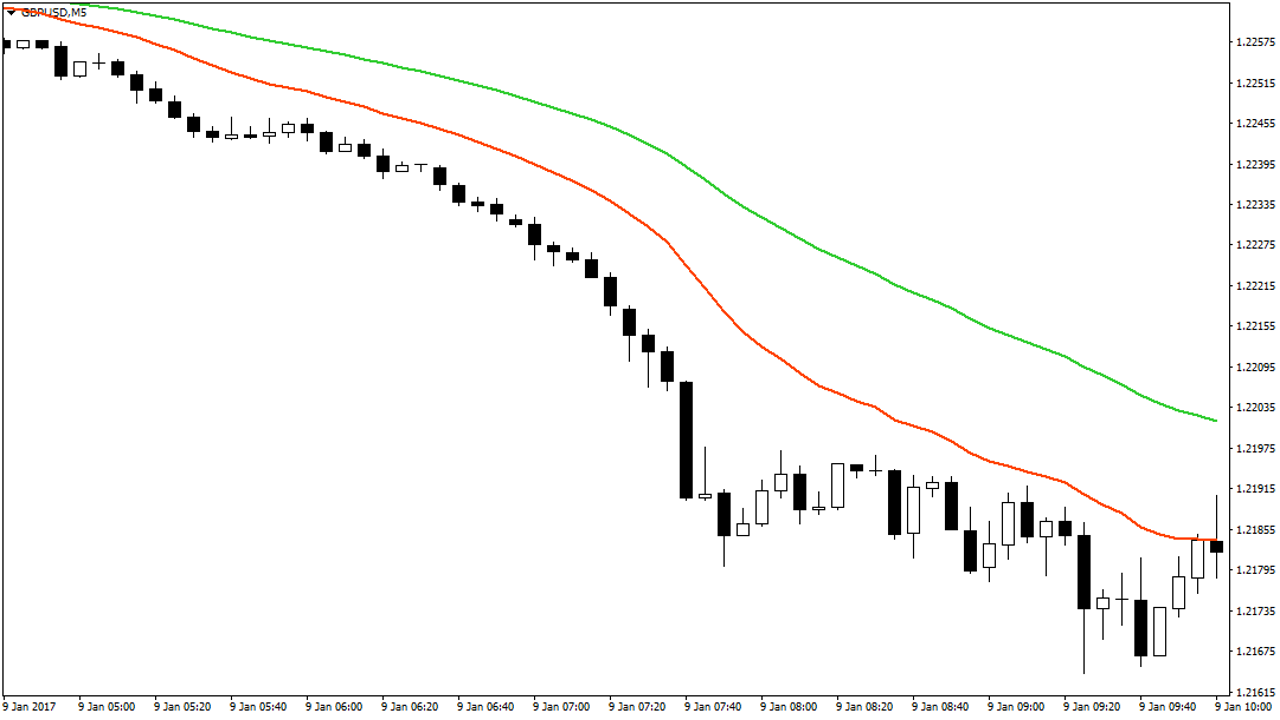
The strategy uses entries on a bounce from moving averages, but on condition that the trend is preserved. For this, it is necessary to distinguish two types of price "flow." For example, in this case, we are dealing with a calm flow resembling a riverbed. The moving averages practically do not cross and have a clear direction, in this case downward.
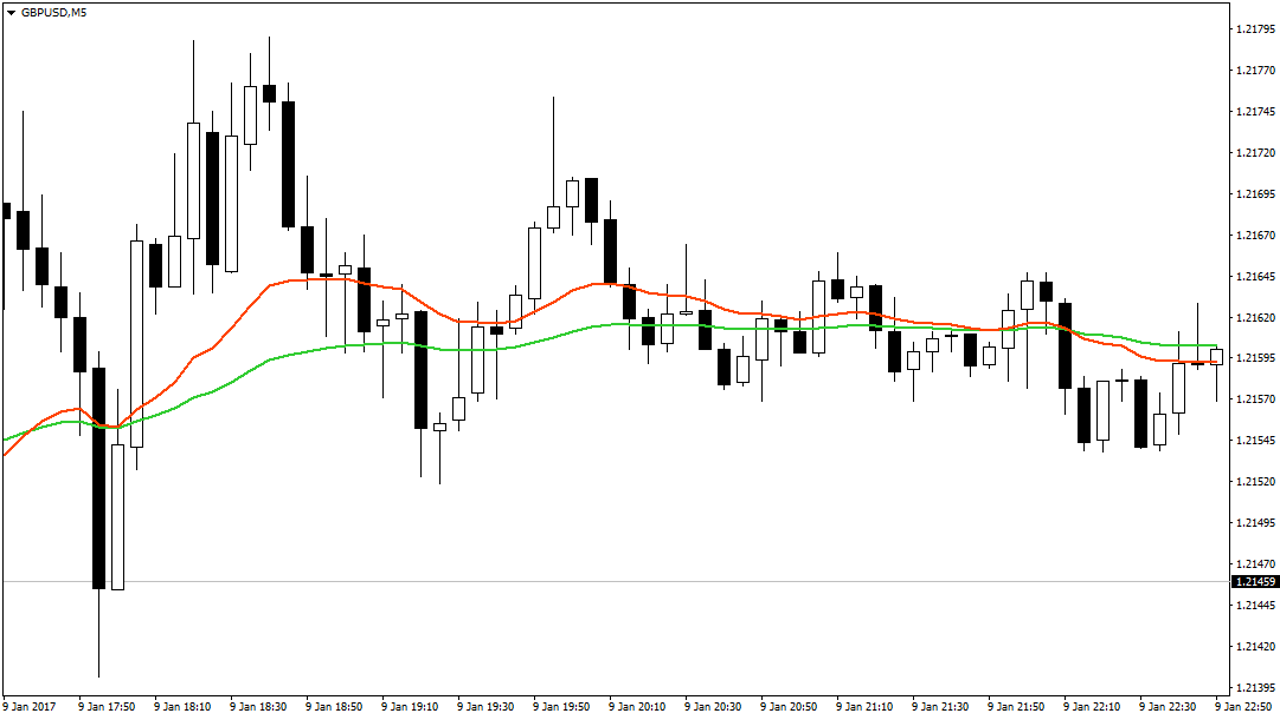
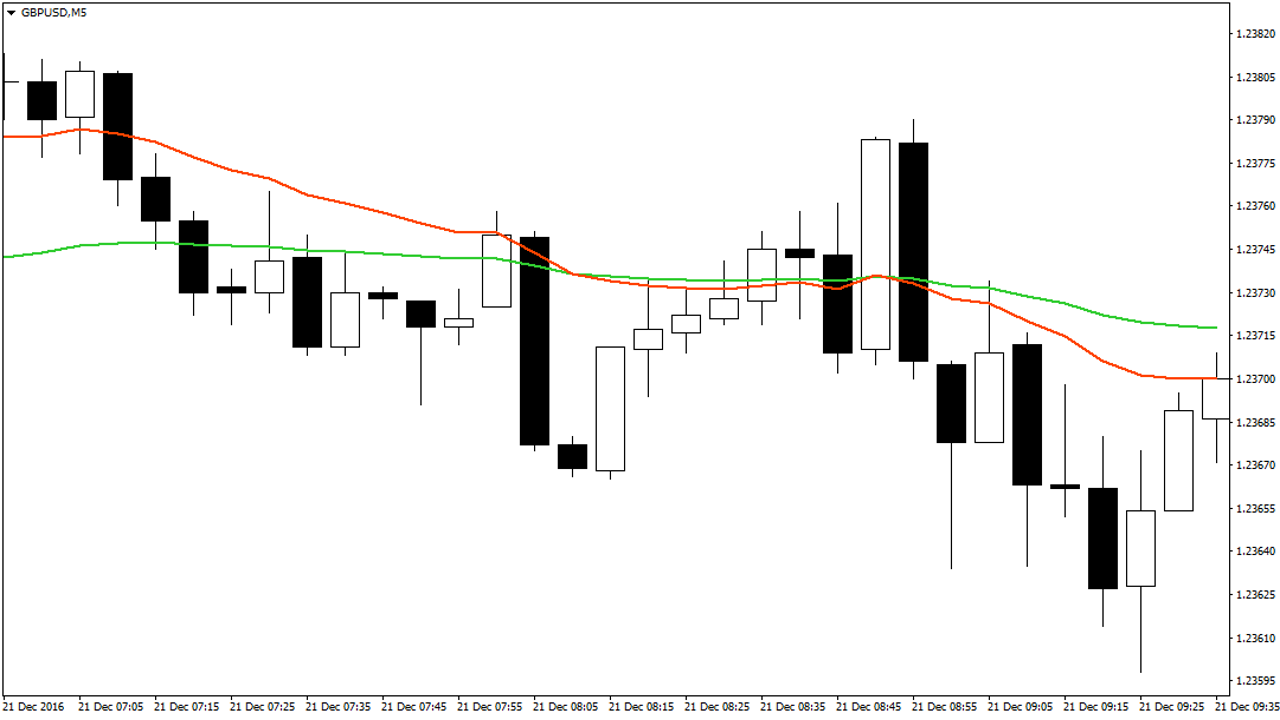
Further on, by contrast, an extremely restless river is shown. The averages cross all the time and have no clear direction. Thus, we can use the averages as a trend model of the market.
Strategy Rules

So, we will need a chart with the M5 timeframe and two exponential moving averages, with periods of 50 and 20.
Both averages must have a clear direction, downward or upward, and should not cross often. Visually, this should resemble some kind of river.
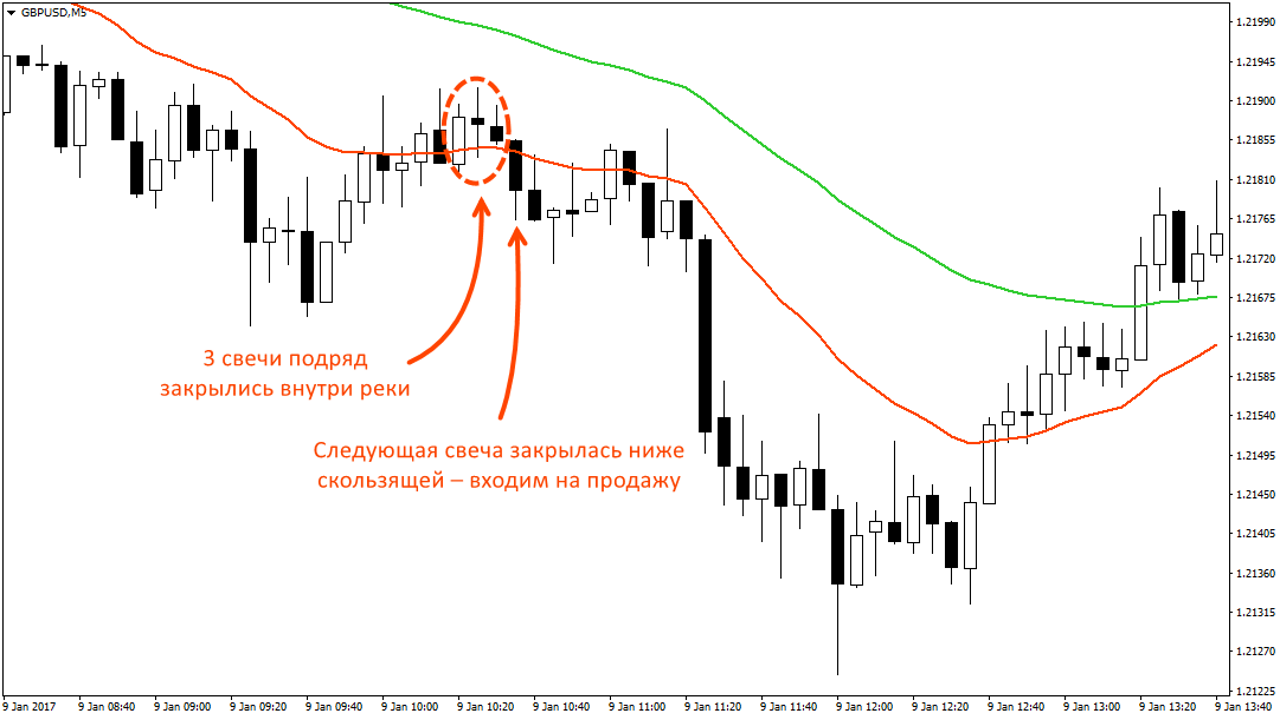
Next, we wait for a price correction to the 20 or 50 average. At the same time, the price should not stay for long in the riverbed. That is, there must not be more than 3 consecutive closes between the two averages, inside the "river." If there are 4 or more closes, we skip the entry. Here, for example, we have as many as 6 consecutive closes, so we do not consider such a trade.
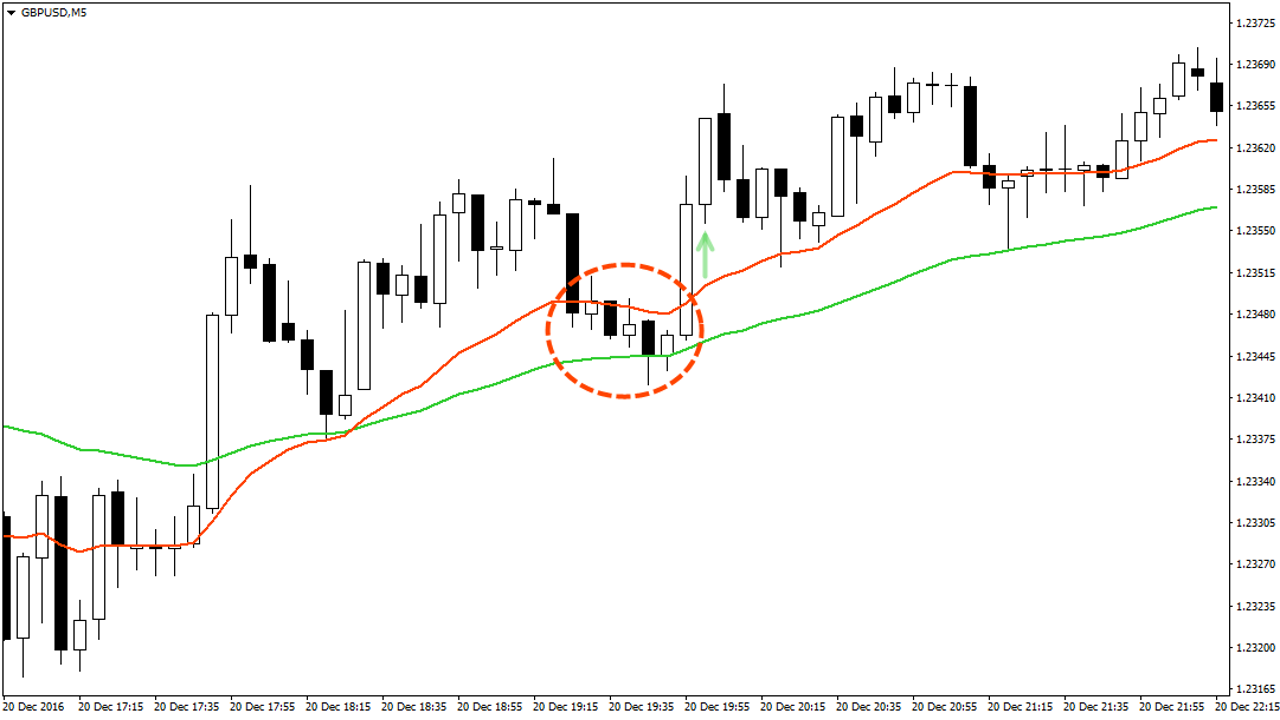
No later than after the third candle, the price must close beyond the 20 average. At the close of this candle, we enter the trade.
The stop loss is placed beyond the local extremum. We will close profit in two stages. To do this, you need to open two orders of equal volume at the same time, with the same stop loss. The take profit of the first order will be equal to the stop loss. The second order remains without a take profit. We will move the stop loss of the second order as new local extrema form.
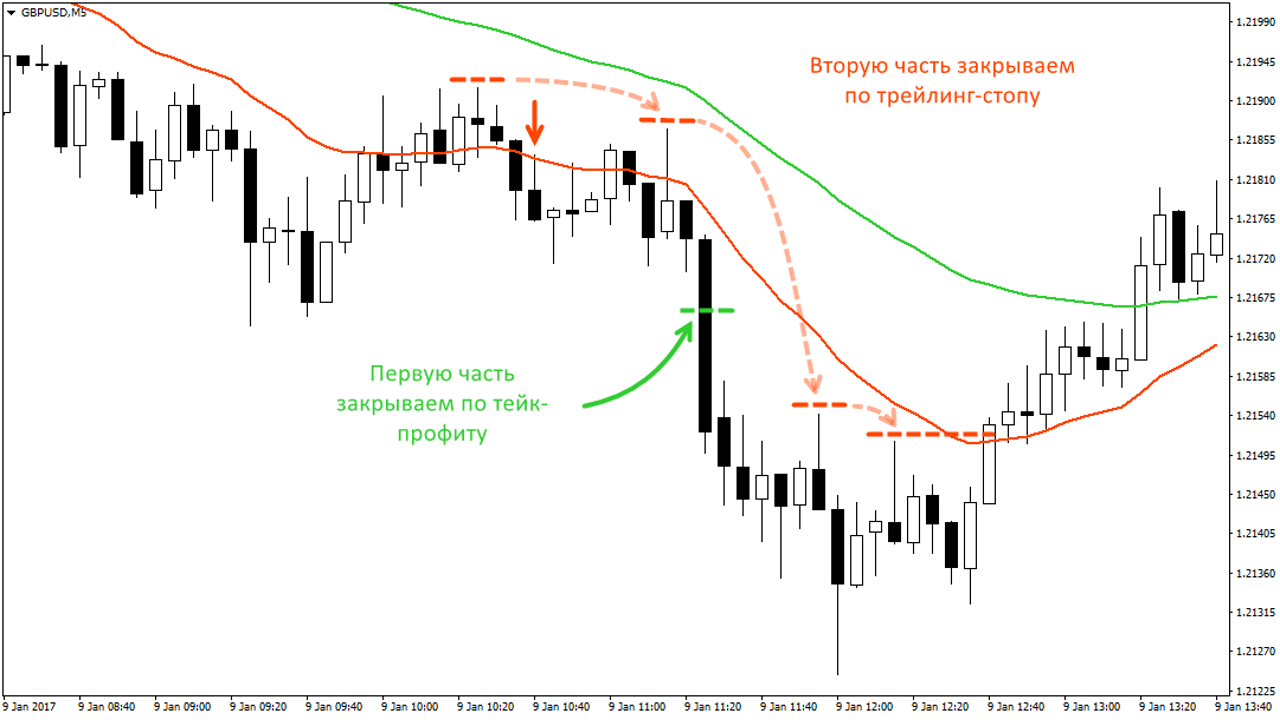
Thus, on the first order we get a small scalping profit. We leave the second order in the hope of capturing a large part of the trend, and sometimes this is quite justified, since one such profit can cover several losing trades at once.
Buy entry:
- Price is above the 20 EMA and 50 EMA.
- The 20 EMA is above the 50 EMA.
- Both averages are directed upward.
- The averages should not cross often. The 20 EMA above the 50 EMA forms a river.
- The price corrects and touches the 20 EMA or 50 EMA.
- The river does not let the price through. There are no more than 3 consecutive closed candles below the 20 EMA.
- The candle closes above the 20 EMA, a signal to enter.
Sell entry:
- Price is below the 20 EMA and 50 EMA.
- The 20 EMA is below the 50 EMA.
- Both averages are directed downward.
- The averages should not cross often. The 20 EMA below the 50 EMA forms a river.
- The price corrects and touches the 20 EMA or 50 EMA.
- The river does not let the price through. There are no more than 3 consecutive closed candles above the 20 EMA.
- The candle closes below the 20 EMA, a signal to enter.
An important rule: until a characteristic "river" has formed on the chart, it is not worth entering the market. For example, a candle crossed the moving average and, it would seem, you should enter a position. However, this is exactly the case when it is not worth entering the market. The averages are too close to each other and cross often, that is, there is an obvious flat.
Examples
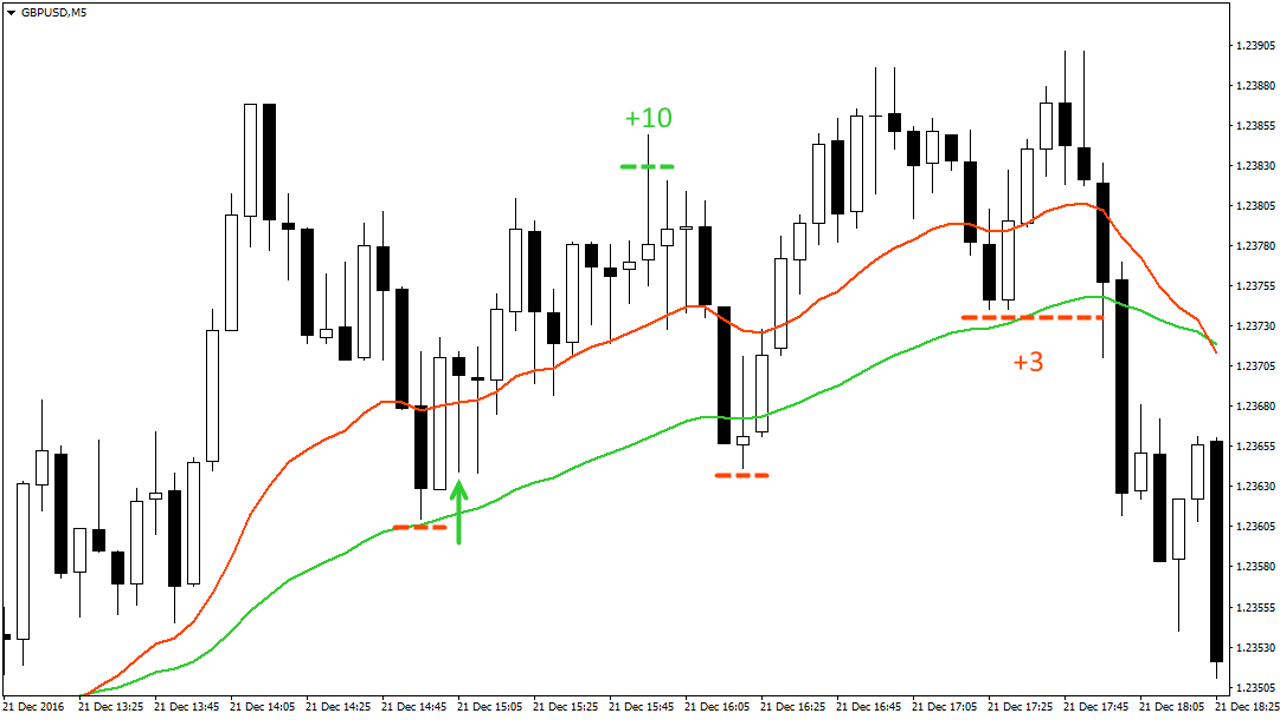
An example in an upward trend. The price closes below the 20 moving average and immediately bounces back, closing above the average on the next candle. At the close of the candle, we enter a buy. We set the stop loss behind the local minimum.
The first order closes at take profit for +10 points. We move the stop loss of the second order as soon as a new low forms slightly above the previous one. Here, unfortunately, the stop loss triggered too early, and the second order closed at +3 points, not counting the spread.
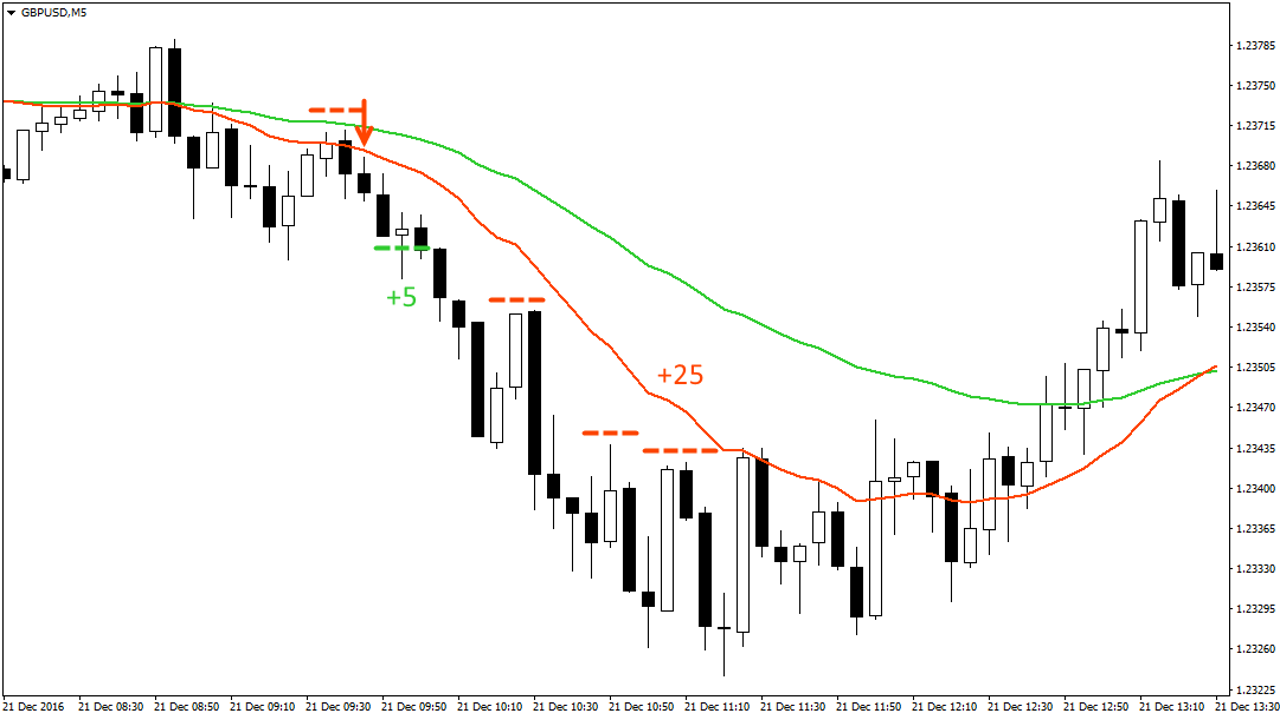
An example of a sell: the price bounced after the first closed candle inside the "river." In this case, the first take profit turned out to be quite small, about 5 points. But on the second order, we got a very decent profit of +25 points.
Money Management

Always keep the risks in mind. For this trading system, stick to 1-2% per position of your deposit size. The lot can be easily calculated using a special calculator.
Conclusion

The strategy is very simple. The main thing is not to forget that if the price stays above the 20-period average for a long time, that is, inside the "river," we do not enter a position. Maximum is 3 consecutive closes. Try to choose trending pairs, since the strategy itself is trend-based and flat instruments will perform worse. And, of course, do not be afraid to adjust the strategy to suit yourself, to add/remove something - this is a sign of a forex trader's development.
Forum Discussion
Respectfully, Pavel Vlasov TradeLikeaPro.ru
