
Bitcoin Waits on Rates While Zcash Rallies on a $500 Million ETF Catalyst

Intro
The crypto market is presenting two very different stories in the same session. Bitcoin has recovered from an early drop but still looks restrained by interest-rate expectations, while Zcash is enjoying a powerful asset-specific rally after a major milestone for Grayscale’s new ETF. The distinction matters because these moves do not share the same engine. Bitcoin is reflecting the market’s broad appetite for risk and the expected path of Federal Reserve policy; Zcash is responding to concentrated demand in a comparatively limited market. One is waiting for macroeconomic permission, while the other has already found a catalyst and is running with it—perhaps without stopping to tie its shoelaces.
₿ Bitcoin Recovers, but the Range Still Rules
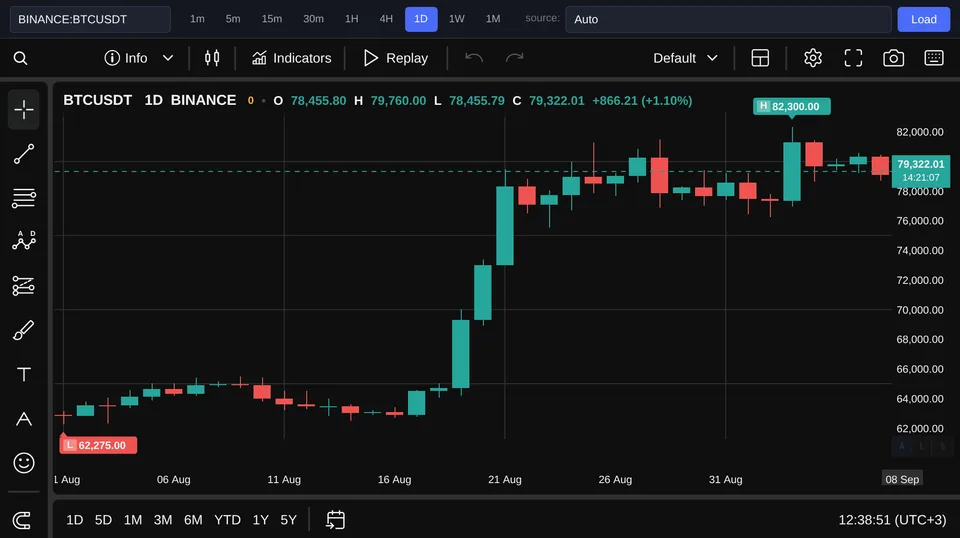
Bitcoin is trading at 79,375 on Binance, up 1.17% for the day, after buyers stepped in below $78,000. That recovery demonstrates that demand remains active near the lower half of the recent range, but it does not yet establish a new upward trend. The relevant structure is still the $77,200–$82,100 corridor, with sellers repeatedly becoming more assertive as price approaches its upper boundary. A return toward $80,000 may improve short-term sentiment, yet that round-number level is not the decisive technical signal. Bitcoin must absorb supply above it and hold beyond $82,100 before traders can treat the move as a credible upside breakout rather than another rotation inside the range. At 79,375, Bitcoin is recovering, but it remains in the middle of an unresolved contest between support near $77,200 and resistance around $82,100. The downside map is equally clear. A retreat from the upper part of the range would preserve the existing sideways structure, whereas a sustained break below $77,200 would weaken the recent rebound and reopen the risk of a deeper decline. Until either boundary gives way with follow-through, directional conviction should remain lower than the daily gain might suggest.
🏦 Federal Reserve Expectations Hold the Larger Key
Bitcoin’s range cannot be understood through chart levels alone because the market is trading expectations about US monetary policy. Softer rate expectations generally support cryptocurrencies by improving liquidity conditions and increasing investors’ willingness to own risk assets. A more restrictive rate path has the opposite effect: yields become more competitive, financial conditions remain tight, and speculative demand has less room to expand. This explains why buyers can defend a dip without immediately producing a breakout. Market participants may see value below $78,000 while still hesitating to chase Bitcoin near the top of its range before receiving a clearer policy signal. In practical terms, incoming information that changes the expected Federal Reserve trajectory can matter more than a brief move through $80,000. The bullish scenario requires both favorable macro expectations and technical acceptance above $82,100. If rate expectations turn more supportive but price cannot hold the breakout area, the market would be signaling that supply remains substantial. Conversely, a firmer policy outlook combined with a loss of $77,200 would align the macro and technical pressures on the downside, making that scenario more consequential than ordinary intraday noise.
🛡️ Zcash Gets a Concentrated ETF Demand Shock
Zcash is moving under a different set of conditions. ZECUSDT is trading at 1,242 on Binance, gaining 5.47% on the day, while its advance over the past week is approximately 43%.
⚖️ Two Rallies, Two Different Risk Frameworks
It would be a mistake to interpret Zcash’s performance as confirmation that the entire crypto market has entered a synchronized rally. Bitcoin is the broader macro barometer, and its 1.17% daily advance still sits within an established range. Zcash is benefiting from a specific institutional channel whose impact is unusually large relative to the asset’s available supply. The distinction leads to different trading questions. For Bitcoin, the priority is whether price can establish acceptance beyond $82,100 or instead lose $77,200 as Federal Reserve expectations evolve. For Zcash, the priority is whether ETF accumulation remains strong enough to offset profit-taking after the approximately 43% weekly surge. The market, in other words, is serving two dishes from the same kitchen, but the ingredients are not interchangeable. Bitcoin currently offers clearer reference levels but less immediate momentum, while Zcash offers stronger momentum with greater event and liquidity risk. Position sizing should reflect that asymmetry. Traders should avoid using Bitcoin’s relative stability to underestimate Zcash volatility, just as they should avoid treating Zcash’s ETF-driven strength as evidence that Bitcoin has already escaped its macro constraint.
Conclusion
The day’s market picture is defined by separation rather than broad agreement. Bitcoin, at 79,375 and up 1.17%, has recovered from its dip but still needs a sustained move above $82,100 to confirm an upside breakout; a loss of $77,200 would restore the bearish scenario. Its direction remains closely linked to changes in Federal Reserve rate expectations. Zcash, at 1,242 and up 5.47% for the day, has a more direct catalyst: a Grayscale ETF with more than $500 million in assets and holdings equal to about 3% of supply. That concentration of demand helps explain the approximately 43% weekly gain, but it also raises the importance of volatility, profit-taking, and disciplined exposure. Bitcoin remains the macro guide for the market, whereas Zcash is trading its own institutional catalyst; neither setup removes the need for strict risk management.