
Bitcoin Holds Near $63K as ETF Outflows Dilute the Fed Tailwind
Tlapchik

Intro

📊 A rebound, but not yet a reversal
Bitcoin was trading at $63,394 on BINANCE:BTCUSDT at the time of writing, up 0.79% for the day. Ether stood at $1,896 on BINANCE:ETHUSDT, gaining 1.08%. Those concrete advances show that buyers have regained some initiative, although neither move is strong enough on its own to establish a new upward trend. Holding the $63,000–$64,000 zone after the weekly decline points to local stabilization, not confirmation of a sustained recovery. A market can stop falling because sellers are temporarily exhausted, because short-term traders are buying the dip, or because longer-term demand is returning. The current price action does not yet clearly distinguish among those possibilities. The slightly stronger daily percentage move in Ether adds a constructive detail, but it should not be overinterpreted. Broad recoveries usually become more credible when demand expands across major assets and persists beyond a single session. For now, the market has found its footing; it has not demonstrated that it is ready to sprint, and sensible traders are unlikely to confuse standing upright with winning the race.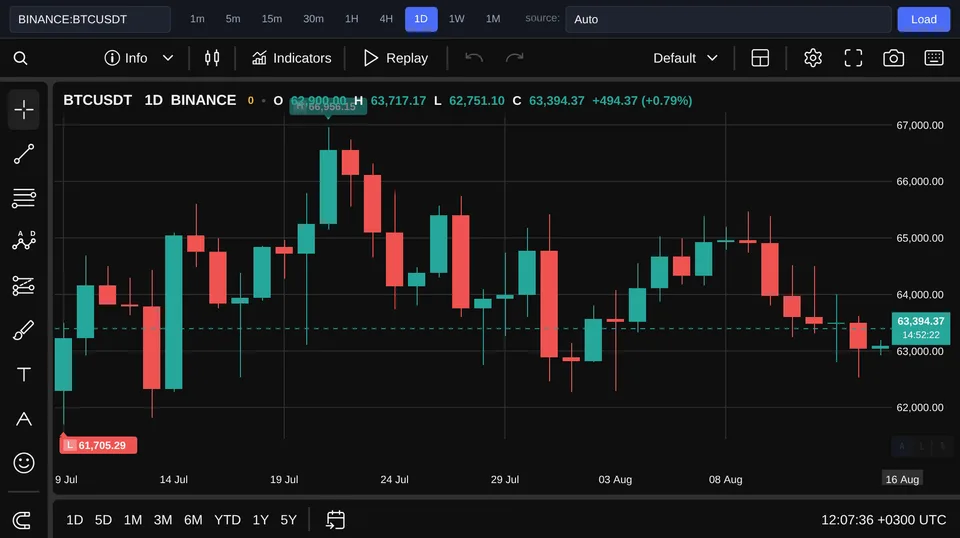
🏦 Softer Fed expectations meet stubborn capital flows
More accommodative expectations for Federal Reserve policy normally help Bitcoin by reducing the relative appeal of cash and defensive dollar assets. Lower expected rates can also improve liquidity conditions and encourage investors to accept more risk. That macroeconomic channel remains supportive, which helps explain why the market can absorb negative headlines without immediately losing the current price area. However, ETF outflows are weakening the transmission of that support into crypto prices. When exchange-traded products lose capital, the market receives a visible signal that institutional or allocation-driven demand is not yet strong enough to carry the advance. A favorable rate narrative can improve sentiment, but persistent buying is what converts sentiment into price momentum. This distinction matters because macro expectations and fund flows operate on different levels. The Fed outlook shapes the broad environment, while ETF flows reveal whether capital is actually entering a major access channel for Bitcoin. If those forces continue to point in opposite directions, rallies may remain hesitant and vulnerable to profit-taking rather than developing into a clean breakout.🧭 Regulation, retail demand, and the dollar remain obstacles
Regulatory delays add another layer of uncertainty because they postpone decisions that could influence market access, product development, and institutional participation. A delay is not automatically a negative final outcome, but it extends the period in which investors must price several possible outcomes. Markets can tolerate bad news surprisingly well; prolonged ambiguity is often the guest that refuses to notice the party is over. Weak retail participation is equally important.🎯 Prediction markets show mood, not certainty
Crypto-related prediction markets currently show a tilt toward higher prices for the day. That is useful as a snapshot of participant positioning and collective sentiment, especially when conventional market signals are mixed. It suggests that traders see enough short-term support to favor an advance rather than an immediate renewed decline. Still, prediction-market odds are neither a guarantee nor an independent fundamental catalyst. They can react to the same price movement, headlines, and positioning that influence spot and derivatives markets, so apparent agreement may partly reflect shared inputs rather than separate confirmation. Liquidity, participant composition, and changing information can also shift the balance quickly. The bullish tilt is best treated as a measure of expectations, not as proof that Bitcoin has escaped its recent weakness. It becomes more meaningful if price strength is accompanied by improving demand, easing ETF outflows, and a less threatening dollar backdrop. Without that confirmation, the signal describes what participants currently believe, while the market retains every right to be inconvenient.Conclusion
The short-term picture is neutral to moderately positive. Bitcoin at $63,394, up 0.79% for the day, and Ether at $1,896, up 1.08%, demonstrate a genuine daily recovery and show that the market is defending important nearby territory. They do not, however, provide sufficient evidence that the weekly decline has developed into a durable upward reversal. For the advance to become more convincing, ETF outflows need to ease, demand must broaden beyond short-term positioning, regulatory uncertainty should diminish, and the dollar environment must remain favorable. Softer Federal Reserve expectations provide a useful foundation, but they cannot substitute for capital entering the market. Until those conditions improve together, Bitcoin’s behavior near $63,000 is better understood as cautious stabilization than as the start of a confirmed breakout.#Bitcoin near $63K#Bitcoin ETF outflows#Federal Reserve rate expectations#BTC price outlook#Ether price today