
Bitcoin Holds $64k Amid Chip Selloff: Crypto Tests Old Correlations

Introduction
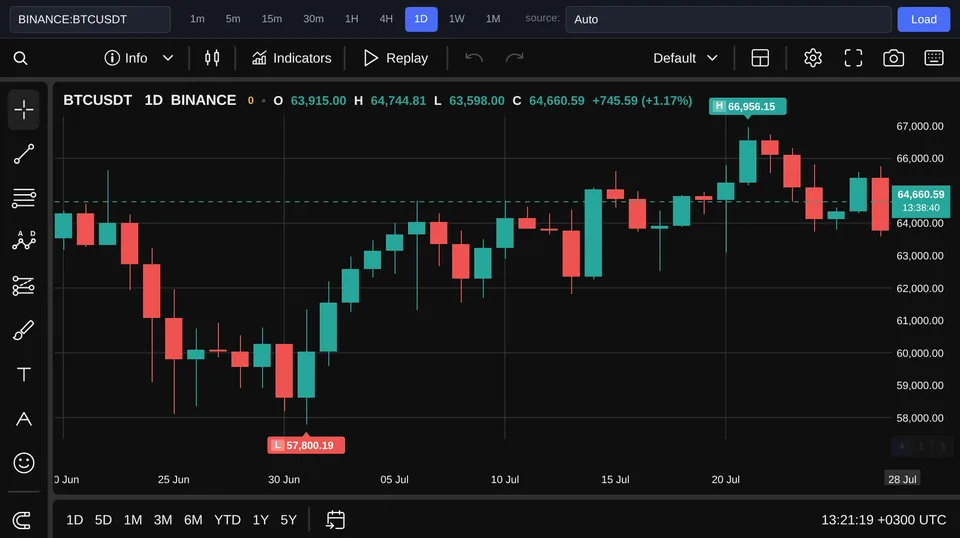
The day did not follow the classic risk-off pattern: chip stocks in Korea and the US slipped, while the crypto market did not march lower with them. At the time of writing, Bitcoin is holding near 64 650, adding +1.15% on the day, while Ether is around 1 921 and barely moving, showing -0.05%. This is an important split in asset behavior: the market is testing whether BTC has really become less dependent on sentiment around the AI trade, or is simply sitting calmly ahead of the day's main sound: the Fed decision.

🟠 Bitcoin Above $64k: Is Crypto Separating From the AI Selloff?
Bitcoin rose above $64 000 during Asian hours ahead of the Fed decision and is now holding near 64 650 with a daily gain of +1.15%. In a normally nervous market, such resilience would look especially suspicious: the chip sector is under pressure, some investors are taking profit in AI beneficiaries, and BTC is still in no rush to fall after them. The main point here is not that Bitcoin suddenly received a separate passport and left technology risk forever. Correlations in markets rarely disappear neatly and on schedule; more often they weaken, return, and again force traders to recalculate models. Bitcoin now looks less tied to AI risk-off than classic correlation models would expect, but for now this is an observation from one important day, not a new market rule. BTC's resilience may be explained by a mix of factors: liquidity expectations, positioning before the Fed, crypto-specific flows, and the fact that some players view Bitcoin not only as a high-beta asset to Nasdaq. While the price is above $64 000, buyers are showing control, but the final meaning of this move will become clear only after the reaction in bonds, the dollar, and equity futures.
⚙️ Chips Fall, Crypto Holds: Why It Matters
The selloff in Korean and American chip stocks shows part of the AI trade cooling down. Investors are reassessing the pace of demand, crowded positioning, and the risk that profit expectations have already been priced in too generously. Usually such an episode easily spills into other risk assets, especially those where leverage, momentum, and liquidity expectations play a large role. Against this backdrop, crypto's behavior looks noticeably calmer. BTC is at 64 650 and shows +1.15% on the day, while ETH at 1 921 with a -0.05% change does not confirm a panic selloff. The crypto market seems not to have received an invitation to the chip selloff, though it is still checking the mail, of course. For traders this is an important nuance, because the market may be shifting from one dominant story to several parallel drivers. This is not a cancellation of correlation, but a signal that crypto's drivers for the day have become broader than AI sentiment alone. If pressure in chips continues and Bitcoin holds above $64 000, the thesis of a temporary weakening of the link with AI risk-off will become more convincing.

🏦 The Fed Remains the Main Risk Arbiter
The Fed decision and the tone of the regulator's comments remain the main filter for the whole picture. Before the release, the market may look resilient, but one hawkish signal on rates can quickly lift yields and force risk assets to reprice. For Bitcoin, holding $64 000 looks constructive, but it does not create protection from a macro surprise. The main risk of the day is not chips by themselves, but a possible jump in yields after the Fed signal. If Treasury yields move higher and the dollar strengthens, it will be harder for the crypto market to keep its distance from the broader risk dynamic. In such a scenario, the old correlation with growth stocks may return quickly, without long warnings. Ether adds caution to the picture. At a price of 1 921 and a daily change of -0.05%, it does not look as strong as Bitcoin and does not yet confirm broad appetite for crypto risk. This makes BTC's rise interesting, but does not turn it into a full signal that the whole digital asset market has already moved into a confident buying mode.

📊 What Traders Should Watch Next
The first reference point is whether BTC can hold above $64 000 after the Fed decision, not only before it. Pre-event moves often reflect positioning rather than the market's final opinion. The real test will begin in the reaction of yields, the dollar, and equity futures. The second reference point is Ether's behavior relative to Bitcoin. If ETH, from its current base of 1 921, starts catching up with BTC, the picture will become broader and more constructive. If Ether stays around zero on the day or weaker than the market, Bitcoin's resilience may turn out to be a narrower story tied to BTC-specific flows. The third signal is whether the selloff in chips continues or the market finds local stabilization there. Confirmation of resilience will come not before the Fed decision, but after the first reaction in bonds and the dollar. If yields rise sharply and Bitcoin quickly gives back its daily gain of +1.15%, it will become clear that the old link among risk assets has not gone anywhere, but merely took a short pause.
Conclusion
Bitcoin at 64 650 and up +1.15% on the day looks stronger than the backdrop in the chip sector, but it is too early to speak of full independence from the AI trade. Ether at 1 921 and with a -0.05% change makes the picture less clear: broad crypto appetite is still uneven. The day's main intrigue is whether BTC will withstand the test after the Fed. A constructive scenario requires calm yields and a controlled dollar reaction; a hawkish signal from the regulator can quickly return crypto to the general flow of risk assets.