
Bitcoin Below $80,000: CPI and the Clarity Act Set the Week’s Risk Agenda

Intro
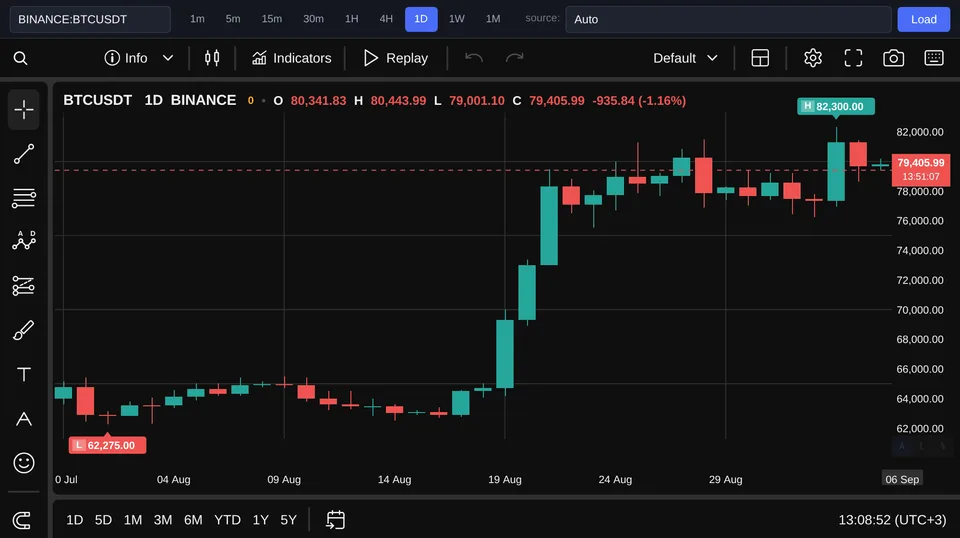
Bitcoin is beginning a catalyst-heavy week on the defensive. The leading cryptocurrency trades at $79,386, down 1.19% for the day, while Ether stands at $2,488 after a 1.07% decline. The immediate pressure came from a stronger employment report, but the next move may depend less on the rear-view mirror and more on two scheduled events: US consumer inflation data on September 11 and a procedural vote on the Clarity Act on September 15. Together, these events cover the two risks that matter most for crypto right now: the price of money and the rules of the market. Neither guarantees a directional move, yet each can materially alter investor positioning. In other words, Bitcoin has two doors to watch this week, and the market is politely pretending that it will not sprint through whichever one opens first.
📉 Below $80,000: What the Pullback Is Signaling
Bitcoin’s retreat below the psychologically important $80,000 level followed an employment report strong enough to complicate expectations for Federal Reserve easing. Robust labor conditions can give policymakers more room to keep interest rates restrictive, particularly if inflation remains uncomfortable. That raises the relative appeal of cash and short-term bonds while making non-yielding, high-volatility assets more demanding to hold. The supplied market snapshot shows a broad but orderly reduction in crypto risk rather than an isolated Bitcoin event. BTC is at $79,386 with a daily change of -1.19%, and ETH is at $2,488 with a daily change of -1.07%. Their similar declines suggest that traders are responding to a common macro factor, although Bitcoin’s move below a prominent round-number threshold naturally attracts more attention. The pullback is best read as a repricing of interest-rate expectations, not proof that the broader crypto thesis has broken. Still, remaining below $80,000 may keep short-term sentiment cautious because failed recovery attempts can encourage tactical sellers and reduce the urgency among buyers. Until one of the week’s catalysts provides clearer information, positioning may matter more than confident long-range forecasts.
🌡️ September 11 CPI: The First Test for Rate Expectations
The CPI report is the week’s first major decision point because it can either reinforce or challenge the message from employment data. A softer inflation reading would give markets room to revive expectations that the Federal Reserve can become less restrictive without reigniting price pressures. That combination could ease Treasury yields, restrain the dollar and improve the relative appeal of Bitcoin and other risk-sensitive assets. Persistent or hotter inflation would create the opposite setup. If traders conclude that policy rates must stay elevated for longer, financial conditions could tighten through higher yields or a stronger dollar. Crypto would then face both a higher opportunity cost and less abundant demand for speculative exposure, leaving Bitcoin vulnerable while it remains under $80,000. The details may be as important as the headline. Investors will look for evidence that inflation is cooling across categories rather than relying on a temporary contribution from one component. A CPI result that genuinely softens the expected path of Federal Reserve policy would be more supportive for crypto than a superficially benign number with stubborn underlying pressure. The market reaction will also depend on prior positioning. If traders have already reduced risk aggressively, even a moderately favorable report could trigger a sharp recovery as hedges are unwound. If expectations have become too relaxed before publication, a small upside surprise could produce an outsized negative response.
🏛️ September 15: What the Clarity Act Vote Can—and Cannot—Do
The second catalyst is regulatory rather than macroeconomic. A procedural vote on the Clarity Act could indicate whether lawmakers are prepared to advance a framework that gives digital assets clearer treatment and strengthens the role of commodity-style oversight. For investors, the attraction is not a fashionable label; it is the possibility of reducing uncertainty over jurisdiction, compliance and the conditions under which market infrastructure can operate. Lower regulatory uncertainty can reduce the risk premium demanded by institutions considering crypto exposure. Clearer boundaries may help exchanges, custodians and issuers plan investment with greater confidence, while investors gain a more stable basis for evaluating legal and operational risks. Meaningful progress toward commodity-style treatment could therefore support crypto valuations by improving market confidence, even before the framework changes day-to-day trading. However, a procedural advance is not final enactment. The text may still face amendments, further votes and implementation questions, so traders should distinguish a favorable signal from a completed legal transformation.
🧭 Scenario Map: How the Two Catalysts May Interact
The clearest constructive scenario combines softer.
Conclusion
Bitcoin’s position at $79,386, down 1.19% for the day, reflects a market reassessing the prospect of easier monetary policy after strong employment data. Ether’s price of $2,488 and 1.07% daily decline confirm that the caution extends beyond a single asset. The September 11 CPI release will test whether inflation permits expectations of less restrictive Federal Reserve policy, while the September 15 Clarity Act vote will test whether regulatory uncertainty can begin to decline. The most supportive outcome would combine convincing inflation relief with credible legislative progress. Persistent inflation or a procedural setback would keep the risk balance cautious, particularly while Bitcoin remains below $80,000.