
Bitcoin After the Surge: ETF Demand Holds the Market, but Leverage Adds Risk

Introduction
After its recent surge, the crypto market has moved from a mode of cheerful acceleration into a mode of checking the fasteners. Buyers are still nearby, but now the market is looking not only at the attractive previous candle, but at whether real demand can absorb profit-taking. Bitcoin looks lively, but it is better not to unfasten the seat belt yet.

🟠 Bitcoin: ETFs Keep the Bullish Scenario Alive
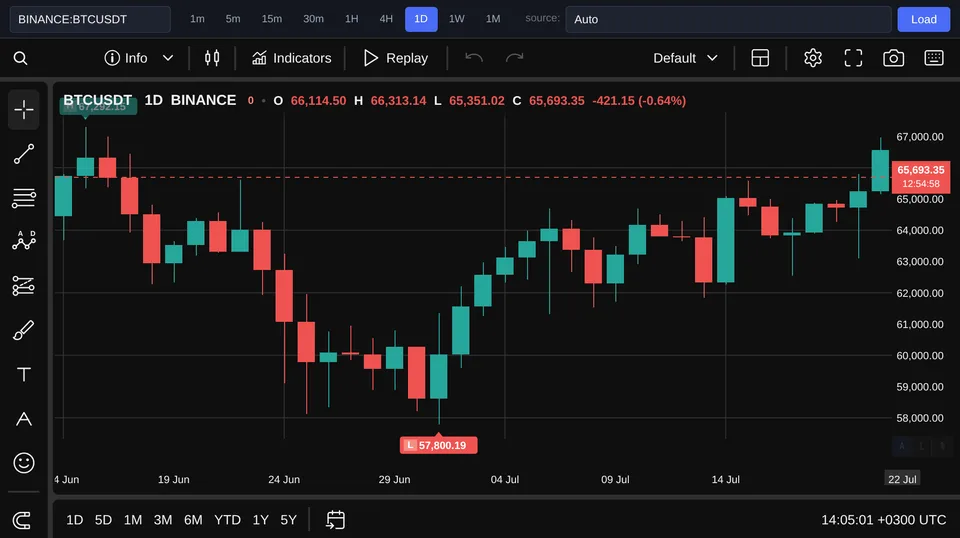
Bitcoin on BINANCE:BTCUSDT is trading near 65 743, showing a daily change of -0.56%. This decline is noticeable intraday, but by itself it still looks more like a pause after a surge than a confident reversal of the trend downward. The key factor now is flows into spot ETFs and the behavior of institutional demand. The bullish scenario remains in place as long as ETF inflows and institutional demand offset profit-taking, because in that case drawdowns become a liquidity test rather than a signal of buyer capitulation. At the same time, after a strong move the market becomes more demanding about the quality of demand. It is one thing when growth is supported by spot buying, and quite another when it is driven by short-term leverage, which starts nervously looking for the exit at the first shakeout.
📊 Ether: Moderate Cooling Without Panic
Ether on BINANCE:ETHUSDT is near 1 928, with a daily change of -0.31%. This move confirms the market’s general tone: major crypto assets are cooling slightly, but there are still no signs of a panicked exit from risk. For assessing sentiment, ETH is important as an indicator of the breadth of the move. If Bitcoin declines while Ether falls moderately, the market more often looks like a profit-taking zone rather than a full risk reset across the sector. The synchronized mild drawdown in BTC and ETH still supports the scenario of controlled consolidation. But if Ether starts to lag noticeably and the decline accelerates, that would already be a more worrying signal for the entire crypto market.

⚙️ Open Interest: Where the Risk Is Hiding
After a sharp move upward, open interest becomes an especially important indicator. It shows how actively participants have built positions in derivatives and helps identify where the market may become vulnerable to forced trade closures. Growth in open interest is not a bearish signal by itself: it can reflect an inflow of new money and trader participation in the trend. But if too many players are sitting in identical leveraged longs, support turns into a thin line beyond which stops and liquidations may be triggered. The main risk of the day is not the BTC decline of -0.56% itself, but a possible chain liquidation of longs if the price fails to hold the nearest support. In that situation, the downward move may accelerate not because of a fundamental deterioration in the picture, but because of market mechanics, where liquidations generate new selling.

🧭 What Traders Should Watch Next
To confirm strength, Bitcoin needs to hold the nearest support and maintain positive dynamics in spot ETFs. If that happens, the move toward 65 743 with a daily change of -0.56% can be interpreted as a normal unloading after the impulse. The worrying scenario looks different: the price accelerates lower, open interest remains inflated, and signs of long liquidations become more visible. If the market falls faster while leverage does not leave, the risk of a cascading move rises sharply. For new longs, this means simple discipline: do not chase a surge that has already happened and do not replace a trading plan with emotion. A strong market can continue, but after an impulse, the entry price, position size, and proximity of support become more important than the day’s attractive headline.
Conclusion
The day’s result is cautiously constructive: Bitcoin preserves its bullish structure if ETF demand continues to absorb profit-taking and support the spot market. But after the surge, sensitivity to leverage has increased, so open interest, the holding of support, and signs of liquidations are now more important than short-term noise. For a trader, the takeaway is practical: the growth scenario has not been canceled, but new positions require discipline, clear risk, and confirmation of demand. Practical takeaway for a Forex trader: the rule should be tested on a demo account, written into the trading plan, and applied consistently before every trade. Practical takeaway for a Forex trader: the rule should be tested on a demo account, written into the trading plan, and applied consistently before every trade. Practical takeaway for a Forex trader: the rule should be tested on a demo account, written into the trading plan, and applied consistently before every trade. Practical takeaway for a Forex trader: the rule should be tested on a demo account, written into the trading plan, and applied consistently before every trade. Practical takeaway for a Forex trader: the rule should be tested on a demo account, written into the trading plan, and applied consistently before every trade. Practical takeaway for a Forex trader: the rule should be tested on a demo account, written into the trading plan, and applied consistently before every trade.