
Bitcoin Above $77,000: The Macro Tailwind Meets the $80,000 Test

Intro

After a sharp weekly advance, the cryptocurrency market has entered a less spectacular but more revealing phase: it must prove that the new price range can hold. Bitcoin is no longer simply racing upward; it is absorbing profit-taking while traders decide whether supportive macroeconomic and regulatory narratives are strong enough to justify another leg higher. The market has therefore shifted from chasing momentum to examining its foundations, which is usually where the tidy story meets the untidy order book.
📊 Bitcoin Holds the Line, but Buyers Have More Work to Do
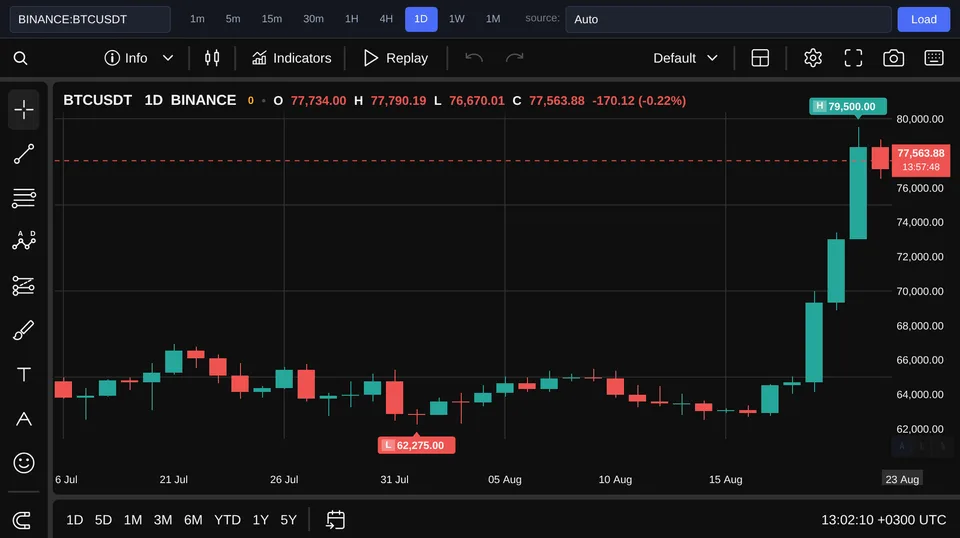
At the time of writing, Bitcoin trades at $77,542, down 0.25% for the day. That modest decline does not invalidate the recent bullish structure because BTC remains above the psychologically and technically important $77,000 area after its strong weekly move. It does, however, show that buyers are encountering supply rather than advancing through an empty market. Resistance near $78,500 is the immediate test. Repeated failures there would suggest that short-term traders are taking profits and that new demand is not yet aggressive enough to force a breakout. Conversely, a sustained move above that zone would turn former resistance into a potential platform for an attempt at $80,000. The distinction between briefly crossing a level and holding above it matters. A quick spike can be produced by liquidations or thin liquidity, whereas consolidation above resistance usually indicates that spot buyers are willing to accept higher prices. For the bullish case, the quality of the breakout will be more informative than the headline number alone.
💵 Liquidity Expectations and the Softer-Dollar Narrative
One pillar of the long-position narrative is the expectation that US Treasury buybacks could improve market functioning and influence liquidity conditions. Buybacks do not mechanically send capital into Bitcoin, and they should not be treated as a crypto stimulus button. Their relevance is indirect: if they ease strains in funding markets or contribute to more comfortable financial conditions, investors may become more willing to hold scarce and volatile assets. The softer-dollar theme points in the same general direction. Bitcoin is priced globally in dollars, so a weaker US currency can reduce the relative burden of purchasing it outside the United States and may support demand for alternative stores of value. The relationship is not fixed, however, because BTC can fall alongside the dollar when investors broadly reduce risk. Expectations of easier financial conditions add another layer. Lower real yields, improved liquidity, or a less restrictive policy outlook can raise the appeal of assets that do not generate conventional cash flows. These factors form a supportive backdrop, not proof that Bitcoin must continue rising. If bond yields climb, the dollar rebounds, or risk appetite deteriorates, the same macro story can lose its persuasive power rather quickly.
⚖️ Regulatory Hopes Support Sentiment, Not Yet the Price Floor
Traders are also assigning value to the possibility of clearer cryptocurrency regulation. More predictable rules could reduce legal uncertainty for exchanges, custodians, institutional investors, and companies considering blockchain-based products. That would potentially broaden access to the market and lower the regulatory risk premium embedded in crypto valuations. Still, hope for progress is not the same as enacted policy. Legislative negotiations can slow down, final rules can differ materially from early proposals, and implementation may create costs even when it improves long-term clarity. Markets often price the friendliest version of a regulatory story first and read the footnotes later. The practical signal to watch is whether regulatory optimism produces durable spot demand rather than only leveraged positioning. Rising open interest can amplify an advance, but excessive leverage also makes the market vulnerable to abrupt liquidations when resistance holds. Regulatory expectations strengthen the bullish narrative only if they are followed by concrete progress and broader participation.
🎯 The $80,000 Bet and Ethereum’s Quiet Warning
Polymarket shows noticeable interest in Bitcoin touching $80,000 in August. Prediction-market pricing can be useful because it aggregates participants’ views and financial incentives, but it is not a dependable forecast or a promise that the target will be reached. Its probabilities can change rapidly with price momentum, liquidity, and the composition of traders using the platform. The path to $80,000 runs first through $78,500. A convincing break above that resistance, followed by continued buying and stable trading above it, would improve the odds of testing the round-number target. If Bitcoin instead loses $77,000 and cannot reclaim it promptly, the market would become more likely to consolidate lower or enter a deeper correction as recent buyers reassess their positions. Ethereum provides an important check on the breadth of the move.
Conclusion
Bitcoin’s position above $77,000 keeps the near-term structure constructive, while liquidity expectations, a softer dollar, easier-financial-conditions hopes, and possible regulatory progress provide a moderately favorable background. None of those narratives removes the need for price confirmation. A sustained break above $78,500 would strengthen the case for a test of $80,000, whereas a loss of $77,000 would raise the probability of consolidation or a deeper pullback. Continued growth ultimately requires durable demand and a broader market impulse, including clearer participation from Ethereum.