
Bitcoin’s $78,000 Rebound and the $500 Million Zcash ETF Anomaly

Intro

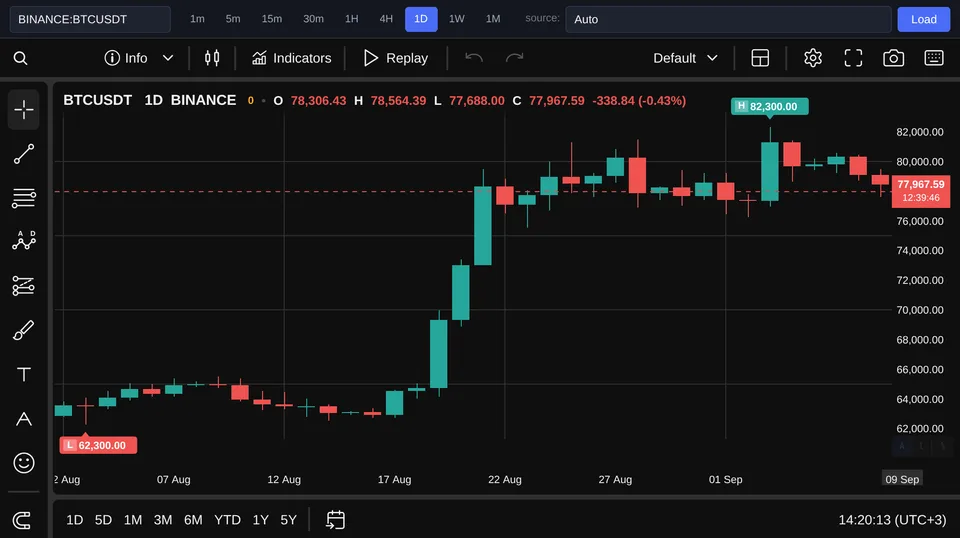
Bitcoin was bought after slipping through $78,000, yet the recovery has not resolved the market’s central question: was this the beginning of another advance or merely a defensive bounce inside a familiar range? At the time of writing, BINANCE:BTCUSDT stands at $78,014, down 0.37% for the day, while traders broadly frame $75,000–$82,000 as the likely operating zone before the Federal Reserve’s decision. Meanwhile, the livelier experiment is unfolding in Zcash. Grayscale’s new Zcash ETF has surpassed $500 million in assets and reportedly absorbed about 3% of the coin’s supply, but BINANCE:ZECUSDT is trading at $1,229, down 1.21% on the day. The contrast matters: Bitcoin is being supported without breaking out, while Zcash has attracted exceptional fund demand without producing uninterrupted price gains.
A rebound is not the same as a breakout
The confirmed fact is straightforward: buyers appeared around the $78,000 area after Bitcoin briefly moved below it. That shows there is demand near the lower part of the current market structure, but it does not establish that buyers are prepared to chase the price higher. With BTCUSDT at $78,014 and down 0.37% for the day, the market has repaired the sharpest part of the decline without demonstrating convincing upward momentum. The editorial interpretation is that this was defensive buying, not yet expansionary buying. A defensive buyer considers the price attractive relative to the recent range and steps in near support; an expansionary buyer keeps purchasing as the price approaches resistance. The difference will become visible only if Bitcoin can move away from $78,000 and sustain demand closer to $82,000. The expected $75,000–$82,000 band also changes how individual moves should be read. Inside that corridor, a bounce from the lower half may represent ordinary range trading rather than a new trend. Markets can look energetic while going nowhere, rather like a treadmill wearing an expensive financial-data subscription.
Why the Federal Reserve keeps Bitcoin inside the corridor
The next Federal Reserve decision is a natural reason for traders to limit conviction. Before an important policy signal, investors must weigh several possible paths for rates, liquidity expectations and the dollar rather than one settled scenario. That uncertainty can encourage purchases near perceived support while discouraging large directional positions near the upper boundary. Oil-related pressure adds another layer because it can complicate the inflation outlook. The supplied context does not establish a direct mechanical link between oil and Bitcoin on this particular day, so it should not be presented as a proven cause of the decline. The more cautious probability-based explanation is that renewed inflation concerns make the future path of monetary policy less obvious, reducing investors’ willingness to pay aggressively for risk assets. Bitcoin therefore appears constrained by macroeconomic timing more than by a collapse in crypto-specific demand. The rebound near $78,000 supports that reading, but the negative daily change warns against declaring victory. Until either $82,000 attracts sustained buying or $75,000 fails under persistent selling, the range remains the cleaner analytical framework.
The Zcash ETF has created a different kind of pressure
Zcash is not simply a smaller version of the Bitcoin story. The confirmed figures describe a concentrated demand event: the new Grayscale ETF has accumulated more than $500 million in assets and taken in roughly 3% of the available ZEC supply. For one regulated product to account for that share is notable because it can reduce the amount of inventory readily offered to other buyers. The likely mechanism is a localized supply squeeze. If ETF creations require the acquisition or economic backing of additional ZEC, continued inflows can remove marginal supply precisely when speculative interest is rising. In a comparatively thinner market, changes in available inventory can have a larger price effect than the same nominal demand would produce in Bitcoin. However, assets already gathered by the ETF are evidence of demand, not a guarantee of continuing inflows. ZECUSDT at $1,229 and down 1.21% for the day demonstrates that a powerful headline can coexist with selling, profit-taking or reduced appetite at elevated prices. The ETF may have tightened supply while early holders simultaneously used the attention as an opportunity to realize gains. This distinction separates structural support from speculative acceleration. A stable or growing asset base could keep part of the supply unavailable over time, whereas a surge driven mainly by launch enthusiasm may lose influence once the initial allocation wave passes. Half a billion dollars is a substantial footprint, but even a large pawprint does not tell us whether the animal is still walking.
Four signals that can distinguish persistence from excitement
The first signal is whether Bitcoin can repeatedly hold the $78,000 area on closing prices rather than merely recover it intraday. Repeated defense would strengthen the case that the lower portion of the range is attracting real demand. Frequent breaks followed by weaker rebounds would instead suggest that support is being gradually consumed. The second signal is Bitcoin’s behavior at the two stated boundaries. A sustained move through $82,000 would challenge the range thesis, while acceptance below $75,000 would indicate that the market has repriced risk rather than simply absorbed volatility. Brief excursions beyond either level matter less than follow-through and the ability to remain there. The third signal is the direction of the Zcash ETF’s assets after the launch phase. Continued growth above the existing $500 million would support the theory that regulated demand is persistent; stagnation or contraction would make the 3% supply absorption look more like a one-off allocation event.
Conclusion
Bitcoin’s recovery from below $78,000 confirms that buyers are present, but its $78,014 price and 0.37% daily decline do not confirm an escape from the $75,000–$82,000 range. The Federal Reserve decision and associated inflation uncertainty remain plausible restraints on conviction. Zcash has the stronger local catalyst: more than $500 million in ETF assets and absorption of roughly 3% of supply can create meaningful scarcity. Yet ZEC at $1,229 and down 1.21% shows that this effect is neither automatic nor one-directional. The practical conclusion is to treat Bitcoin as a macro-sensitive range market and the Zcash ETF as a promising supply experiment that still requires confirmation from subsequent flows and price resilience.