
Big Tech Reports Will Test the AI Trade's Strength

Introduction
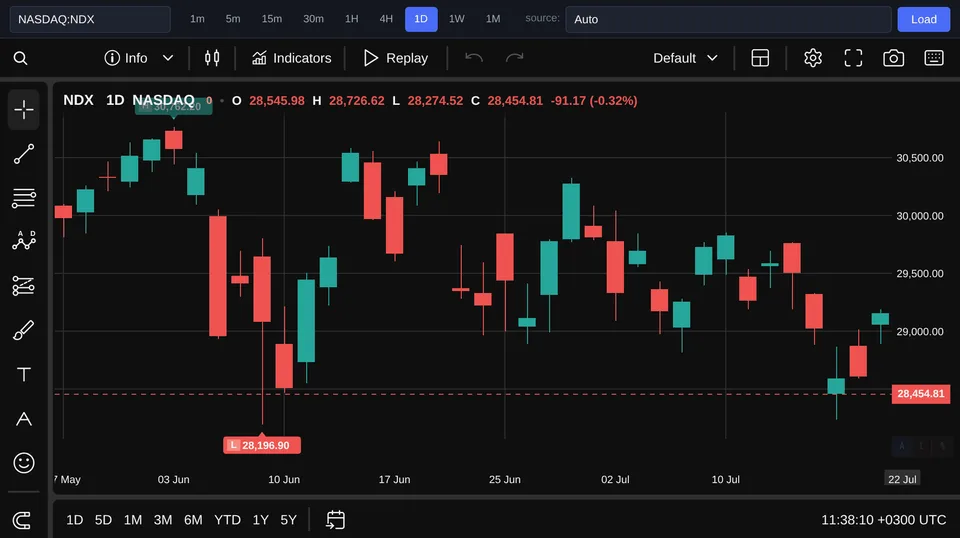
Big Tech enters earnings week at a moment when the market is no longer satisfied with the pretty word "AI" in a presentation. Investors have not come to gently stroke the shiny artificial intelligence story, but to look at the bills for data centers, servers, and cloud capacity. At the time of writing, the Nasdaq 100 is at 28,455 USD and is down 1.87%, which means the backdrop before the releases is more cautious than festive.

🧠 Big Tech Before the AI Capex Exam
Apple, Meta, Microsoft, and Amazon are coming to investors after a powerful rise in expectations around artificial intelligence. Now what matters is not only revenue, but how convincingly the companies explain the link between spending on AI infrastructure and future monetization. The market will judge not promises, but the quality of AI spending. If capital expenditures look like investments in sustainable growth for clouds, services, and advertising tools, investors may accept the high bill. But if spending grows faster than a clear effect on revenue and free cash flow, even a strong quarter may meet a cold reception. Microsoft is especially illustrative here: the stock trades near 381.6 USD and loses 2.24% on the day, showing the market's sensitivity to Azure, Copilot, margins, and the cost of new infrastructure.
☁️ Clouds, Margins, and Capex
For Microsoft and Amazon, Azure and AWS remain the main scoreboard. The market wants to see not just high demand for AI capacity, but demand that can be served profitably and scaled without endless pressure on margins. Strong cloud revenue by itself no longer looks like a universal pass into the buying zone. Meta's test is arranged differently: the advertising business must keep funding data centers, servers, and AI development. If advertising monetization remains strong, heavy capex looks tolerable; if the revenue impulse weakens, the same expenses quickly become the subject of unpleasant questions. Apple needs to carefully explain its AI strategy without creating the feeling that the company is sharply changing its financial profile. If capex grows faster than confidence in future monetization, the market may punish even strong revenue.

📉 Nasdaq and Options Await a Nervous Week
The Nasdaq 100 decline to 28,455 USD with a daily change of -1.87% shows that investors are already cutting risk before the key reports. This is not a signal of an inevitable collapse, but it is a clear sign that the market is approaching mega-cap week with raised eyebrows and a calculator in hand. The options market is also pricing in noticeable moves because Nasdaq's concentration in the largest technology companies remains high. If one or two companies give a weak forecast, the reaction may quickly move beyond individual tickers and hit the broader index. Weak guidance is now more dangerous than a weak quarter, because the market is trading the future of AI payback.

🍏 Apple, Meta, Microsoft, Amazon: What to Listen For
For Apple, comments on AI features, the iPhone cycle, services, and margin protection will be key. The company does not necessarily have to spend like the cloud giants, but it needs to show that AI strengthens the ecosystem and can support commercial growth. For Meta, the market will watch advertising demand, user engagement, the effectiveness of AI tools, and the capital expenditure forecast. For Microsoft, the focus will be on Azure growth, Copilot adoption, server capacity availability, and operating margin dynamics. For Amazon, AWS, retail discipline, and data center plans are important. Management language may be almost as important as the numbers: a confident forecast can stabilize the market, while an evasive tone will increase pressure.
Conclusion
The day sets a cautious backdrop before the key Big Tech reports. The AI story is not broken, but the market demands proof of discipline: capital expenditures must turn into revenue growth, sustainable margins, and clear forecasts. While the Nasdaq 100 falls 1.87% to 28,455 USD and Microsoft loses 2.24% to 381.6 USD, investors are clearly choosing caution before the publication of earnings. Practical takeaway for a Forex trader: the rule should be tested on a demo account, written into the trading plan, and applied consistently before every trade. Practical takeaway for a Forex trader: the rule should be tested on a demo account, written into the trading plan, and applied consistently before every trade. Practical takeaway for a Forex trader: the rule should be tested on a demo account, written into the trading plan, and applied consistently before every trade. Practical takeaway for a Forex trader: the rule should be tested on a demo account, written into the trading plan, and applied consistently before every trade. Practical takeaway for a Forex trader: the rule should be tested on a demo account, written into the trading plan, and applied consistently before every trade. Practical takeaway for a Forex trader: the rule should be tested on a demo account, written into the trading plan, and applied consistently before every trade.