
Basket Trading, or How to Find and Trade Instrument Dependencies

Good afternoon, fellow forex traders !
In continuation of the topic of arbitrage, today we are going to look at a variant of portfolio trading – “Basket Trading”. Unlike pair trading, Basket Trading involves trading a whole basket of interrelated instruments. The main advantage of this method is the creation of a market-neutral portfolio, which allows you to earn on any market condition, regardless of its specific direction.
Portfolio trading is fundamentally different from traditional trading strategies. Usually it is customary to create a strategy for an instrument, taking into account its peculiarities. We will go the opposite way – we will try to create a new instrument with ideal characteristics for our strategy.
Ideal portfolio

The simplest way to build a portfolio is to gather a group of undervalued instruments with the expectation of their growth. These can be stocks, currency pairs, investment accounts, and basically anything. One such example is Warren Buffett’s portfolio. In general, examples include many indices whose composition changes periodically to keep the curve rising.
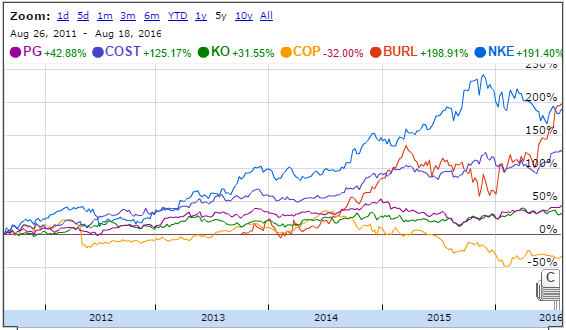
You can say that an arbitrage portfolio is a separate synthetic instrument to which you can give any desired characteristics. Imagine that you have a chance to create your own trading instrument of arbitrary nature, what will its chart look like?
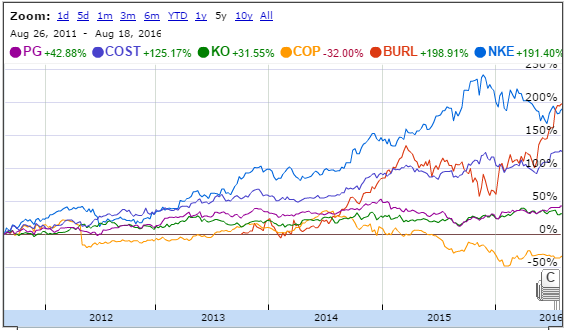
I think you will want to create an instrument that is the easiest to trade. For example, a tool that is constantly in a channel, or a tool whose chart is constantly growing. In other words, it is not the strategy that adjusts to the instrument, but rather the instrument adjusts to the strategy.
It is very easy to trade such a portfolio. In such conditions even a knowingly unprofitable martingale will work, as we will always know that the price will definitely return to the average.
We can get such a chart by subtracting its moving average from the instrument price. That is, the price of an instrument + its average represents a perfect market-neutral portfolio. The problem is that we cannot trade on the average.
Here we come to one important point. Our task is not to create a beautiful chart, but to find real correlations between instruments. If the instruments are not related in any way, the portfolio will immediately fall apart outside the testing interval, and goodbye to market neutrality. On the other hand, a beautiful chart may well be an evidence of interconnection, and this should be taken into account as well.
However, there is no single correct way to create a co-integrated portfolio, as it is not clear how to find the underlying interrelationships. In the example of pair trading between EURUSD and GBPUSD, we determined the dependence of two currency pairs using Pearson correlation. Now the task is more complicated – we need to determine the dependence between several instruments.
Recycle complex

The Recycle indicator complex is the most advanced in solving the problem of finding an ideal portfolio of assets. The program receives an arbitrary number of time series (currency pairs, stocks, indices…) as input and outputs a ready portfolio with the lowest dispersion (the narrowest chart). In other words, by adjusting the share of each instrument in the portfolio, we get the flattest possible chart. Why do we need this ?
Let’s remember again how to get a market neutral position by trading two interdependent instruments. So, we have two trading instruments with similar charts (the name of the instrument does not matter):
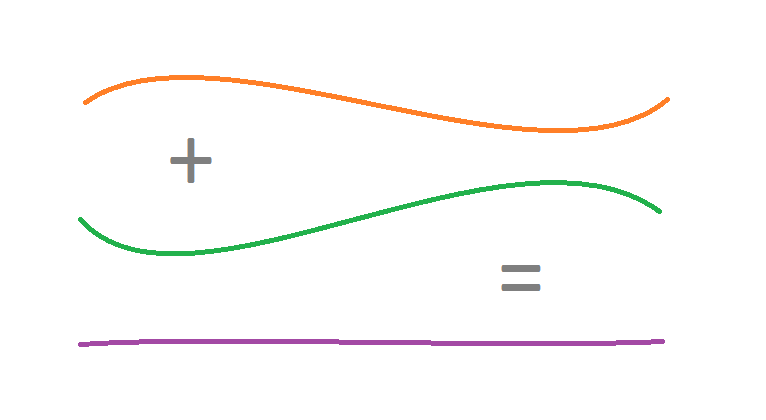
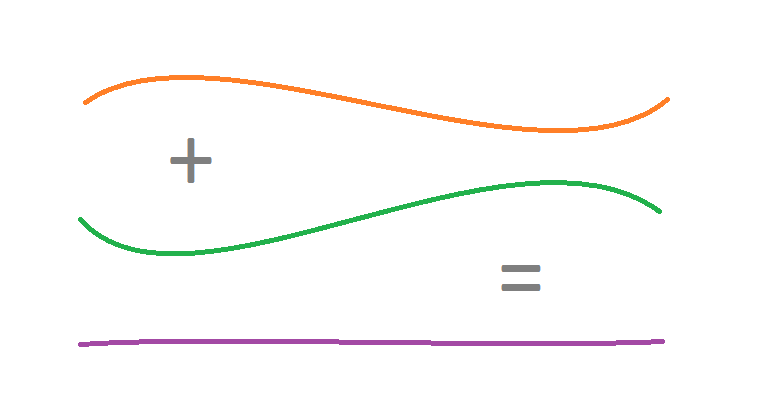
As you can see, the charts of the instruments move in a coordinated but differently directed way. Thus, if we open two positions of the same direction at the same time, the graph of total profit will be a flat line. That is, regardless of the market direction, the equity of the common position will always be around zero. The Recycle indicator set solves the same problem, but simultaneously with a bunch of tools.
The set includes several subprograms:
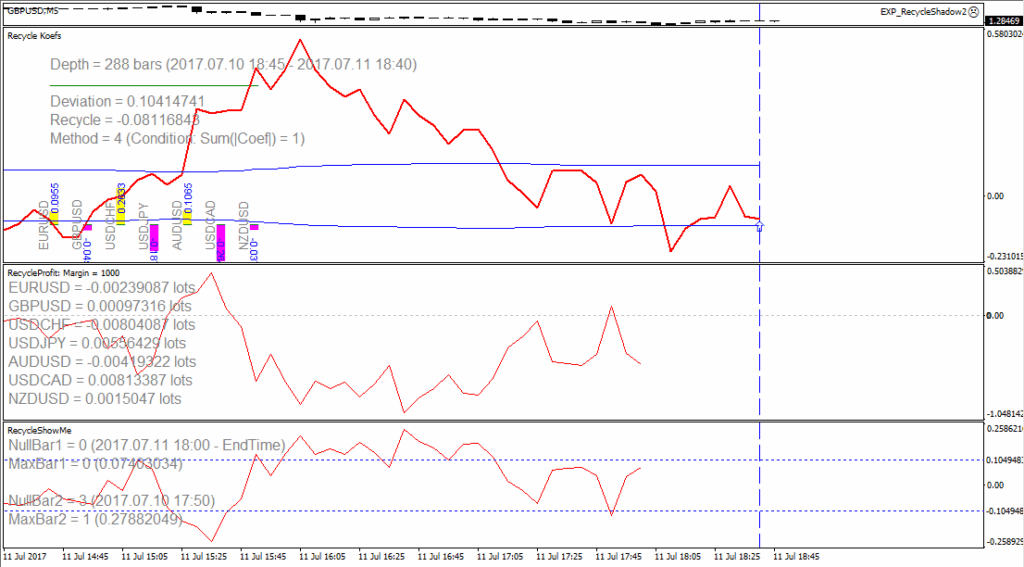
- Recycle2 – directly an indicator showing the dynamics of synthetic movement and values of correlation coefficients (values of interrelation) in the portfolio;
- RecycleShadow2 – an additional Expert Advisor that allows you to view the dynamics of the synthetic on history (run before Recycle2);
- RecycleHistory – script for swapping history. It is needed to display the past history of the instrument (can be run at any time);
- RecycleProfit – displays the spread dynamics in money. This chart can be used to calculate the potential profit. This window also shows the calculated lots for creating a neutral position.