
All About Forex Scalping
 Hello, fellow Forex traders!
It is no secret that quite a few traders do not have deposits with several zeros, and a result of 20-40% per year is simply not interesting to them. Traders who do not have the opportunity to invest amounts sufficient to be satisfied with two- or three-digit annual returns use scalping to grow a deposit to what they consider an acceptable size, after which they switch to medium- and long-term strategies. What “scalping” is, what working strategies there can be, how to choose a broker and account for this type of trading, and money management - all of this is covered in today’s material.
What Is Scalping?
A small size of profit usually corresponds to a short time spent in trades, which in turn leads to a high frequency of opening orders. In other words, this trading method is called “scalping” - the trader makes precise, short and shallowly profitable “cuts” into the market.
The strategy is popular for its use of “short stops.” The financial losses of losing trades are small, and a large number of orders allows you to “make back” the resulting losses, finishing the trading session “in profit” almost every working day.
Scalping, due to the speed of the trades, quickly tests and filters trading systems; one working day “simulates” a one-week stretch for a medium-term strategy.
Pip – the minimum price step (change) of a currency pair, the size of which is indicated in the specifications on the broker’s website.
Scalper – a trader who works with a strategy that involves closing orders with a profit of several points (pips).
According to theory graphical analysis It is known that candle formations Elliott waves, figures Fibonacci etc. valid for any time period of quote changes (candles, bars). Many scalping strategies are adaptations of well-known medium- and long-term trading systems.
The market entry skills developed by pip traders subsequently lead to accurate entries with minimal losses in all trading systems.
Psychological Mindset

The high frequency of trades and protective orders placed close to the entry point produce relatively low efficiency; the positive expectancy (the predominance of closed profitable orders) is usually no more than 65%.
The advantage in profit is achieved by the number of transactions, which carries a serious psychological trading load, the profit curve is similar to a cardiogram, “dives” into positive and negative areas many times during the session.
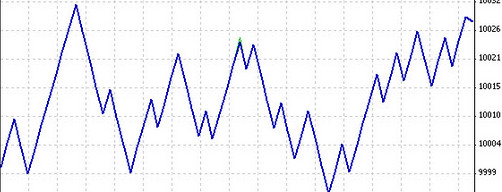 The “main enemies” that distract a scalper’s attention are consecutive losing trades and errors associated with the “human factor” - one’s own mistakes that caused a loss.
A trader who scalps manually has to rely on the general rules for opening orders, based on knowledge of the peculiarities of changes in the pair’s quotes. Events that distract from these aspects (greed, frustration, regret, etc.) lead to growing losses that can no longer be justified by future profitable trades.
If the trader is unable to control himself, he must not continue trading! The sign of such a situation will be a series of losing trades caused by the trader’s own “mistakes”.
Traders who have visited Tibetan monasteries and mastered the techniques of “withdrawal” to find balance will find it easier to psychologically prepare for the upcoming trading day. Some people use neuro-linguistic programming techniques, but you can also use a simple approach - if possible, remove “irritants”, thereby limiting losses.
Tactics of “psychological protection” against blowing the deposit:
- You must not keep the current financial result in view while trading. During scalping, losing and profitable trades are counted, but the trader does not watch how the deposit figures change;
- Having received a loss, the trader stops trading. You need to step away from the screen or close the terminal for at least 5 or 15 minutes. After three “minuses” in a row, they take a long break or stop trading;
- At the end of the working day, all transactions are reviewed step by step, the conclusions are summarized, so that the next day there is an “emphasis” in the mind on not repeating “yesterday’s mistakes”;
- A scalper’s mistakes are written down; repeated errors are turned into rules, with attention focused on getting rid of them.

In short-term strategies, a trade lasts minutes or even seconds. Improvisation will lead to worse results ; even if it does not cause a one-time loss, time will be lost during which other trades should have been taken instead of concentrating on one.
Profitability is provided by a 10%, at most 15%, advantage of profitable trades over losing ones. Scalping is sensitive to any deviations from the strategy.
Medium-term and long-term trading systems have a reserve of time; while in a position, a trader can improvise, rearranging the stop, fixing a profit prematurely or, conversely, without setting a stop, sitting out a loss or not closing a profitable position, taking the transaction to a greater advantage.
Changes to the strategy are possible only after “offline” testing in the trading terminal tester or by manually checking a new algorithm.
Many trading principles based on VSA, cannot be changed at all; this constancy is the “strong side” of scalping trading, turning it from a strategy into a tactic that does not require test confirmations.
An attempt to refute or modify scalping tactics that have been developed over decades will lead to an inevitable negative result. In almost all cases of dissatisfaction with the existing system, the culprit is the inattention and sluggishness of the trader.
Before making any changes and looking for new strategic techniques, a trader must analyze his own actions.
Why a Demo Account Is Not Useful to a Scalper

A great deal has been written on thematic sites and forums about the benefits and harms of using demo accounts.
Fans of demo trading claim the following: “Demo accounts test the strategy.” Such “testing” is a thoughtless waste of time.
The MetaTrader tester is much faster for testing large sections of historical quotes, as well as individual interesting periods, for example stretches of trading during an economic crisis.
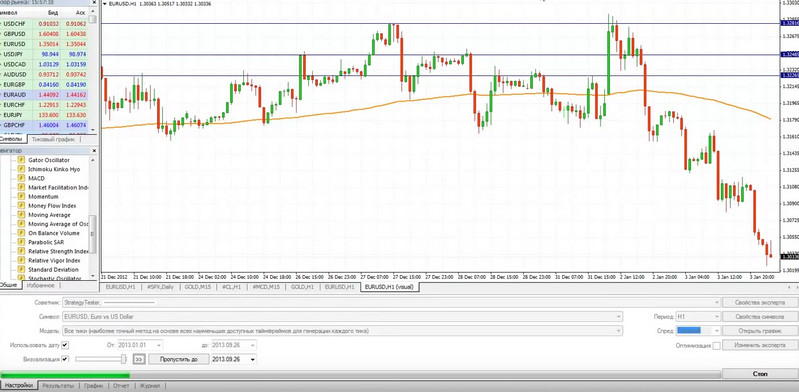 The effectiveness of a strategy depends on the symmetrical distribution of historical data by market conditions - flat, trend, high and low volatility. Demo trading does not provide such a sample.
Before testing, the trader must formalize the entry and exit rules by creating a full-fledged automatic algorithm; otherwise the test is impossible. On demo trading, indicator signals are worked manually, so there is no incentive to formalize the strategy algorithm.
Testing produces results based on the size of the drawdown and the expected value (the number of profitable trades). These parameters are constantly checked in real trading to see the moment when the strategy begins to bring only losses. The trader, seeing deviations, makes a decision in advance to optimize or change the strategy. After demonstration trading there is no such data.
Indicator-free manual trading is strictly prohibited on a demo account. Decisions about a trade are based on relative ideas of volume, the size of movement, and the behavior of quotes near important levels, etc. Human consciousness is associative and self-deceptive; the “excitement factor” in real trading makes a person perceive the same data differently depending on the position in the trade, current losses, the desire to “win back,” haste, and greed. In demo trading, such feelings are either absent, or mistakes made out of excitement are quickly forgotten.
There is no need to completely abandon the demo account. Scalping involves fast, one-click trades, which must be practiced until “muscle memory” becomes automatic. You need to practice opening trades on a demo account without chasing performance.
If additional equipment is used whose signals are used to open trades in MT4 through a link, a demo account must be used to check the functionality without fail .
The same applies to all Expert Advisors - the opening and closing of trades are checked on demo accounts while monitoring the log and simulating connection losses and power outages.
Choosing a Broker and Account Type

Forex brokers operate on the basis of a license issued by the regulatory authorities of the country in which they are legally registered. Regulation guarantees the safety and return of client funds, as well as legal supervision over the company’s activities.
Companies have several licenses to operate in different countries of the world. When choosing a broker, priority is given to a “local license” issued by government authorities in the national jurisdiction; further, in terms of reliability, jurisdiction and regulation in developed countries, “civilized” offshores (Cyprus or British tax-free zones) are welcomed.
The account type determines whether scalping is possible at all. When choosing a broker, scalpers pay attention to the list of liquidity providers of the international interbank Forex market, where Central Banks, investment funds, financial institutions, and clients capable of paying a minimum of several million dollars per lot trade without leverage participate.
The international Forex market dictates the course. Special agencies are responsible for the accurate distribution of these values; banks and funds are ready to buy/sell at these prices all offers from Forex dealer clients. Such financial institutions that buy and sell currencies, creating a “personal” interbank Forex, are called liquidity providers.
The more significant the brands and the number of suppliers, the more liquid the broker’s interbank currency exchange market.
The account type should have a floating spread. This saves on spreads and guarantees that trading orders are passed to the interbank market of liquidity providers.

The trading platform should not have delays in the execution of orders - trade orders should be processed automatically (this is an ECN account type) or go directly to liquidity providers with a selection of a “competitive” (best) execution price. The latest technology provides a spread equal to zero (the bid and ask prices are the same) when one liquidity provider has the best sale price of a currency pair equal to the other provider's bid price.
Direct order routing reduces the processing time of a trade order, while the technology for selecting the best price helps eliminate slippage - the worsening of price after a trading order has been sent to the broker’s server.
NDD, ECN, and STP accounts allow you to save on the spread. A scalper’s gross earnings per session can reach up to 100 pips. On typical fixed-spread accounts, each EURUSD trade would cost about 1 pip, which would amount to 20% of the profit. Adding losses (about 35 pips) makes the scalping strategy unprofitable.
Scalpers who use advisors in trading depend on the speed of the Internet provider, the stability of the Forex dealer’s servers, and power outages. If the trading terminal loses connection with the broker’s server, the robot “loses” control over the positions. Placing an expert on data center servers helps to avoid these problems. If the company provides services VPS, you should definitely use it. Thus, by managing the account remotely, the trader is guaranteed to be protected from the above problems.
Certain scalping methods require placing pending orders close to current prices. Brokers on some account types in the MetaTrader4 trading platform impose a limit on the minimum number of points - this must be taken into account by checking the account specifications.
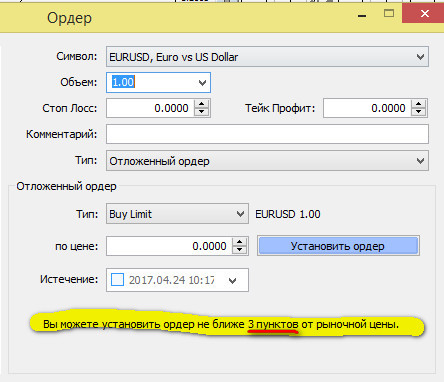 If a trader is going to scalp, then setting stops, targets, and entry levels under such a restriction will take too much time, if not make the use of a scalping strategy impossible.
Manual or automated trading?

Beginner traders believe that buying a robot will eliminate psychological problems and mistakes in manual trading. “Miracle Expert Advisors” are seen as a device for continuously making money.
Automation will not save you from the mandatory training stage; buying an Expert Advisor as an unprepared trader will bring more problems than a long period of learning manual trading skills.
Scalping can be programmed using the language built into the trading platform. The strategy should be based on the readings of indicators that issue trading signals according to a specific algorithm.
After testing, the written Expert Advisor is launched on a real trading account, and the trader can only observe and analyze the trading results, comparing them with the test ones to monitor the strategy’s performance, or sell the finished scalper EA to those interested.
Automation will not help a beginner; he will not be able to check the Advisor in the tester in order to understand and evaluate the purchase, understand the reasons for the drain (software failure or strategy error), and control the current work.
Manual trading is recommended as the first step, which will help you learn both trade and discipline, get to know the market and choose an instrument.
A scalper does not trade many currency pairs, usually studying one or two. Over the years, certain features of currency movements make it possible to further increase performance by “playing out” recurring moves and currency reactions to news or the time of day (the opening of various world exchanges).
Having developed rules and algorithms in the trading process, a trader can write an algorithm himself or draw up technical specifications for a programmer.
Unfortunately, algorithmic trading is limited to Boolean logic, which does not fit into indicator-less scalping strategies. Therefore, some pip traders always trade manually, without using advisors and indicators.
The measure of the correct choice of style and strategy type is the amount of profit on the deposit. Numbers do not lie; they objectively assess a trader’s efforts.
Choosing the Time to Trade

The effectiveness of scalping is increased by intraday microtrends, which depend on the time factor of trading participants’ activity. One of the main tactics used by scalpers is trading during certain time intervals.
The duration of trading sessions for currency pairs is 24 hours a day. Directed intraday moves are ensured by a large number of trading participants, whose activity is tracked through an increased number of trades using a Volume indicator.
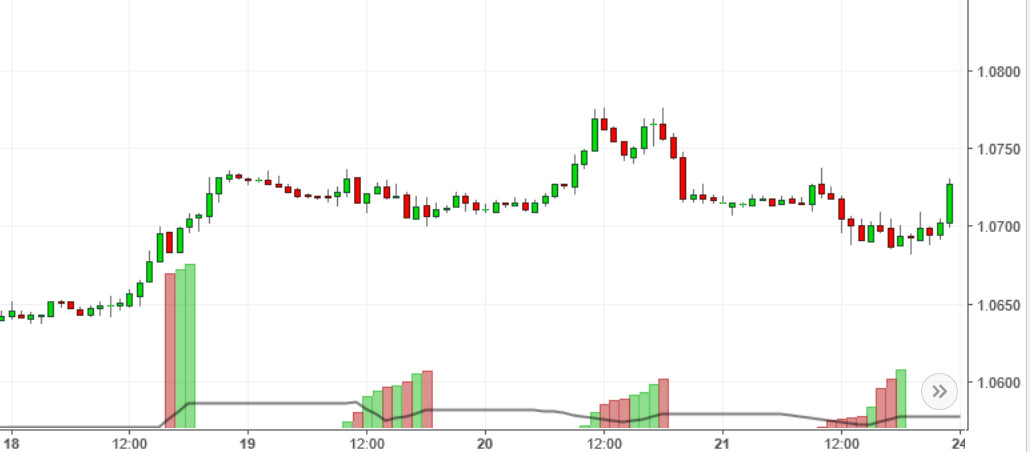 This is not the only way to measure activity; any volume indicator or volatility (price spread) meter will do, but experienced traders approach this issue differently.
The activity of trading participants coincides with the time and the first hours of operation of the stock exchanges of the country to which the currencies included in the pair belong.
EURUSD is active at the opening of the London Stock Exchange and North American exchanges. Considering the daily turnover of US stock exchanges, their opening affects all world markets - this is a clear time of trends.
Tactics can be varied - novice scalpers use a couple USDJPY in “night trading”, taking off positions from 21-00 to 3-00 Moscow time. The volatility of the pair is leveled by the lack of activity of traders during these hours, but it is sufficient for “catching pips”; quote movements remain in a certain corridor (flat), by determining which, the trader avoids mistakes.
Traders also have access to session indicators that allow reminders and session boundaries to be set at the user’s discretion.
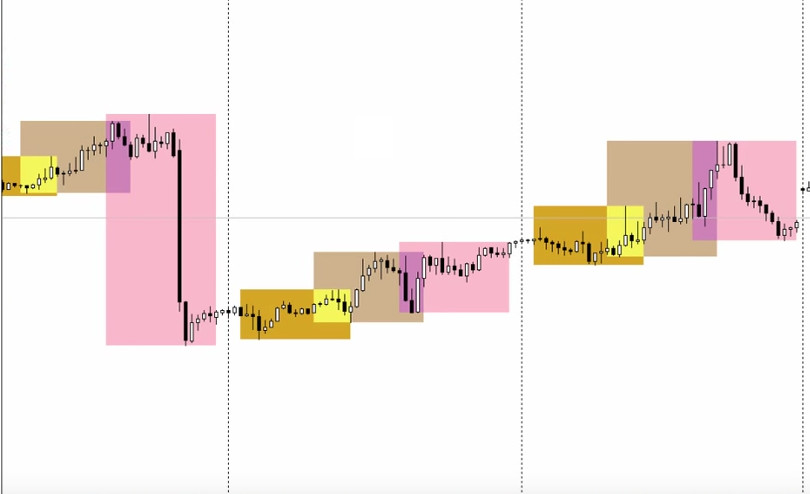 If a microtrend is a scalper’s friend, then volatility (strong price fluctuations in both directions) is the enemy. Strong price fluctuations in both directions lead to premature “triggering” of protective stop orders. It is impossible to predict the spread of prices, increasing protective stops leads to increased losses, and the rules of the strategy are violated. This makes it difficult to make a correct forecast of price direction, so traders avoid trading at the time of news release, unless this is included in the strategy (news trading).
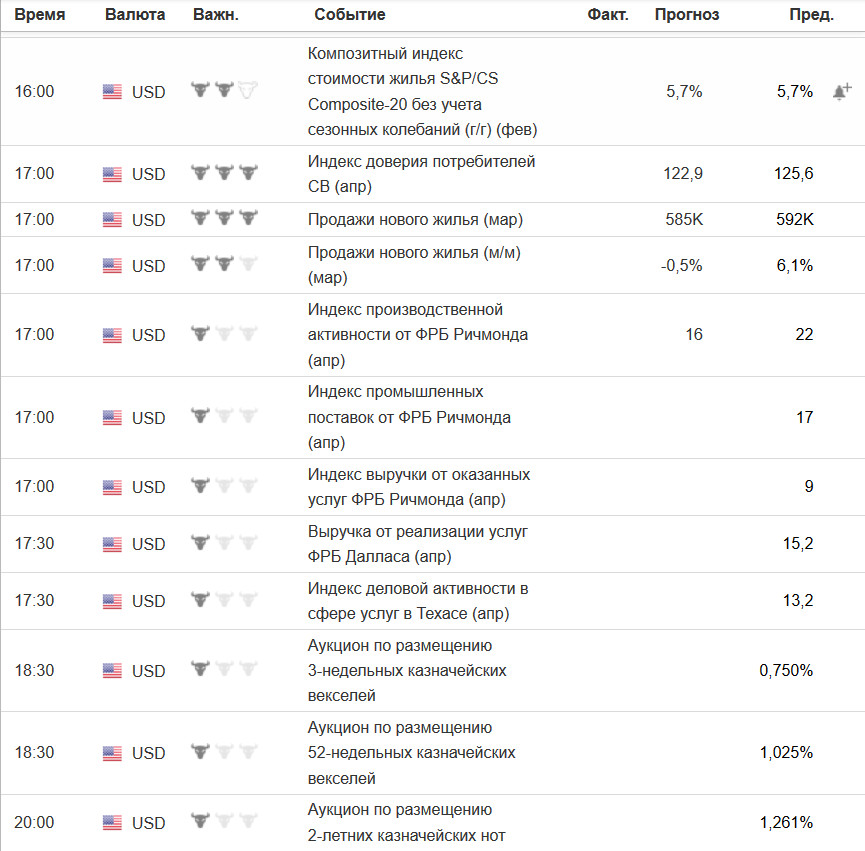
Every trading session begins with studying calendar current economic events. Important news, such as GDP data, unemployment, decisions of national Central banks on changes interest rate etc. - all this can affect the previous part of the session. In anticipation of changes that set long-term trends, traders may make few trades, holding speculation until the news comes out. In this case, the opening of world exchanges will not lead to the formation of microtrends and scalpers will not trade.
 A special case is national holidays. Any events that “remove” US and Eurozone traders from the market serve as a signal for scalpers to ban trading activity on those days.
The opening of national exchanges after a long weekend immediately causes a “tide” of significant financial resources into the markets, therefore it is equated to “news”; during the first hours and at the start of trading, scalpers do not participate in current trading.
From a cent account to a dollar account

The initial stage of scalping involves the use of “cent accounts.” A small initial deposit will protect a novice trader from losses, while high profitability in a mastered strategy can grow the deposit on its own, assuming only a small amount of subsequent investment from the trader.
Similar tactics apply to intraday trading. If the trading session starts with losses, they will be minimal, while trading a full lot will introduce discomfort from the first minutes of the session. Small losses will not encourage the scalper to “fight back at all costs” and influence subsequent trades.
The amount allocated for the “working lot” is divided into several parts - at least three. Trading starts with a small lot, increasing with each profitable trade.
The tactical approach of trading with a gradually increasing deposit reduces losses. There are sessions at the beginning of which the trader did not take everything into account fundamental factors. During the trading process, inactivity will result in minimal losses, which are inevitable in the absence of trends.
Money Management Tactics

A scalper transaction requires setting a take profit and stop-loss. Otherwise, without the latter, taking into account the “accelerating” lot size, there is a high risk of losing the entire deposit by the evening - if the price did not want to go to take profit and went in the opposite direction from the forecast. The risk per trade as a percentage of the deposit can be from 1 to 20% - depending on the ratio of profitable/losing trades, entering the market with exactly one order, like a sniper, or a grid of orders for averaging the position.
The size of a scalper’s deposit usually does not exceed several hundred dollars. A deposit is a tool that allows a trader to “squeeze” the maximum out of the market, so the leverage used should be the maximum the broker provides. If there is 1:500 leverage, we take it; if there is 1:1000 leverage, we take that. The higher the leverage, the less money will be tied up as margin when a trader opens a position. At the same time, one must always remember that there should be a reserve for at least 15-20 trades; if mistakes are made (after receiving stop-losses), the entire deposit can be lost. No one is immune from mistakes, especially in trading.
The transaction is necessarily limited by the “holding time” - from several minutes to several hours are allotted for the implementation of the predicted movement. Positions are not held for days and weeks, as when trading on D1. As a rule, by the evening of the working day, all transactions are already closed and there is a certain result, reflected in points and percentage of the deposit.
Scalping Strategies and Indicators for MetaTrader 4
In the book “Long-Term Secrets of Short-Term Trading,” Larry Williams described a ready-made scalping strategy whose trades are made on timeframes from five to 15 minutes using currency pairs and CFD contracts.
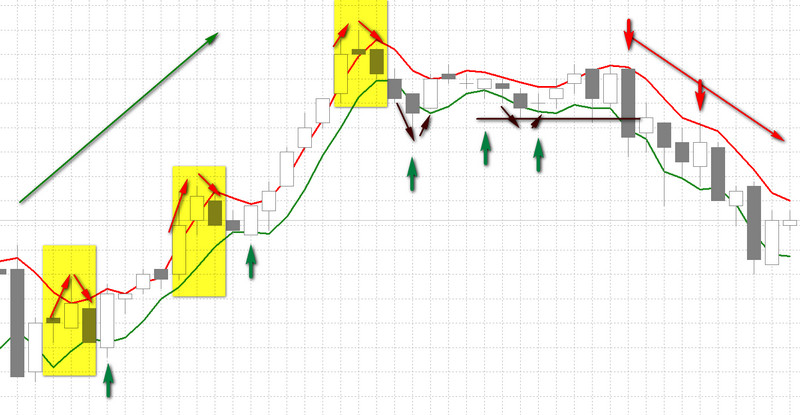
 The trading system has two indicators - simple three-period ones moving averages, built on the highs and lows of the candles. Having established the extrema of quote fluctuations using the Larry Williams method and the direction of the trend, entries are made when crossing moving average on a pullback from a directional movement if the trend remains in force.
When determining the highs, Larry Williams took three candles in the middle with the maximum value of the “tail” and the closing prices of the candles on the left and right below the closing price of the middle candle.
Exceeding this maximum was considered a guarantee of trend continuation, as long as quotes did not exceed the minimum determined in a similar mirror way. From three candles, a time frame was selected with a minimum tail in the middle and candle closing prices on the sides that exceeded the minimum candle.
 The second strategy involves the use of five indicators RSI: 5, 7, 9, 14, 21 – periods on a five-minute interval for all currency pairs. Entry is based on the reverse crossing of the level 60 - for buying and 40 - for selling all five indicators.
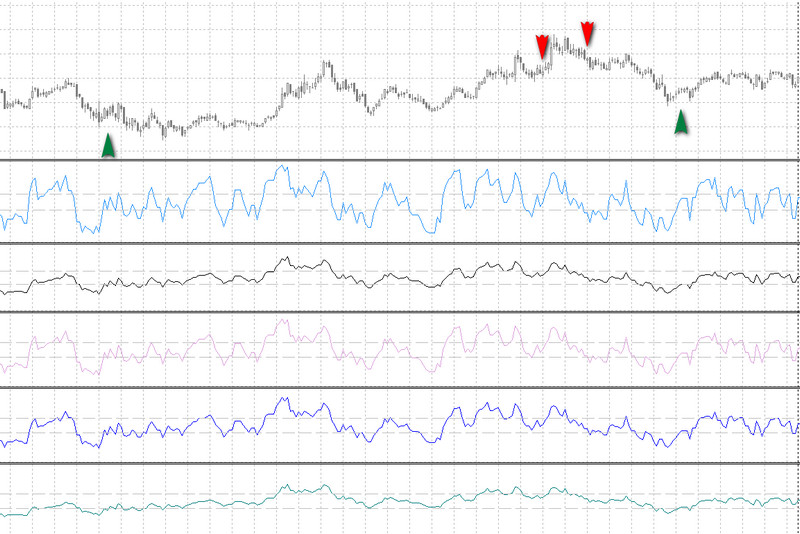 The main signal of readiness to buy comes from RSI 21, after the indicator curve drops below 40. The trade is carried out on a reversal and rise of the curve above the 40 level, if the readings of all other four RSIs are below 60.
The sale occurs at the reverse intersection of level 60 RSI 21, while all four remaining RSI indicators should be above 40.
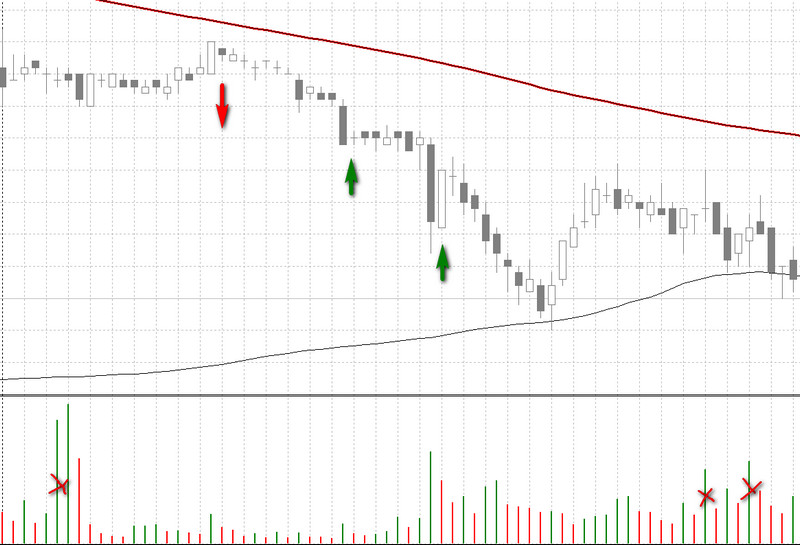
Trading on impulse volumes includes configuring the Volume indicator and analyzing candle size. The candle body is assessed when it is two or three times larger than the previous ones and coincides with an anomalous, unexpectedly increased volume. The strategy is traded on candles no lower than fifteen minutes, counter-trend, buying on the decline and selling on rising candles.
 For beginner scalpers, the Laguerre indicator is suitable; it gives signals of the 0 and 1 type. After setting level 1, when the indicator crosses this line upward, the trader buys a currency pair if the previous indicator value was 0; the trader sells when the indicator crosses the 0 line downward if Laguerre had previously reached 1.
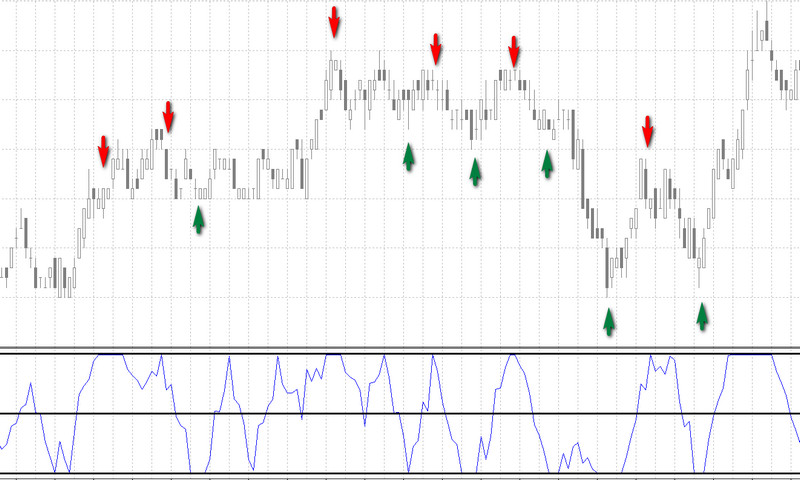 Re-entry to sell is allowed if the indicator has returned to one, without crossing 0.5; re-buying occurs when it falls to zero, without going beyond 0.5.
Timeframe size – from five minutes; currency pair - any; trading time and the level of stops and take profits are selected based on general recommendations for capital management.
Conclusion

Of course, trading with a large number of short trades is more complex than more measured medium- and long-term tactics. This requires a completely different approach, which not everyone understands in time. In order to avoid making a number of typical beginner mistakes, it is enough to follow some simple but very important rules:
- Pay attention to the broker's trading conditions, in particular: the size of the spread, the size of the stop level, and the speed of order processing. You will get the best conditions for scalping on modern ECN/STP accounts;
- Choose a system and stick to it. When choosing a trading strategy, thoroughly study the conditions for entering the market and try not to “improvise” on the fly. In scalping, trades last for minutes and seconds, so any inaccuracy will lead to losses. Also, do not forget to follow money management and always set stop-loss and take profit;
- Take into account time patterns in trading: each pair has its own hours of maximum activity, when the period of night flat (quiet market) is more suitable for trading in the channel;
- Avoid trading during news. For scalping, large and sharp price movements are extremely harmful, since they can lead to slippage of stop levels, while the strategy itself lives off a large number of micro-profits.
Best regards, Alexey Vergunov TradeLikeaPro.ru
