
AI Again Leads Nasdaq Higher: Chips, Earnings, and an Inflation Test

Introduction
The American market was again running on a familiar engine: artificial intelligence, chips, memory, data centers, and everything that helps this machine avoid overheating on the climb. Nasdaq and S&P 500 closed the week higher because investors keep believing that spending on AI infrastructure is not a fashionable signboard, but a real capex cycle. But ahead is no longer a stroll on a flat road, rather a stretch with TSMC reports, banks, inflation data, and the risk of sharp reversals at the start of earnings season.

🤖 AI Pulls Nasdaq Again: Chips in Focus
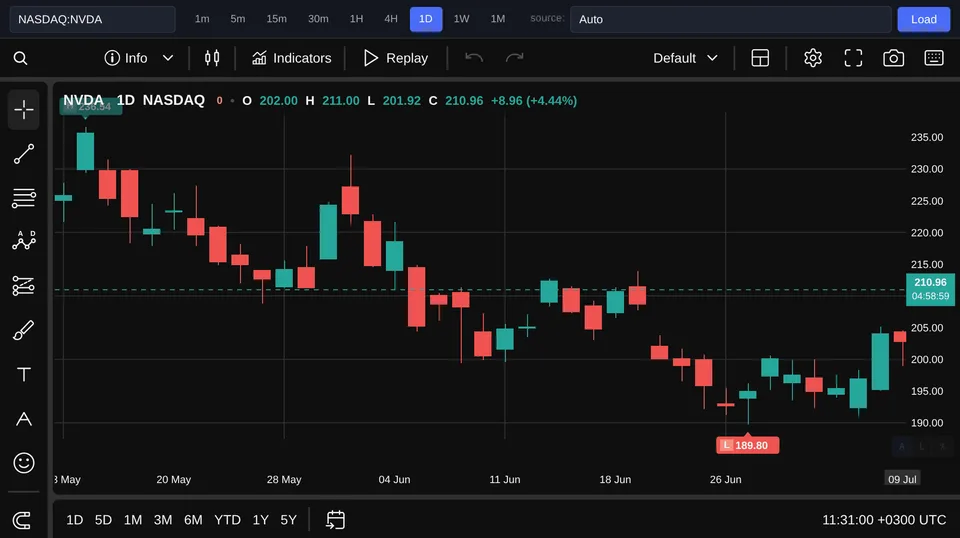
The AI trade remains the main market story in the United States: buyers are still paying for companies that stand closest to growing demand for GPUs, servers, clouds, and data centers. Nvidia is again acting as a barometer of AI appetite: a gain of +4.03% to 211.0 USD shows that the market is still ready to pay for leaders in the infrastructure race. The broader technology tape looks calmer, but also keeps its shape: Nasdaq 100 at 29 825 USD and +0.33% for the day looks resilient, but that resilience now depends on whether reports confirm real demand, not only a pretty story. For a trader this is an important difference: momentum is alive, but the market now wants to see not presentations about the future, but orders, margins, and clear guidance.
💾 SK Hynix and AI Memory: A Debut with Spark
The strong debut of SK Hynix added arguments for those who view AI not as a one-Nvidia story, but as a large supply chain. Investors are more actively assessing memory makers, especially HBM, because high-speed memory has become a critical part of AI accelerators and data centers. This broadens the market focus: demand moves from one bright stock to a whole set of suppliers, including memory, foundry capacity, networking equipment, server solutions, and cloud operators. The market is again behaving like a guest at an AI infrastructure buffet: first reaching for the main course, and then noticing that the neighboring plates also look convincing. Interest in SK Hynix shows that investors are trying to assess not only the leaders of the AI race, but also those without whom this race physically will not move..
📊 Earnings Ahead: TSMC, Banks, and a Reality Test
The next important filter for the market is earnings, and especially TSMC data, because they can confirm or cool expectations for semiconductor demand. Market participants will look at orders, capacity utilization, comments on AI clients, profitability, and signals from the largest chip customers. Bank earnings are important from another side: they will show credit quality, margin dynamics, the state of the consumer, and corporate demand outside the bright AI spotlight. Next week matters not because the market will “learn the future,” but because it will test the price of current optimism. This is exactly where whipsaw risk appears: strong actual results can quickly lose weight if forecasts are cautious, and good inflation headlines may not help if the details change rate expectations. For a trader, the danger is not only being wrong on direction, but also a situation where the market first confirms an idea and then sharply changes its interpretation of the data.
🌡 Inflation and Rates: The Backdrop Decides What Growth Costs
Inflation data will become the backdrop that determines how expensive growth in technology and AI-related companies can remain. If inflation comes in softer than expected, pressure on rates and the discounting of future profits may ease, supporting the growth segment. If inflation proves harder or more persistent, the market will quickly remember multiples, the cost of money, and required returns. This does not cancel the AI thesis, but it changes the attitude toward the entry price: even strong companies can come under pressure when investors begin to calculate future cash flows more strictly. For the market now, not only the strength of the AI story matters, but also how much investors are ready to pay for that strength at the current level of rates. Therefore, fresh inflation will not be a secondary macro backdrop, but a direct factor in assessing risk in the technology sector.
Conclusion
The takeaway for the day and the week is simple: AI beneficiaries are again setting the tone, Nvidia looks strong, Nasdaq 100 is holding positive momentum, and SK Hynix strengthens the argument for broad demand for AI infrastructure. But the market is entering a phase of fact-checking, where earnings, guidance, margins, orders, bank signals, and inflation will matter more than the index-growth headlines themselves. Momentum remains, but the risk of sharp moves is elevated, so investors and traders should watch not only the direction of the trend, but also the quality of the confirming data. Practical takeaway for a Forex trader: the rule should be tested on a demo account, written into the trading plan, and applied the same way before every trade. Practical takeaway for a Forex trader: the rule should be tested on a demo account, written into the trading plan, and applied the same way before every trade.