
AI Agents in Trading: From Automation to Autonomous Intelligence
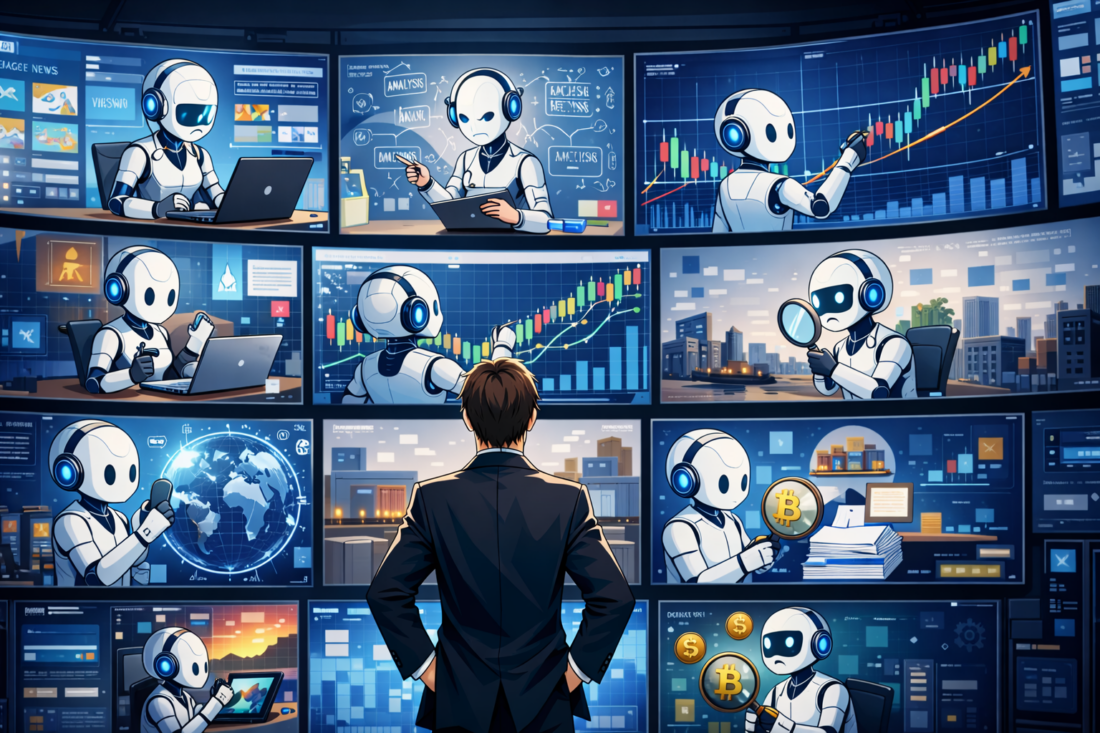
AI agents in trading (or AI Agents) are one of the main trends of 2025-2026.
What are AI agents? Put very simply, they are computer programs that can analyze data, learn from their mistakes, and make decisions. Unlike old trading bots that simply follow pre-set instructions, AI agents can "understand" the market and adapt to changes.
Major centralized exchanges (OKX, Binance, Bybit, Coinbase, Kraken, and others) have already introduced support for AI agents. Independent startups and projects (for example, the TradingAgents framework, HKUDS AI-Trader, Spectral Labs Syntax, and others) offer open and commercial solutions based on deep learning, RL, and LLM algorithms for market analysis and generation of trading signals.
This material is for informational purposes, and cannot and should not be regarded as consultation or advice.
The Evolution of Trading: From Algorithms to AI Agents

For many years, trading automation was based on the "if-then" principle. Traditional trading bots connected to exchanges through APIs and followed strictly defined logic: when a certain price or indicator value was reached, a specific action was executed (for example, "if RSI < 30, buy"). However, this architecture has a hard limit to adaptability: the bot cannot understand why the market is moving or adjust the strategy without manual intervention.
The current stage of development is marked by the transition from algorithmic trading (AT) to agentic trading (AGT). As noted in research by Open-Finance-Lab, if a traditional algorithm is assembled from a linear sequence of modules (data → signal → portfolio → execution), then the agentic approach rethinks this process as an ecosystem of interacting autonomous agents.
Put simply, an AI agent "thinks" like a trader: it analyzes news, on-chain data, sentiment on social media, fundamental indicators, manages risks, and learns from its mistakes.
In short, the key difference between traditional trading bots and AI agents is as follows:
- Trading bots execute instructions.
- AI agents interpret intent in natural language, think through an action plan, use tools, and adapt to context.
Classification of AI Agents in Trading
There are three main classes of AI agents in trading: independent (startups and open-source projects trading on different platforms), exchange/broker agents (integrated solutions from trading venues and brokers), and hybrid ones (for example, systems aggregating several agents).
Technical architectures range from simple LLM chats to multi-level agents: for example, the TradingAgents project (Tauric Research) deploys a chain of specialized agents (technical analyst, fundamental analyst, news and sentiment analyst, trader, and risk manager).
Independent AI agents. These are standalone platforms and tools developed by startups, research groups, or developer communities. They can work on any available markets (stocks, cryptocurrency, futures, Forex, and others) through public APIs.
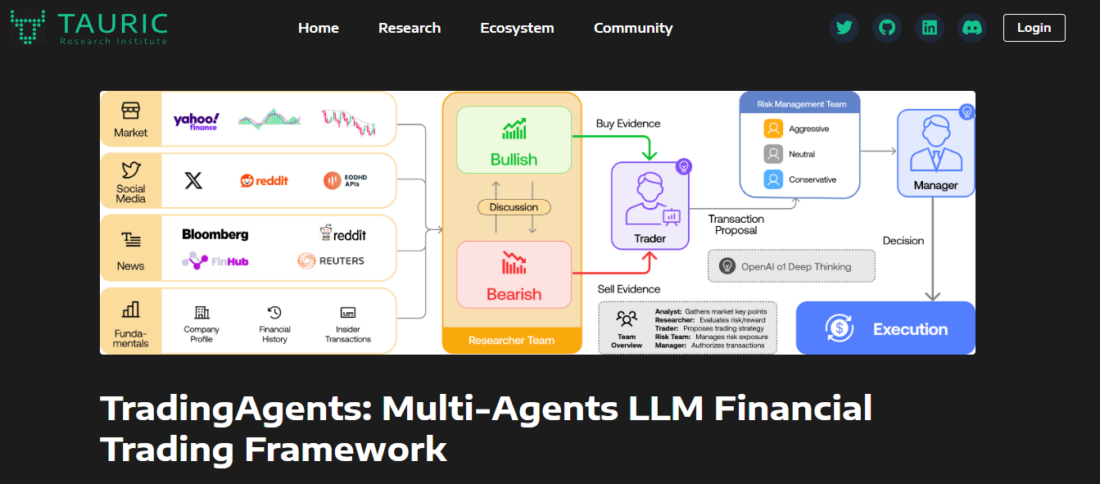
Examples of independent AI agents include open frameworks and bots based on RL and LLM (for example, TradingAgents by Tauric Research, AI-Traderv2/AI-Trader by HKUDS), commercial SaaS platforms, and applications. The algorithms range from classic algorithmic strategies to hybrid schemes with LLMs and reinforcement learning (RL). Independent solutions are often provided as open source (under MIT, Apache, and similar licenses) or under a SaaS licensing model.
Integrated exchange/broker agents. Major exchanges and brokers are introducing support for AI agents into their internal infrastructure. This allows traders to run bots directly on the exchange with access to market data and orders. Such tools are usually provided free of charge or by subscription for the platform's clients.
Examples include the OKX Agent Trade Kit (an open API kit for launching agents based on OKX, supporting spot and perpetual trading, conditional orders, demo mode, and local key storage), Binance AI Agent Skills (a set of "skills" for getting quotes and placing orders on different Binance markets), Bybit AI Hub (a chatbot interface for trading through text requests), Coinbase AgentKit/Agentic Wallets (tools for autonomous agent wallets and on-chain operations), and Kraken CLI (a console tool for developers with support for streaming data and local paper trading).
All these initiatives are aimed at simplifying bot development and increasing security (for example, local storage of API keys, automatic system shutdown, and a demo environment).
Multi-agent systems. A separate category is made up of architectures in which many specialized agents act together.
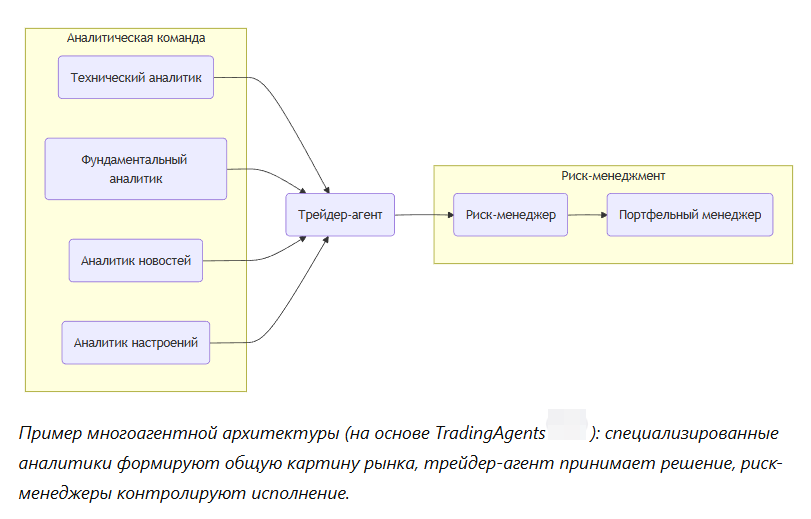
An example is the TradingAgents framework (Tauric Research). It breaks the trading process into stages: several analytical agents analyze fundamental data, news, social sentiment, and technical indicators; then a group of "researchers" (bulls/bears) discusses alternative scenarios; next, the trader agent makes the decision on trades, while the risk-management and portfolio-management teams assess risk and approve the orders.
In this approach, LLM agents act as different "specialists," and their interaction (negotiations, debates) brings the system closer to the processes of a real trading department.
As of today, multi-agent systems are for the most part still in the research stage.
Architecture and Algorithms of Trading AI Agents
Technical solutions for AI agents are quite diverse.
A popular approach is reinforcement learning (RL). An AI agent learns trading on historical data by maximizing a reward (for example, profit or the Sharpe ratio).
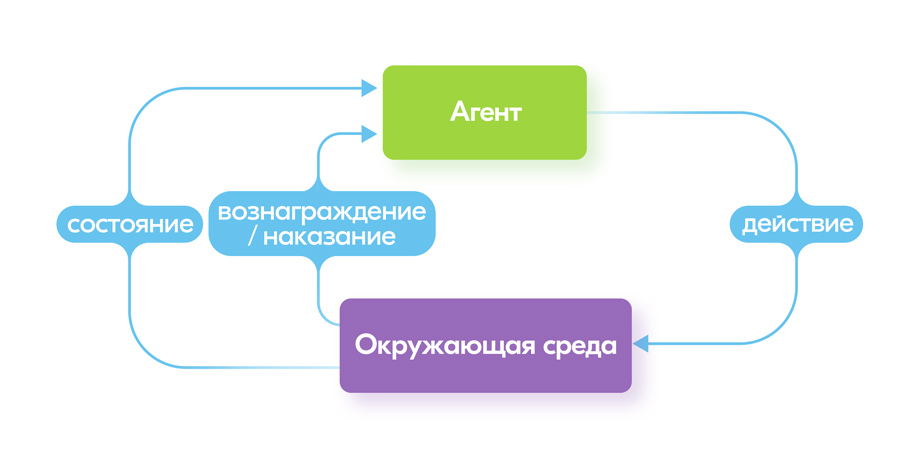
In one study, a hybrid RL model showed a higher Sharpe ratio (a measure of investment efficiency adjusted for risk) compared with single algorithms.
Large language models (LLMs) are used to analyze news and market signals, generate trading ideas, and adapt strategies in natural language. At the same time, the current trend is to use LLMs as an analytics or UI component, not as a fully autonomous trader.

In other words, LLMs more often serve as analytical modules in hybrid models that combine AI, algo trading, and human oversight. Fully autonomous LLM agents are still rare because of problems with interpretability and reliability.
Mixed models (LLM + RL, meaning reinforcement learning plus manual adjustment of results) are being studied in works such as Trading-R1 (Tauric Research), where adding LLM reasoning to an RL-based strategy improved risk-adjusted returns and reduced drawdown.
Classical algorithmic strategies (strategies using technical indicators, scalping strategies, market-making, etc.) are still widely used and are often integrated with AI components for adaptation or parameter generation.
Analysis of Examples and Trader Feedback
Traders' opinions about AI agents vary.
Skepticism is often heard in professional circles: many consider current solutions to be more marketing hype than a full replacement for a trader. As one expert wrote on Habr: "90% of use cases for AI agents can be implemented with ordinary algorithms... And to 'introduce an AI agent' is a way to hang a fashionable label on existing chaos."
Another typical comment, "Nice words, but there is no proof at all. This is a banal system prompt inside ChatGPT," reflects the community's doubts about the effectiveness of complex systems without transparent results.
Most IT specialists still use LLMs as an auxiliary tool for analyzing news and data (generating ideas, scripts), but do not trust them with fully autonomous decision-making.
By the way, what Russian banks and brokers offer is, by and large, an AI agent that gathers news, analyzes company reporting, and backtests the simplest trading strategies.
On the market of AI agents for trading, fraudulent schemes also appear. Our analysis of trader reviews revealed common patterns of deception.
For example, one female user described "quick profit" schemes through a Telegram channel: after a small investment, she was promised a doubling in 15 minutes, and then they demanded payment of a "network fee" (and in rubles, which is impossible in the Bybit system).
In reality, this is a classic money-extraction scheme: no withdrawal of funds takes place. Analysis of review-checking sites showed that similar "bots" have more than 99% negative external reviews. Formally positive reviews are often posted in closed channels by the creators themselves, look fake, and have no confirmation whatsoever.
Typical signs of fraud are creator anonymity, promises of excessive returns, a requirement for prepayment for the "withdrawal of funds," and the absence of public statistics.
It is worth noting the presence of positive feedback on exchange systems.
For example, users note the convenience of cloud platforms that do not require setting up their own server. For example, OKX clients praise the openness of the Agent Trade Kit and the ability to create their own bots without unnecessary complexity. In trader chats, stories sometimes appear about the successful use of simple bots (for example, based on well-known strategies), but often without mentioning specific AI models.
A Simple Conclusion: How All of This Works in Practice
A good AI agent performs the following actions both linearly and nonlinearly, double-checking itself and assessing the situation from different angles:
- Data collection - price, volumes, on-chain metrics, news, Twitter/Reddit, company reports.
- Analysis - several agents do the following in parallel: fundamental analysis, technical analysis, sentiment analysis, risk assessment.
- Decision and execution - the main agent makes a decision and sends an order to the exchange (Binance, Bybit, Hyperliquid, etc.).
- Learning - the system remembers trade results and improves strategies.
Whether or not to trust AI agents in trading is a personal choice for everyone. In the following articles, we will talk about AI agents on popular crypto exchanges, and we will also get acquainted with some services for creating AI agents.