
Trading system "Schrodinger's Cat" - what's inside the box?

Hello, friends! I have repeatedly mentioned in webinars the importance of specialization in a trader's work. Namely, that there is no need to try to trade all available currencies, on all timeframes, using all strategies at once. As a rule, the best results come when you focus on one thing. For example, working one pattern on one currency pair.
In today's video lesson we will look at the forex strategy "Schrodinger's Cat". It is precisely narrowly specialized: it is based on an interesting observation of a particular currency pair (GBPUSD), around which the entire trading system is built, which, by the way, is well suited for busy Forex enthusiasts, since it requires only 10-15 minutes a day.
Characteristics of the "Schrodinger's Cat" trading system
Platform: Any
Currency pairs: GBPUSD
Timeframe: D1 + H1
Trading time: 1-2 times a day
Recommended brokers: Alpari, Roboforex
Reference section

- How to trade pending orders
- Installing indicators
- What locking is
- Round price levels
- The correct time for opening a daily candle
Basis of the strategy

This trading system came into being in recent years, based on the price behavior of the "cable" (the GBPUSD currency pair). The observations are as follows:
- The market opens at 17:00 New York time, and we use this time as the base. The price may, quite likely, rise or fall by 75, 100, and 150 points from this level; this base level, statistically speaking, acts as a pivot point from which the price moves and to which it returns back.
- Leaving such positions open while observing certain risk management conditions, until the price returns to the day's opening price or moves 75 points in the corresponding direction from the opening price of the following day, can yield a good profit and only rarely losses.
- Any such loss can quite normally be offset simply by the fact that take-profit orders will always be set at favorable levels, taking into account the average risk-to-reward ratio.
- In some cases, that is, on about 8% of trading days in recent years, the price moves very quickly, breaking through the 75, 100, and 150 point levels, thus endangering too many of its positions. By carrying out a quantitative assessment further, one can notice the following. On 70% of trading days, the price will generally reach 75 points from the opening point, but no more than that; on 20% of trading days, the price moves 100 points from the opening point, but no more than that, while overall volatility, for the most part, shows movement of 150 points, but no more. And only approximately 2%, or during 4-5 days a year, the price, on average, shows movement up to 200 points.
- In general, the direction of price on each specific day is not confirmed until the price has moved more than 50 points from the opening price. After the 50-point level is broken, there is a very high probability that the price will continue its movement, at least to 75 points from the opening price level.
- Based on this, one can place sell orders at the extreme maximum levels and buy orders at the extreme minimum levels.
The "Schrodinger's Cat" system was specifically designed in order to take advantage of the benefits of points 1 and 2, while at the same time not getting caught by the effects described in points 4 and 5.
Entry rules, SL and TP

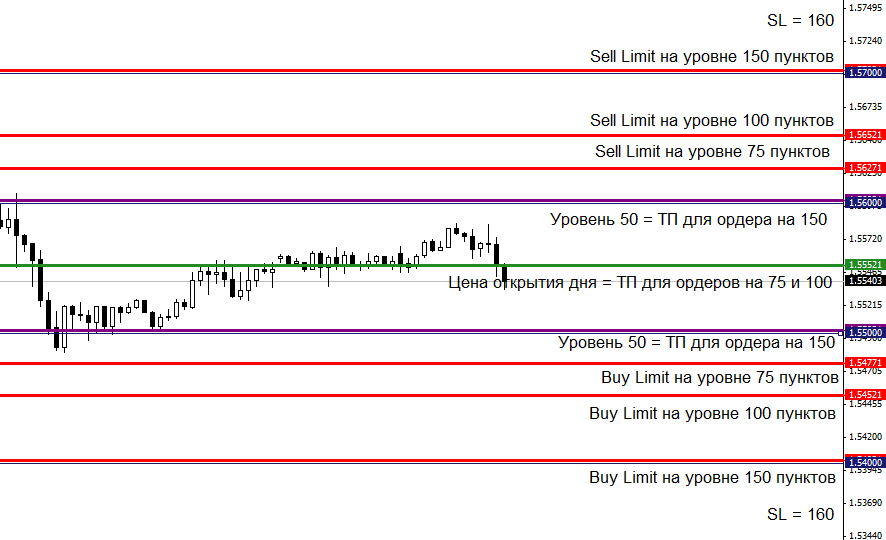
Rule of thirds

Check the "rule of thirds." This will increase the percentage of profitable trades.
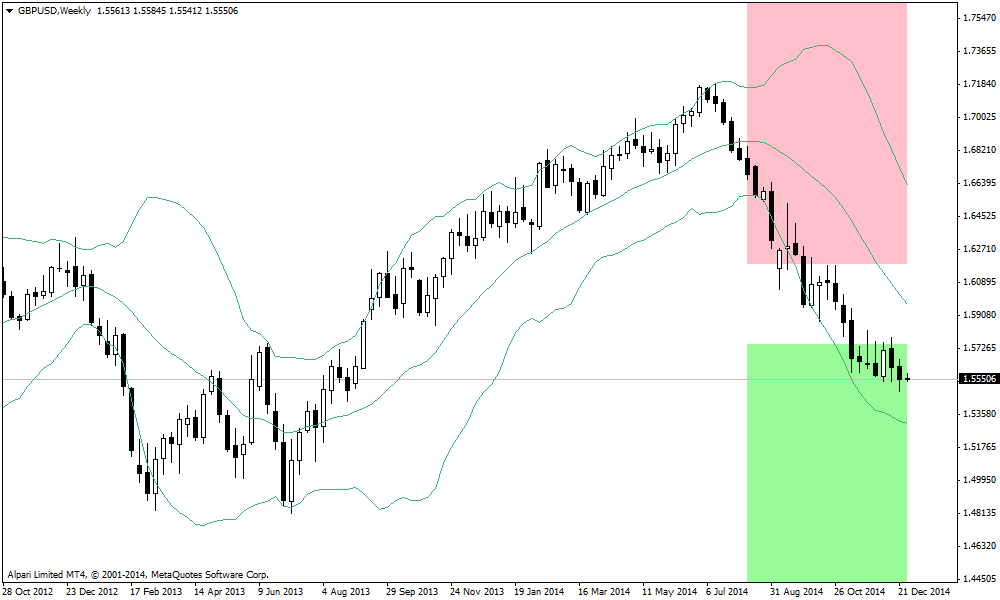
To do this, look to the right at the range between the extreme values of the upper and lower Bollinger Bands on the weekly chart (represented by a simple moving average with a period of 20 and 2 standard deviations). The upper third of this range is reserved mainly for sell orders. The lower third is reserved mainly for buy orders. The central third can be used equally for both buy orders and sell orders.
To make the analysis easier, you can use the indicator bb_thirds, which is part of the strategy. This tool works automatically and updates the areas at the beginning of each trading day. The screen looks approximately like this:
Additionally

- Move your takes and stops to slightly smaller values than the round price levels (the level_lines indicator shows them as well).
- If you want to increase the percentage of profitable trades (while the number of trades will decrease), place pending orders only at levels 100 and 150 points away from the opening price.
- The "rule of thirds" also increases the percentage of profitable trades. See above
- You can close profitable orders during the day. One option is to check the charts 2 times a day: open orders once, and check a second time before the American session.
- If there has been no take for several days and the order is in profit at the same time, it is better to exit with profit.
- Keep track of order dates so you do not get confused.
- For experienced traders only: it is possible to use the locking technique. At the same time, watch that there are no more than 3-4 orders in one direction. That is, 3-4 buys and 3-4 sells maximum at the same time
Locking

Originally, this system does not use stop-losses, only locking. I added the rules for placing a stop-loss because it is too difficult for beginners to work with locks. But I think that, although locking is intended for experienced traders, adding a few words about applying this technique specifically to this strategy would not hurt.
So, this methodology is based on using positions equal in size but opposite in direction in order to cover losses on unsuccessful positions, and it works as follows:
If the initial position is a buy, we place a sell position as protection, and vice versa. The protective position must be equivalent to the initial one in lot volume (size). Protective positions can be set using pending orders.
In our practice, we always place pending protective orders in cases when we do not have the opportunity to monitor price movement on the screen, especially when important news or an event is released, after which the market may move sharply against us while we are forced to step away.
After placing such a pair of positions, you need to know how to manage them properly in order to close them.
Placing and moving protective positions
If your position becomes unprofitable, then, before it is too late, you should urgently take measures to prevent losses from growing to an unacceptable level.
Namely, use the method of placing an order equal in size and opposite in direction. Such "locks" stop losses, prevent them from growing, and give us time during which we can manage the situation and make up our losses.
The term "equal and opposite order" implies that we open an order equal in volume (size), but opposite in direction (we "fix" our monetary difference in equivalent for a point of price movement), that is, one of the orders is profitable and the other is losing, while the monetary difference between them is fixed. Thus, if the initial order is a buy with a 0.1 lot (that is, a price movement of 1 point is equivalent to about $1), then the equal and opposite order to it will be a sell with a position size of 0.1. If the initial order were a sell with a position size of 0.3, then the equal and opposite order to it would be a buy with the same position size of 0.3. In addition, an equal and opposite position can be used in cases when it is necessary to protect several buy positions or several sell positions by placing equal and opposite orders with a volume equal to the sum of all volumes of the positions to be protected.
After placing a protective equal and opposite order, the losses on the initial order become unchanged, regardless of whether the current price rises or falls. It is possible that the losses will change slightly because of a different spread price when placing the protective order, and also if different swaps will accrue over time on one or both positions.
By placing a protective order, we pursue the goal of reducing and eliminating the losses that are blocked by both orders. To get out of the lock, we need the price to move to lower values for opening a buy position, or we need the price to move to higher values for opening a sell position. This logic fits well with the idea of buying something at a lower price and selling something at a higher price. When the gap between the initial position and the protective position is eliminated, or when the difference between them actually becomes positive and the trading as a whole brings profit, the protective lock can be removed by closing both positions. I hope that the examples and charts presented below will clarify the understanding of this process.
Example: Locking an unsuccessful buy position
Despite the presence of several methods of reducing losses that exist in a pair of equal and opposite positions that "lock" losses, it is probably easiest to wait until the price approaches one of the positions that will be in profit and then close that position. And after that, as the price approaches the remaining position, place a new protective equal and opposite position. Repeating the closing of one of the positions and placing a new one located closer to the opposite one should be done as many times as necessary to prevent the losses that arise when both positions are closed at the same time.
That is, our top-priority task is to minimize the size of the lock as much as possible, the distance between the orders.
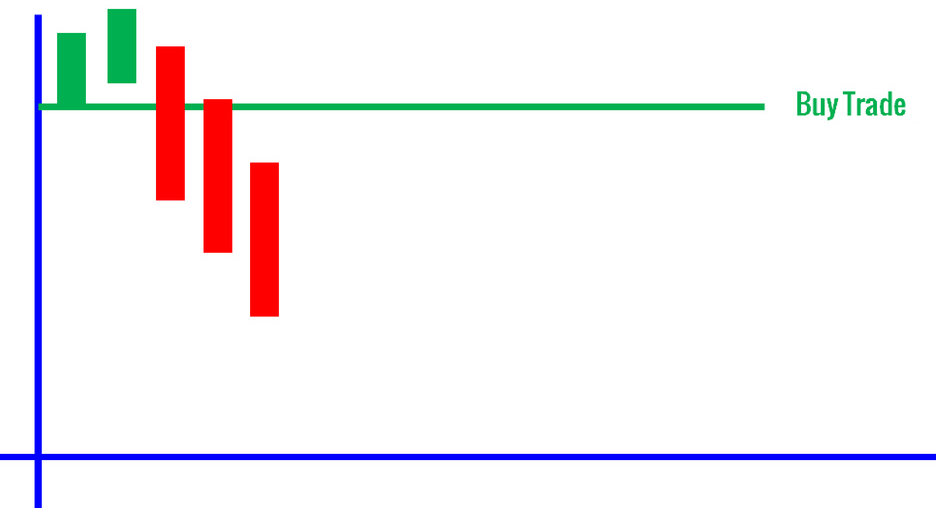
Fig. 1. The price starts moving against you. A buy position is open, but the price went down and you are taking losses. The price trend reflects a far from cheerful outlook.
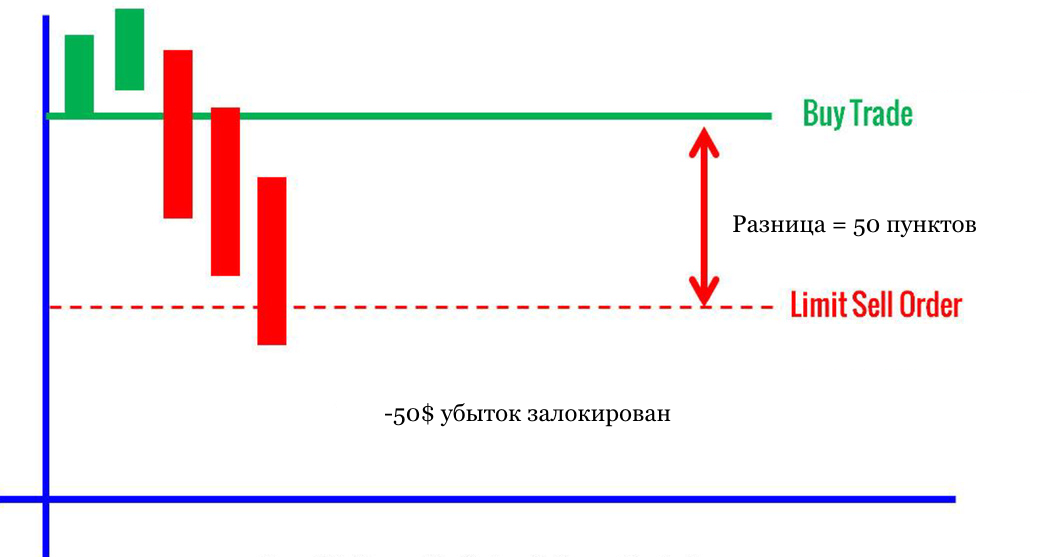
Fig. 2. In order to stop any further loss, you decide to place an equal and opposite sell order. You determine the placement of the sell order yourself, according to your individual risk level. It can be placed at a distance of 25 to 50 points below the buy position.
Buy Trade - Buy order (size 0.1 lot)
Difference between orders = 50 points
Limit Sell Order - Sell limit order with a size of 0.1 lot
Please note that if the buy has already gone, say, 60 points into the red, we do not open a sell at market, but place a Sell Limit where we need it. In this example, at the -50 point level.
If the current price continues to fall further, the loss from the initial buy position will keep growing, but the profit on the new protective sell position will also increase by the same amount, keeping the total loss at the same level. When the price trend changes (if the price rises), the losses on the buy position will decrease, since that position will become profitable, while the profit on the protective sell position will decrease, since that position will become losing. Therefore, the losses that existed at the moment the protective sell order was placed will remain unchanged. In this example, I demonstrated a lock with a loss of 50$. Nevertheless, this value will depend on the difference in the number of points between the two placed positions and on the size of those positions.
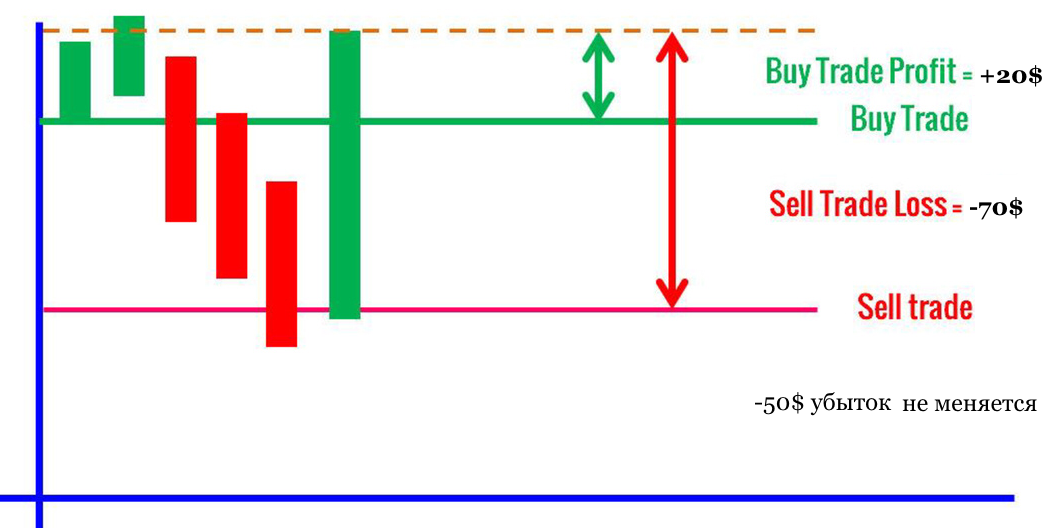
Figure 3. Now, to manage the lock, to reduce its size, you have the option either to sell at a higher price or to buy at a lower price. To manage the buy position, the price needs to stop falling and start rising. As soon as the buy position begins to show a small profit, it can be closed, and then a new buy position can be opened by placing it at a lower price. Thus, the value of the lock will decrease, since the buy position brought a small profit and was closed.
Buy Trade Profit = $20 - Profit on the buy position = 20$
Buy Trade - Buy position size 0.1 lot
Sell Trade Loss = -70$ - Loss on the sell position = 70 $
Sell trade - Sell position size 0.1 lot
The losses remain stable at the level of 50 $
In this example, the loss on the buy position was 50 $ and has now decreased to 30 $, because we closed the buy position with a profit and opened a new buy position at a lower price, locking our actual loss at the level of 30 $.
Next, we wait for an opportunity to replace the sell position with a sell at a higher price or, using the same technique, to move the initial buy position so that it will be even closer to the sell position.
Money Management

Since there may be several orders, it is not recommended to risk more than 1-2% in 1 trade. If you use the locking technique together with this trading system, then the risk is 0.5% per trade maximum. You can use a special money management calculator for calculations.
Conclusion

The "Schrodinger's Cat" forex strategy shows an excellent example of specialization in the multifaceted currency market. Its advantages also include the small amount of time required to work with this system, as well as ease of use due to the absence of complex analysis. With the addition of the locking technique, it is quite possible to almost completely get rid of losing trades, but inexperienced traders are advised to use a stop loss.
P.S. In general, in the original the system has no stops, only locks.
I selected the stop size myself based on the average volatility over the last couple of years. So you can safely experiment with the stop size. Moreover, both in the larger and in the smaller direction.
Download the "Schrodinger's Cat" TS files

Sincerely, Pavel Vlasov
TradeLikeaPro.ru