
The Santa Claus Rally and More: How to Trade Before the Holidays
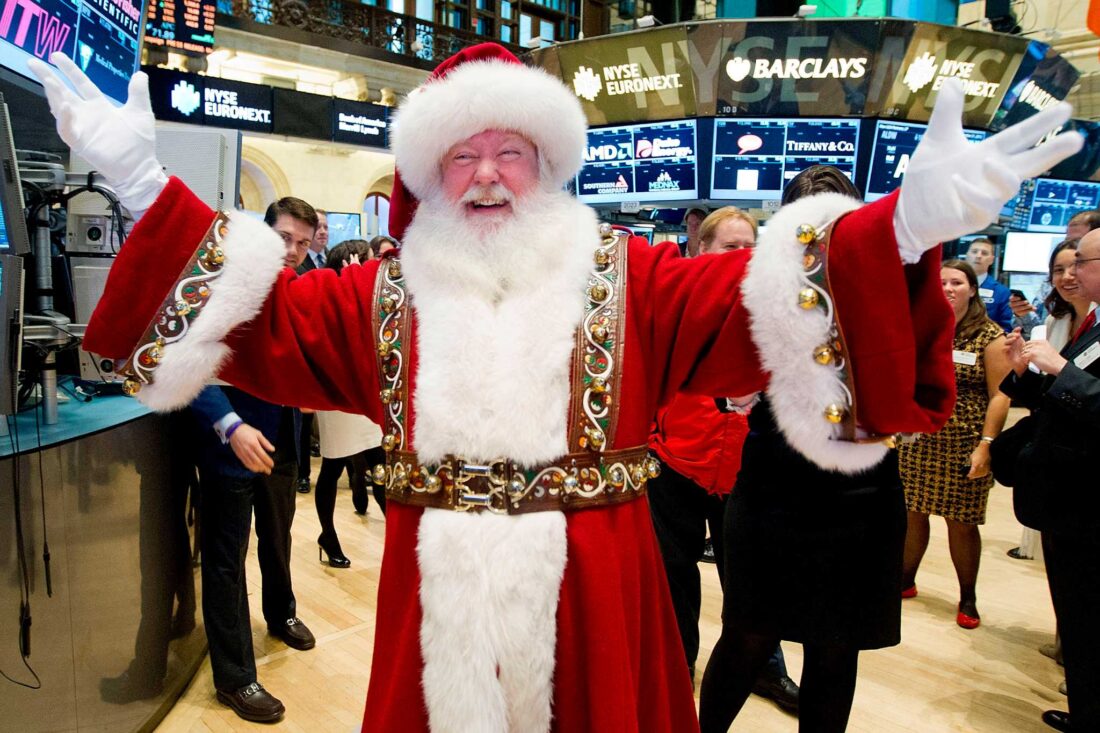
There is a persistent belief among market speculators in the Santa Claus rally. It has grounds, but the issue deserves a deeper look.
According to Russell Investments, from the third decade of December until the beginning of the second decade of January, trading volumes on exchanges fall by 35-50% from their usual level. In plain language: almost half the market disappears, and it becomes fairly thin.
But trading volumes on global exchanges also drop just as sharply in early July, when the United States celebrates Independence Day. On Russian exchanges, there is nothing to do in late April and early May because of the long May holidays.
Most professional market participants and seasoned individual traders prefer to rest on holidays and the days before them.
But trading continues, which means someone is taking part in it. Quite often, that "someone" is you and me. So if that is the case, let us figure out how to trade in a thin pre-holiday market.
What a "Thin Market" Means in Simple Terms
The term "thin market" usually describes a market where trading volumes are small, liquidity is low, and the number of participants is limited.
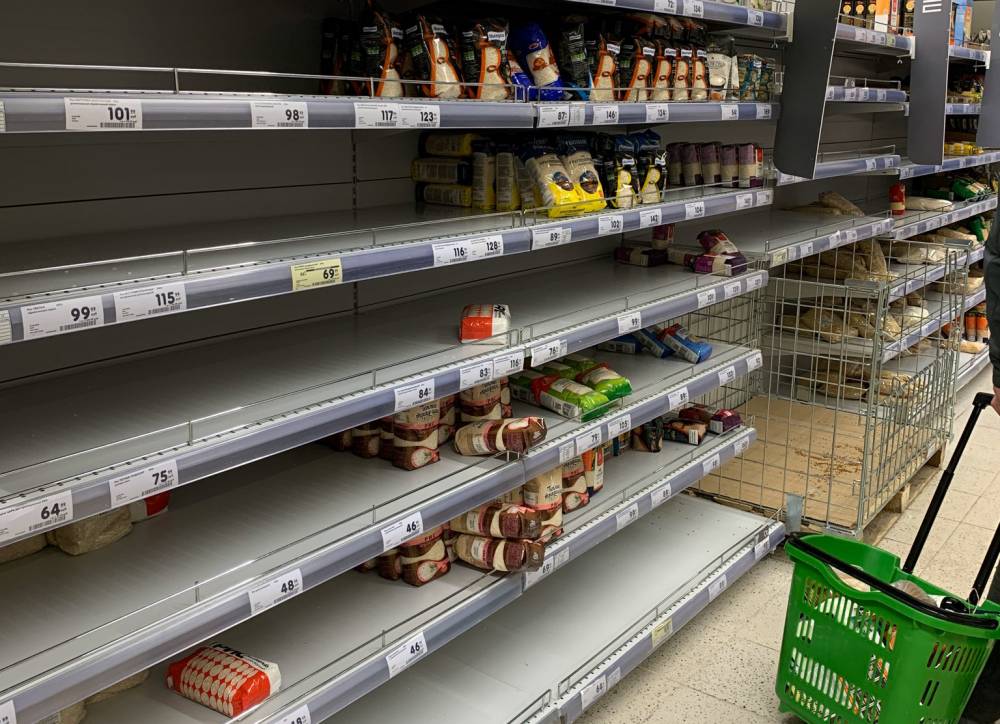
In the usual sense, this can be a market for narrowly specialized securities, small-cap stocks (penny stocks), private-company debt instruments (junk bonds), certain segments of the currency market during off-hours, or the market for exotic goods, including various shitcoins (crypto is recognized as a commodity in the main global jurisdictions).
In such conditions, even a small trade can significantly affect the price, and the spreads between the bid and ask are often wider than in liquid markets.
If we are talking about liquid instruments, then in this case a thin market means a period when the number of players drops significantly. This usually happens on holidays or during crises. In the first case, overall volumes fall; in the second, they rise, but the market becomes even thinner because of it.
We are interested in the situation when trading turnover falls on "normal" instruments because of a calendar factor, that is, because of various holidays. In this case, the market is thin not because liquidity disappeared due to force majeure, but because it is time to rest.
This is very important, because these are exactly the kind of "thin markets" that are very interesting to work with.
Features of Pre-Holiday Trading
Exchange trading on pre-holiday days is most often about "good spirits" and the distribution of liquidity loaded earlier. This "good spirits" effect is especially visible before Catholic Christmas (that very Santa Claus rally) in the stock market and its derivatives.

In this context, we should not forget about U.S. Independence Day (July 4) and Thanksgiving at the end of November. On these days, a complacent mood often reigns in the markets, which means some kind of upward dynamic can be expected.
Of course, rallies or even just impulses do not happen every time the calendar shows a "red-letter date." But the higher probability should be kept in mind.
Pre-holiday trading has its own features.
Lower liquidity. Many institutional participants and algo traders reduce activity: order books become "thinner," and depth falls. But this market depth is more than enough for us to open and close a position.
Wide spreads. Because the number of counterparties declines, the difference between the best bid and ask often increases, but on highly liquid instruments this is not critical for plankton, that is, for you and me. In other words, we have enough liquidity, and even market execution can be slightly better precisely because there is no queue of orders, if we are talking about instruments that are highly liquid to begin with.
Higher price sensitivity to orders. Small pressure from one side moves the price more easily. That is exactly what we need.
Simplified volume patterns. A pronounced spike is often seen at the start of the session, followed by calm trading within a normal distribution without unnecessary stop hunting. On pre-holiday days, you can count on a good one-sided move: maybe not very strong, but stable.
Shortened hours and changed settlement/clearing. On pre-holiday days, exchanges operate on a shortened schedule: all moves have to be made before the early close. And that is also very good.
The increased role of retail. During the holidays, retail traders have a stronger influence on price, and retail sentiment is festive, so it is clear where they will push, while no one is really stopping them.
The risk of manipulation. In the pre-holiday market there is usually much less manipulation, if we are talking about instruments that are highly liquid to begin with: stocks and stock futures. In commodity and currency markets, manipulation also happens less often on these days.
How to trade on pre-holiday days
Trading on pre-holiday days should be cautious. Though that is true on any other day as well. Risks should also not be exceeded, just like on any other day. That is, the general trading rules on these days are absolutely the same.

What is worth paying attention to? You should always remember that the pre-holiday rally is often "empty". It is more of a crowd emotion than the calculation of a major player. Therefore, it is better to close positions before the holidays so that it does not become painfully disappointing after the holidays.
If we talk about the type of trading, then if there is confidence in market growth, you can work in one direction for several days, as there should be no resistance. You can also wait for a specific short pre-holiday day and trade it together with the market.
Example 1. Trading within a pre-holiday day
Here is an example of the Dow Jones index future, YM. The session is American only, since we are talking about "clean" money, and in the case of American securities it is traded precisely on the American session.
Our first day is Friday, December 19. The last full trading week of the year.
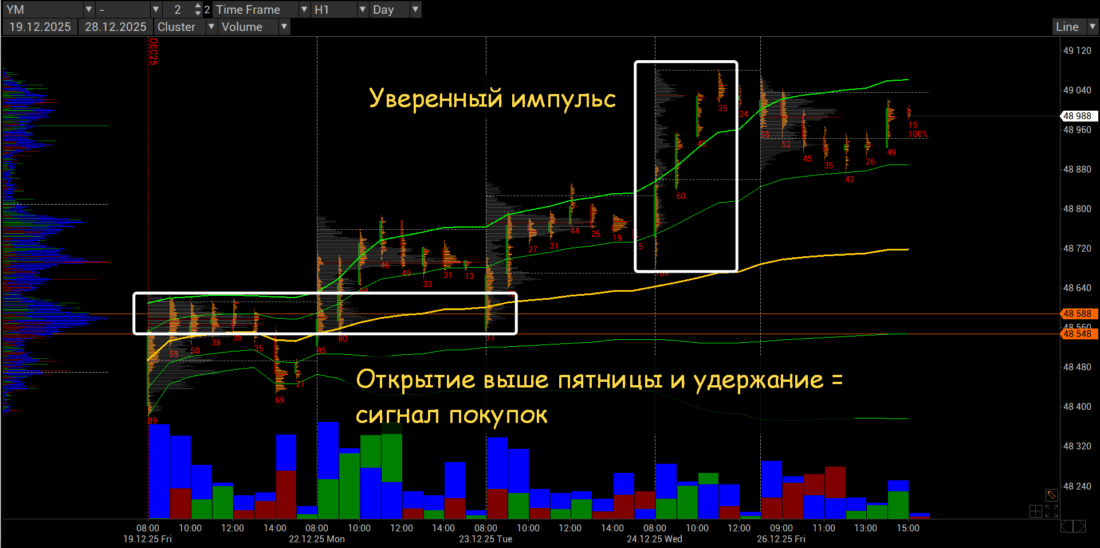
We see that Monday begins with an expansion to the north. This is a good sentiment signal, especially since we already know that the market is inclined to the north.
Can you enter on Monday? Theoretically yes, but practically no. If we talk about risks, they may not reverse it after all (it is still the Santa Claus rally!), and at the very least they may just stand there for a couple of days, but why should positions just dangle in the market for no reason?
On Tuesday we open at the low of the week and rise. It was possible to open here, but we are not playing that either.
The market is thin: the Monday-Tuesday range is only 330 pips.
Wednesday is a short pre-holiday day. We open at support and move sharply to the north. 3 hours of growth. Almost 400 ticks from high to low.
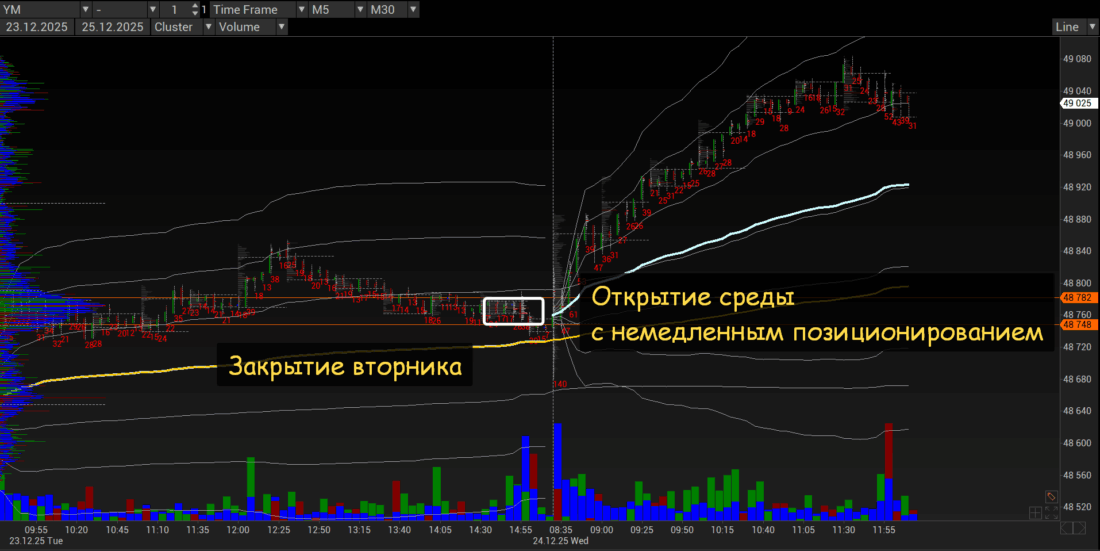
Support is the market close on Tuesday. The opening of Wednesday's short pre-holiday RTH session within Tuesday's closing range with a sharp move above is a very strong buy signal that we had been waiting for: the Santa Claus rally.
Find a convenient place and time to enter after positioning, and off we go!
Example 2. Trading during the holiday week
The example above shows that it was possible to open positions on Tuesday during the support test (Friday's close).
I will show the same days, but using NQ, the NASDAQ index future, as an example. On Tuesday it opened at the low of the week, testing Friday's breakout into Monday. If it feels scary to enter on the test, then after volume positioning by 10 a.m. CT on Tuesday it was already possible to open a position.
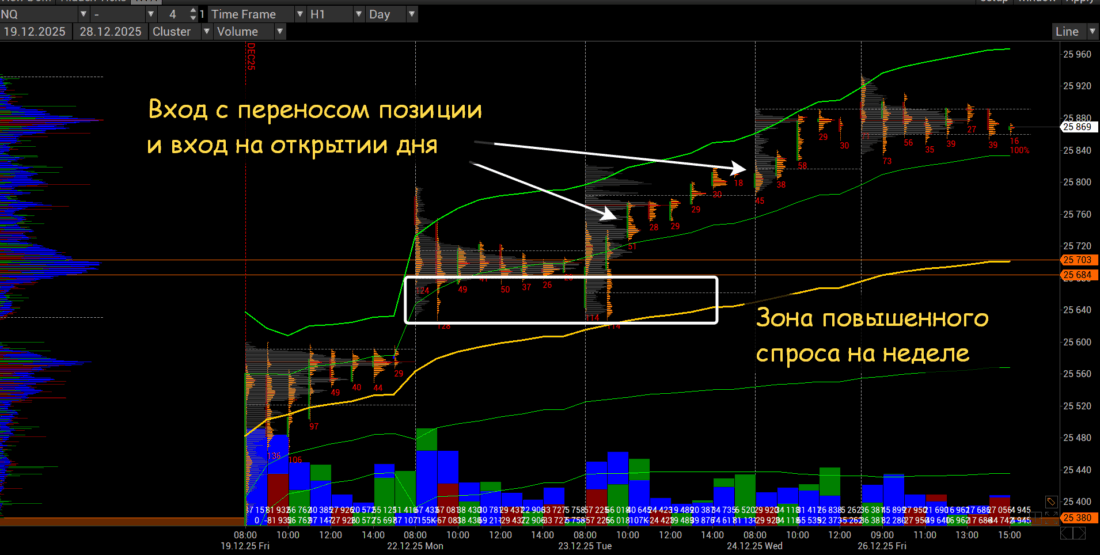
If in the first example Wednesday gave a range similar to Monday-Tuesday, then here Wednesday worked clearly but gave very little, so of course it would have been more interesting to open on Tuesday.
But even an opening on Wednesday gave a small but very clear pre-holiday move.
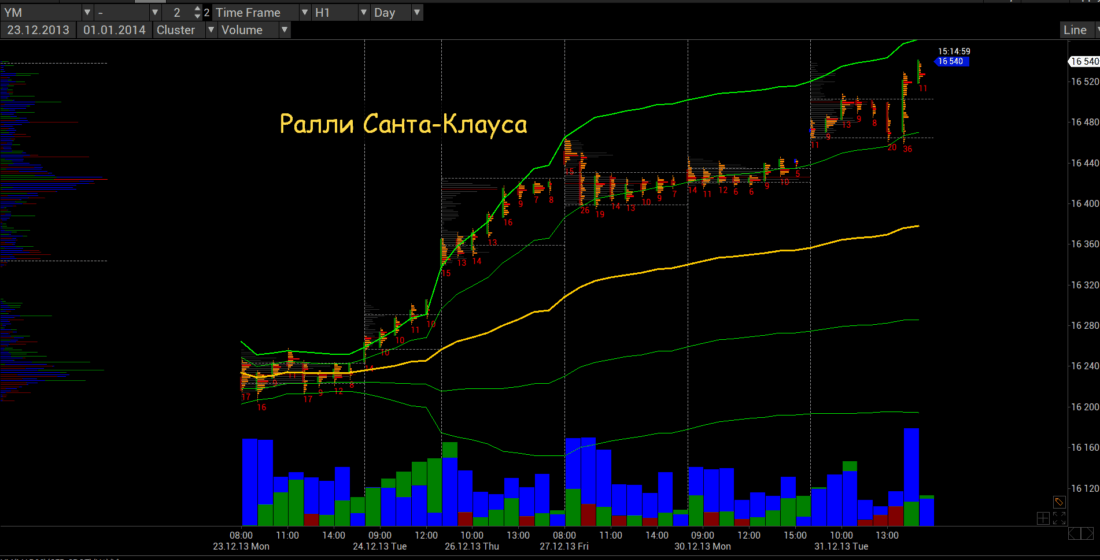
And the year-end rally can also look like this. This is 2013.
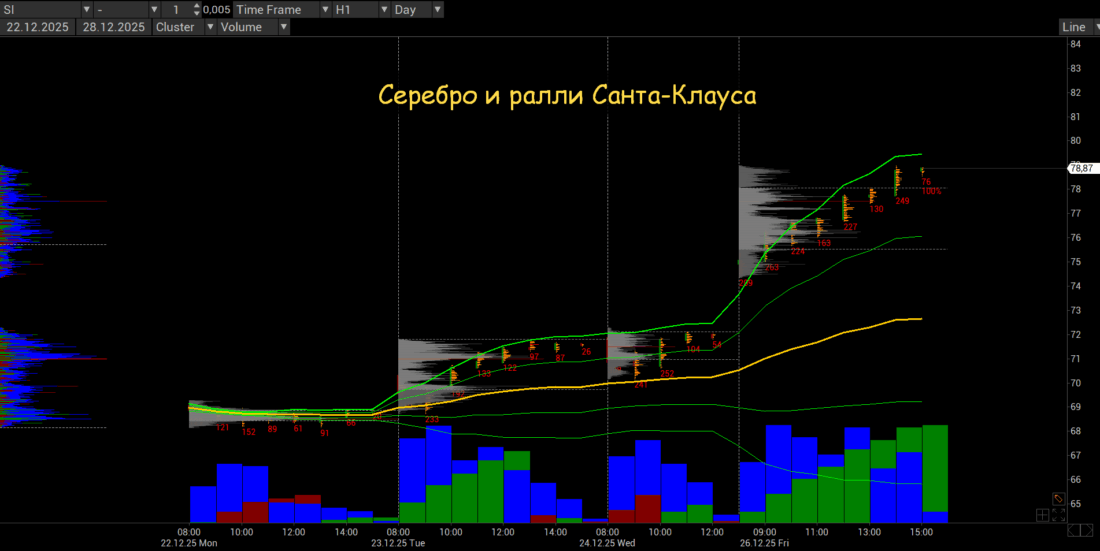
But wait, isn't this what we are seeing now (the end of 2025), for example, in silver? Exactly, this is precisely it in its pure form.
Risks of Trading in the Pre-Holiday Market
Risks of Holding Positions for a Long Time
Above I wrote that it is good to trade before the holidays, but dangerous during the holidays or after them.
Here is an example of trading the YM futures at the beginning of July, that is, before Independence Day in the USA. Tuesday was up, Wednesday was accumulation, Thursday (the short pre-holiday day) was up. Everything is simple and clear.
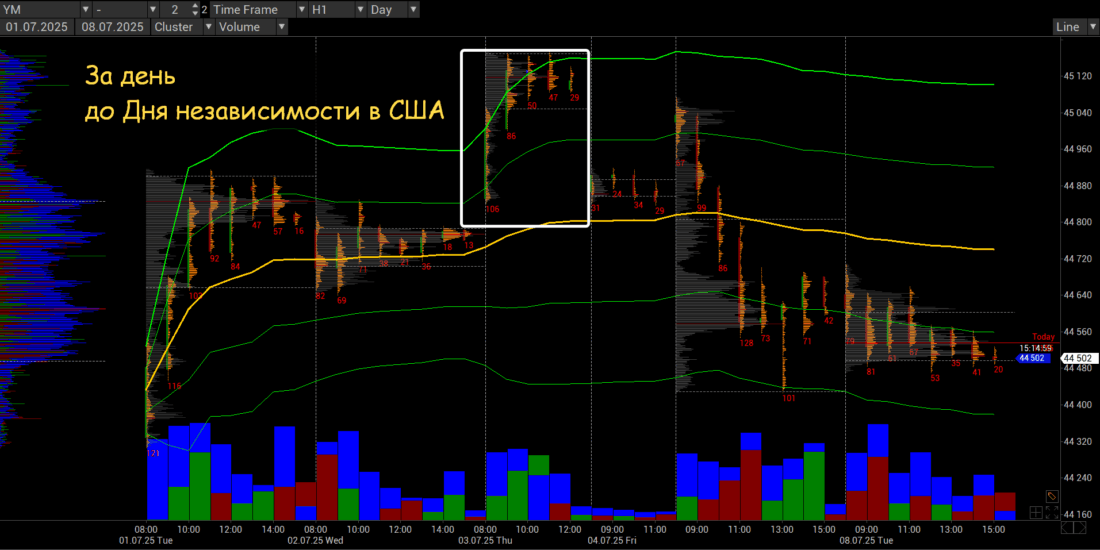
But on July 4, when there was a holiday in the USA and for some reason electronic trading was open, the quote was dragged downward. Then it was pulled even lower. And the point is not even that, but that before the holiday the market had risen on good expectations. The specialist loaded up sells at the highs. And that was it.
Buys had to be made before the holiday. Otherwise they get eaten afterward.
Can you play countertrend on holidays? I have seen pre-holiday days on EUR/USD when they went up in one direction during the first half of the session and fell during the second half. Typical swings.
In the stock market, such behavior within a pre-holiday session is more the exception, but starting with the next session surprises may begin, as in the example above. Or they may not begin. Therefore, you should not look for entries against the trend, because they can keep pulling for a long time in a thin market. And even keep dragging afterward. No leveraged deposit will be enough.
Risks of Intraweek Trading
Here are Christmas and New Year in 2012. Back then the markets were not very lively, and there was no Santa Claus rally. There were no buys, while at the same time the short side looked frankly weak: maybe not a Santa Claus rally, but clearly not a collapse either.
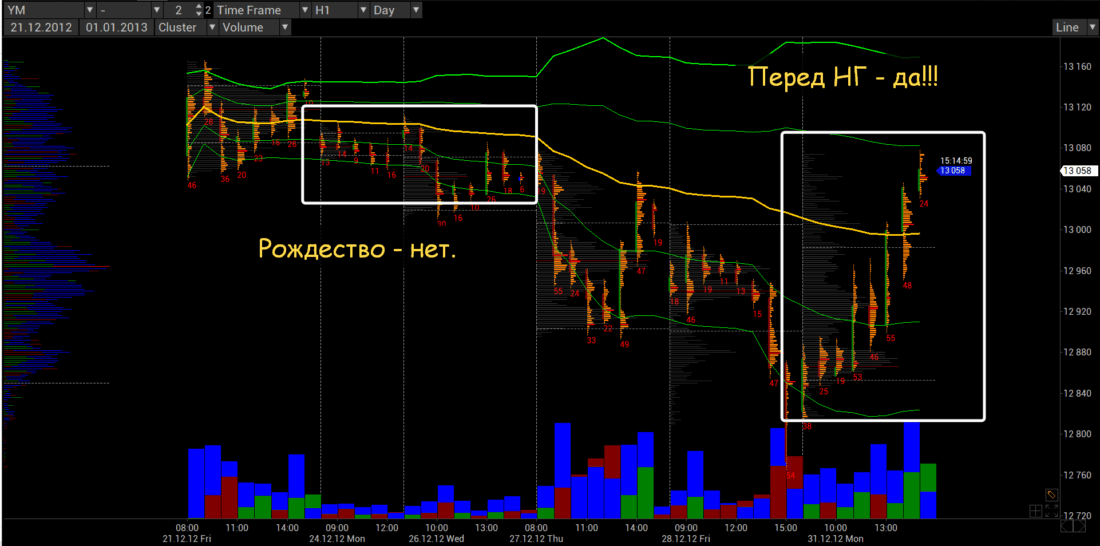
But on December 31, right under the tree, they played back almost the entire short from the 21st.
Rare but Accurate: US Presidential Elections
Above we looked at history to see how one can work relatively calmly on pre-holiday days in a thin market.
But there is one more holiday that for some reason we do not consider one. It is the day the voting results of the US presidential election are announced. These are days when the market is not thin at all. But in any case, these are days and weeks of strong one-way moves.
I will show the available charts on the YM instrument. Any other stock index futures behaves in a similar way.
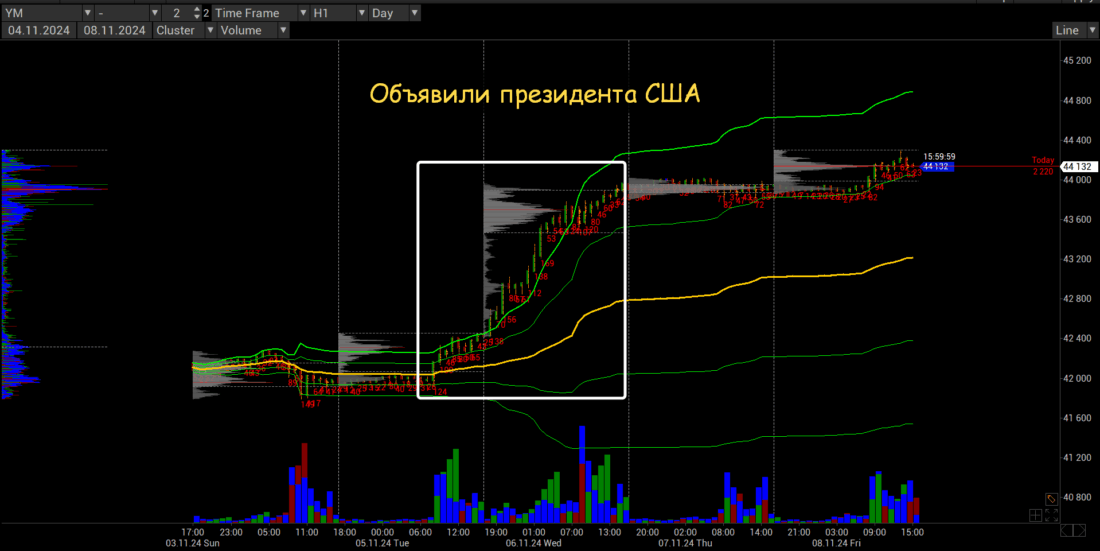
November 5 and 6, 2024. Almost 2 thousand points of growth, which is just under 5%. And this is a case when you can "enter at market."
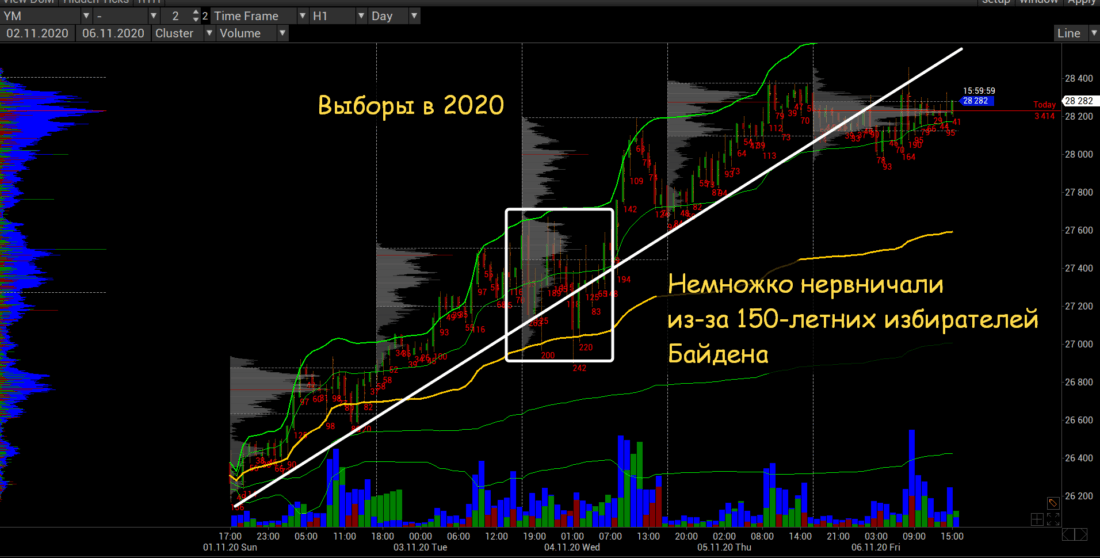
Let's roll back 4 years. 2020. The contest between Trump and Biden: ballot stuffing, 150-year-old Democratic voters, and so on. And +8% in a week. With a complicated story precisely at the moment of determining the winner. That was exactly when the whole "show must go on" story was unfolding, and so on.
If you look at the pattern, they simply gathered liquidity at the stops and then continued north.
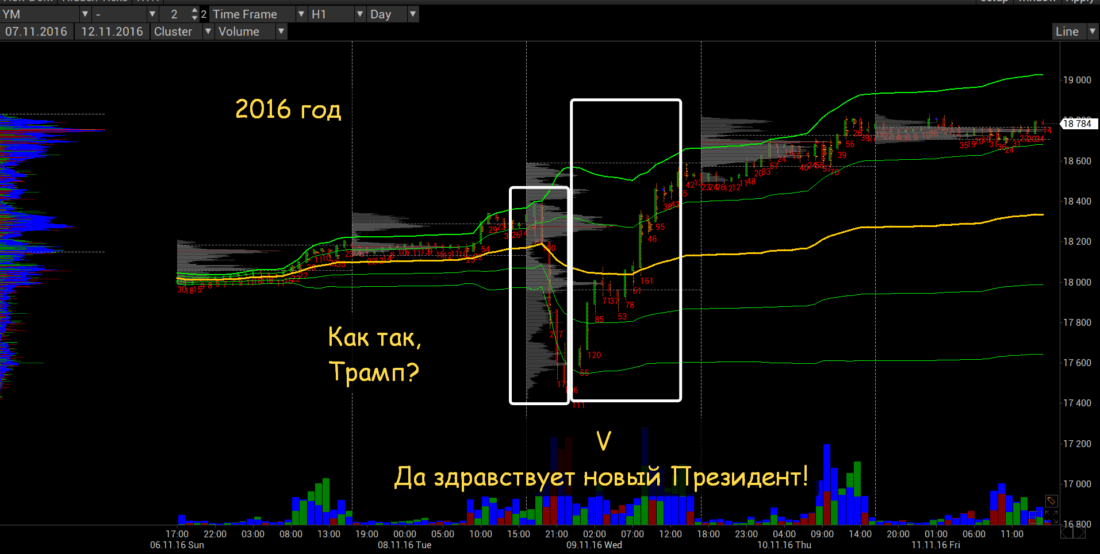
Let us roll back another 4 years, to 2016. The market was preparing to rise, but then Trump was suddenly announced. In 5 hours the loss amounted to 5%, after which a sharp V-shaped reversal occurred. The president is elected, long live the president!
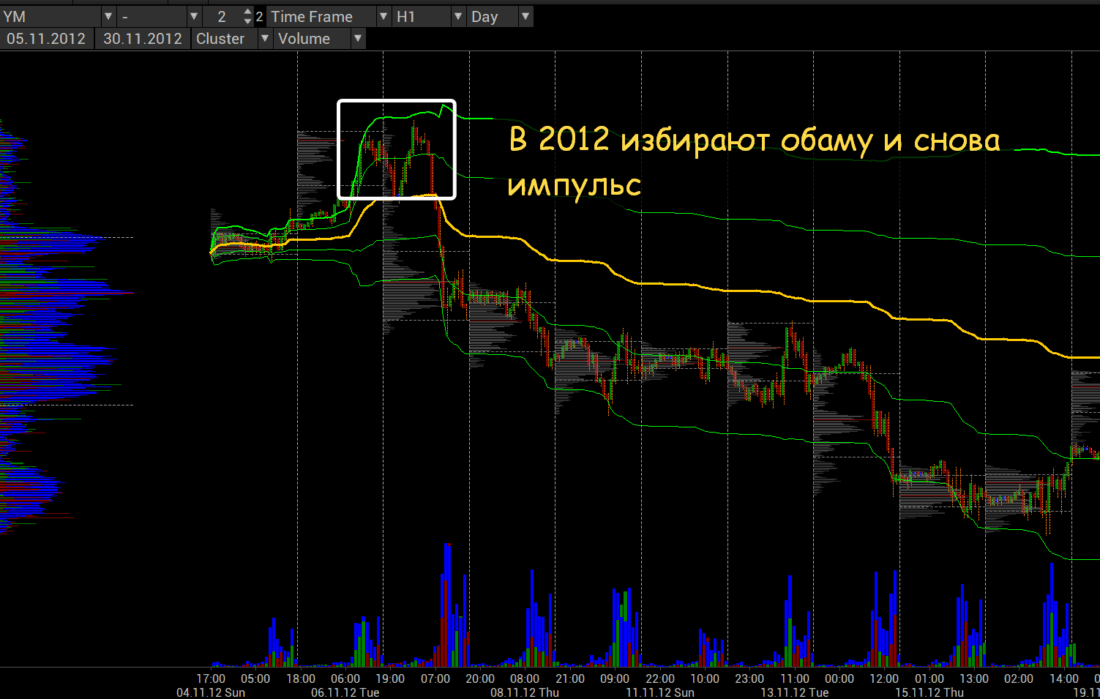
2012. Obama and a second term. The market did not react very well, but the main thing is that the reaction was strong. Upset speculators drove the quote down by 6% over a couple of weeks. Of that, half of the move south began immediately after the winner was announced.
By the way, it is worth paying attention to the behavior of the dollar index after Trump's election. Almost identical in 2016 and 2024. I will not show it - many people have MT at hand.
Conclusion
Holidays are meant for rest. But exchanges often continue operating on pre-holiday and holiday days.
On these days there can be very interesting trading opportunities: stops are hardly hunted, and the setups are drawn cleanly.
But whether to trade at this time or not - everyone decides for themselves.
Best regards,
Ivan Rusin