
How to combine several expert advisors on one account?

Good afternoon, ladies and gentlemen!
A smooth, beautiful rising equity curve without significant fluctuations not only gives the trader aesthetic pleasure, but also perfectly attracts investments. This is the dream of any serious trader in the Forex market. And in today's article we will figure out how it can be brought to life. I will explain what techniques can be used to obtain a beautiful equity curve from several expert advisors trading on one account.
Right and wrong equity curve
As many of you probably already know, a beautiful equity curve can be obtained by trading expert advisors that use dangerous position management methods in their algorithms, such as martingale or adding to losing positions. In these cases it turns out very beautiful, for example like this:
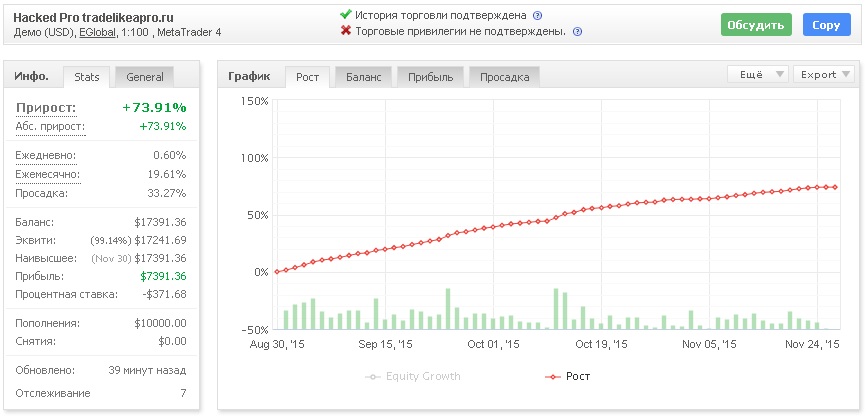
Or like this:
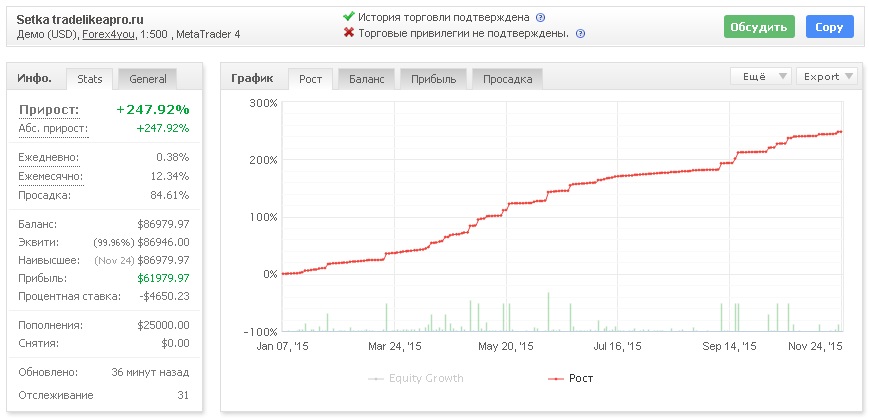
And yet, if we enable the display of the equity line (account funds), a much less pleasant picture of so-called "squiggles" will open before our eyes, which clearly makes it understood that we are looking at a grid:
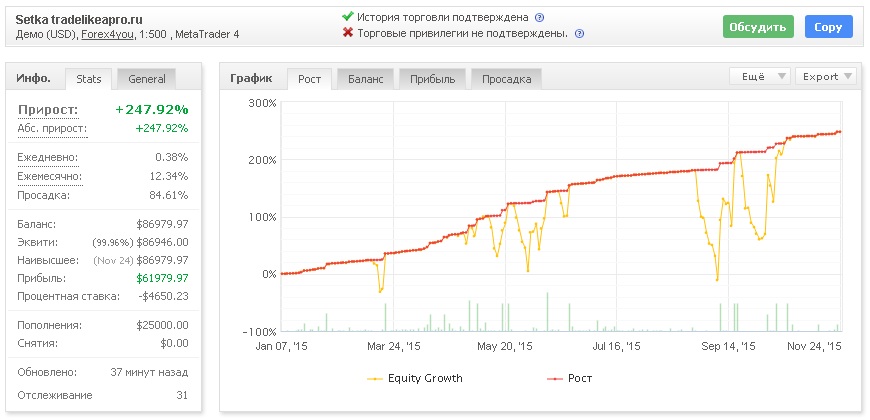
We will not discuss now the advantages and disadvantages of trading dangerous expert advisors, I will only say that investors are in no hurry to trust such robots with their hard-earned money, just as you should not. Yes, with the proper ability, skill, and accompanying luck, you can make money with their help, and not badly, but it is still dangerous, and trusting such robots with good money, and especially other people's, investors' money, is not the best decision. Such an equity curve, despite its beauty, is the wrong one.
And here is an example of the right equity curve:
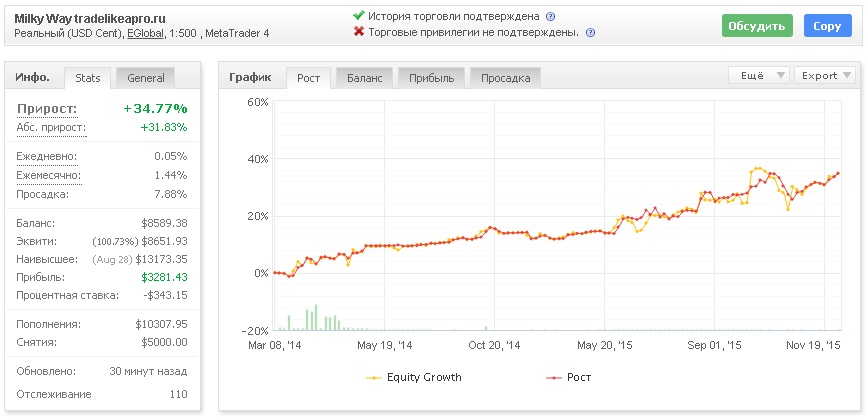
Or here is another one:
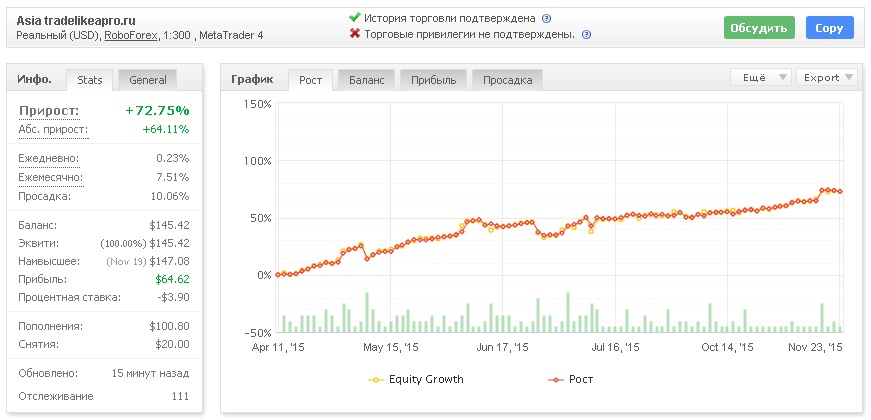
Yes, they are not perfectly smooth, but they are still beautiful too. So how can such a result be achieved? What is the secret? Why do most expert advisors have equity curves that are really somehow "crooked," and only a few truly attract the eye? Let us try to figure this out.
Number of traded instruments

One of the three factors that makes it possible to obtain a beautiful equity curve is the number of traded instruments. Suppose you wrote an expert advisor, optimized it on the maximum possible number of currency pairs, and conducted forward tests on a small real account for about 3-6 months. The next stage will be to filter out the currency pairs that showed negative results.
Let us examine this using the example of the Asia advisor. In myfxbook monitoring there is an option for custom analysis, for example, analysis of trading on each pair separately. That is exactly what we need. I identified the currency pairs for which the advisor's performance does not look very good:
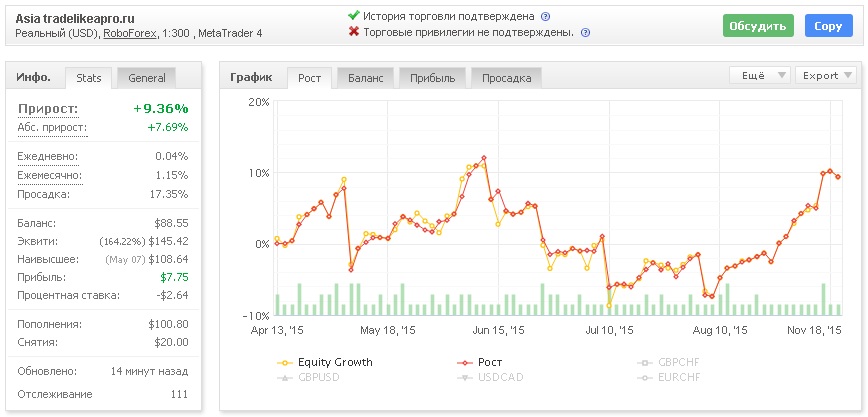
These are the pairs GBPUSD, USDCAD, GBPCHF, EURCHF. In further trading with the advisor, I would throw them out of the basket. That leaves, respectively, USDCHF, USDJPY, GBPCAD, EURGBP:
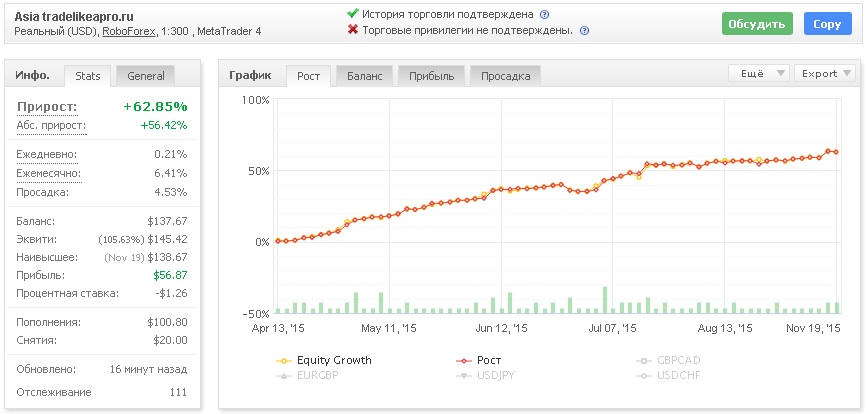
Please note that the equity curve became smoother, profitability fell from 70% to 60%, but the drawdown was reduced by half.
A huge advantage of running the advisor on the maximum number of trading instruments is that losing trades on some instruments are offset by profits on others, which is clearly visible in this example: look at the ugly performance of the pairs that we threw out and at the advisor's performance on all pairs. In this case, the successful pairs wonderfully pulled up the unsuccessful ones. At the same time, the more successful pairs there are, the better, naturally, and the smoother the final equity curve will be.
Another positive point in using the maximum possible number of instruments is that even a profitable set (settings set) may at times work not very effectively, while the other pairs will be pulling it up. For example, the pairs we discarded may not actually be that bad, they simply traded poorly over a specific stretch of time, and in a week or a month they may suddenly show themselves in all their glory. From this comes a logical conclusion: you need to separate the live basket and the demo basket. Only proven sets that have shown themselves well go to the live account, while on demo the trading of our whole mix continues with periodic analysis in the hope of finding sets that simply have not yet had time to show themselves. By the way, who said that there must be one expert advisor on one pair with one set in the basket? What should you do if, after optimization, you liked several sets? Forget the agony of choice, put both sets to work and let time choose the worthy set for us. A small life hack: do not forget to set different magic numbers and different comments in the settings for two different sets on one pair; it is best to write the set name in the comment.
Operating time and strategy types

So, you did listen to me after all and tested about a dozen of your expert advisors on small accounts over a sufficiently long period, selected the sets, and are ready to put all of it on your main live account. The time has come to find out which expert advisors should be placed together and which are better saved for another account. The ideal basket is one in which trades do not open simultaneously, and if they do open, then not on correlated currencies, and if they are on correlated ones, then in different directions. In other words, your task is to choose expert advisors in such a way that their trades do not intersect, otherwise you will simply increase risks inadvertently. Just imagine that your expert advisors simultaneously opened buys on the pound, euro, and yen and, to top it off, a sell on the franc and euro-franc, while the risk per trade in your expert advisor is set at 2%. What will happen if all these trades get a stop-loss, given that the expert advisor logic is the same and the pairs move very similarly? Correct, you will end up with a total loss of 10% of the deposit.
To avoid this, you can use several techniques. We have already discussed one of them: selecting the sets that showed the best results in tests on small live accounts. This will allow you to get sets with the best possible statistics, including, for example, the minimum probability of a repeated losing trade.
You should also avoid installing expert advisors with cyclical drawdowns that overlap each other. If a feature of the strategy is, for example, ineffective trading in the summer on all currency pairs, which is clearly visible in tests, it is not worth using it during this period with high risks and on a large number of instruments in order to avoid deep drawdowns.
The second technique is to place expert advisors with different operating principles into the basket, ideally with different trading times. For example, installing a night scalper that trades the Asian session, a medium-term intraday robot that trades the European and American sessions, and a couple of daily scalpers with rare precise entries a couple of times per month on one instrument. Then the probability that 5 trades will be opened at once will decrease noticeably.
Limitations in operation

And the third technique, available only to those who wrote their expert advisors themselves, is programming limitations on order opening for their algorithms. For example, I use the following limitation: if the current open risk on positions in the basket (open means the orders still have risk of loss and are not protected by breakeven) exceeds a certain set threshold (by number of trades, 3 trades at a time for example, or by total risk, no more than 6%), then a new trade is skipped. In this case, the hypothetical situation described above with a huge loss is ruled out in principle. A more complex version of the algorithm described above is to include currency pair correlation in the calculations. That is, it is possible to take into account and exclude from calculation not only trades for which losses are already ruled out (due to protecting the position's profit with a stop-loss), but also pairs directed in different directions. For example, why not allow a GBPUSD buy trade to happen if EURUSD is hanging in sells for us? Most likely one of these trades will turn out to be correct and will cover the loss of the second.
A short summary:
- optimize your expert advisors on the largest possible number of instruments;
- if you cannot decide which set to prefer, run both with different magic numbers;
- start testing a new bot on a small live account;
- after 3-6 months, put the best sets on your main live account;
- do not stop the work of expert advisors on a small live account; some sets may still show themselves;
- try to select expert advisors with different principles and operating times for the basket in order to avoid duplicating trades;
- if you programmed your expert advisors yourself, think through functions that limit the possibility of expert advisors trading on correlated instruments.
Conclusion

Even just assembling at least five profitable good expert advisors and running forward tests on them lasting at least three months is already a very considerable amount of work. But on the other hand, what in trading comes easily? Algo traders have a lot of advantages compared with traders who trade manually, and among them is the ability to get a smooth equity curve, because following 20-30 intraday pairs by hand is far from an easy task for a person. Nevertheless, it is precisely solving this task that most often gives such attractive equity curves.
Now you are aware of the main features of running several expert advisors on one account. All that remains is to painstakingly assemble your own ideal basket of expert advisors, which, with the knowledge gained in this article, becomes a more manageable task. As for me, I can only hope that this article will help you in assembling your "money-making machine."
Sincerely, Dmitry aka Silentspec
TradeLikeaPro.ru