
A Critical View of the Problem of Choosing a Timeframe in Trading

It is believed that both in learning exchange trading and in practical trading, the choice of timeframe is one of the main issues. There is also an opinion that trading is more successful on the daily timeframe.
If we speak about American stocks, this statement became true in April 2025. But buyers of Russian stocks are ready to prove with figures in hand that such an approach is groundless: for them, medium-term speculation has long turned into long-term investment.
On the other hand, for many of us trading is a source not only of additional income or expense, but also of quite definite emotions: for example, euphoria and fear. Some need adrenaline here and now, others are simply afraid to leave trades unattended for more than 5 minutes.
Is there any point in choosing some other timeframe besides the daily one? How can one trade on it while taking into account increased risks and overtrading?
Below we will explain why lower timeframes should be considered even by position traders, briefly tell how to trade without timeframes at all, and explain the difference between timeframe and timing.
As a result of reading, it will become clear why there is no "best" timeframe for everyone and why one cannot say that choosing a timeframe improves trading performance.
What Types of Timeframes Are There?
The question is trivial. In the familiar MT4 the choice is limited: M1; M5; M15; M30; H1; H4; D1; W1; MN. You can expand the number with the PeriodConverter script.
MT5 already offers 21 timeframes:
- Minute: M1, M2, M3, M4, M5, M6, M10, M12, M15, M20, M30.
- Hourly: H1, H2, H3, H4, H6, H8, H12.
- Daily: D1.
- Weekly: W1.
- Monthly: MN.
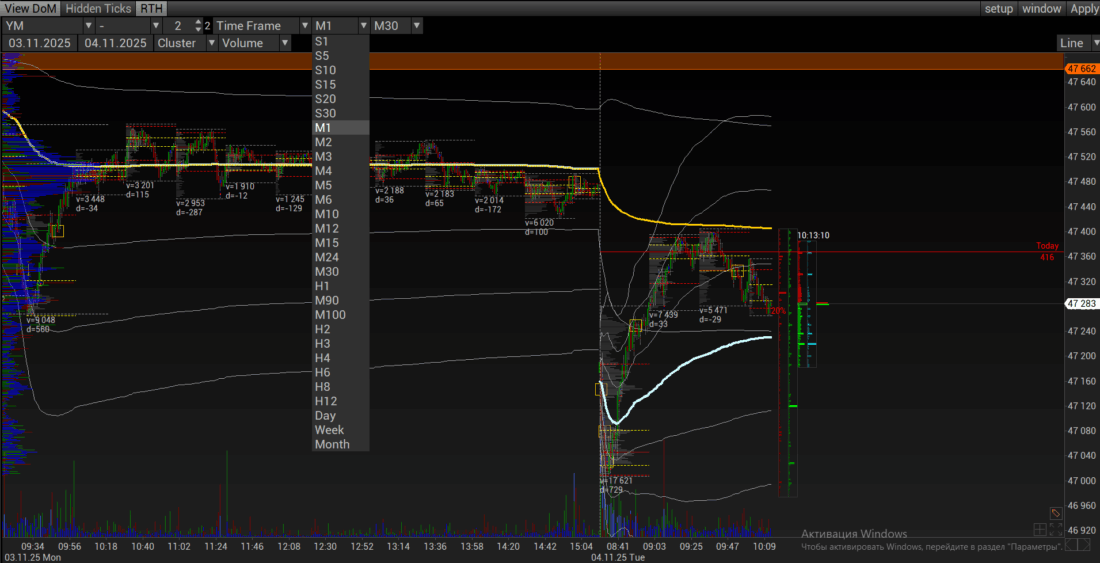
Enough? Not necessarily. In the VolFix terminal there are even more of them. For microscalpers and for those who understand what timing is, second-based TFs have appeared: S1, S2, S10, S15, S30. M90 and M100 have been added to the minute ones. There is also an option to choose an "external" timeframe: inside an hourly TF, for example, two-minute charts are built.
How to Choose Your Working Timeframe?
There are several opinions on this matter. But in general one can distinguish personal and professional factors in choosing a TF. It is also written that the choice of timeframe is influenced by the amount of time you can devote to trading.
Personal Factors in Choosing a Timeframe
Calm and unhurried people can choose daily and weekly charts. Such people, having gained experience and knowledge, can move from the category of traders to the category of investors; I say this without sarcasm.
On the other hand, there are many people who want to see money in their pocket / account every day as payment for the work done. Historically these include both pit traders and modern screen traders trading intraday.
It is also worth mentioning those who prefer minute charts and hundreds of ultra-short-term trades. They are believed to have high stress tolerance and composure. But they also burn out more often and more severely than others, and overtrading primarily affects traders of this type.
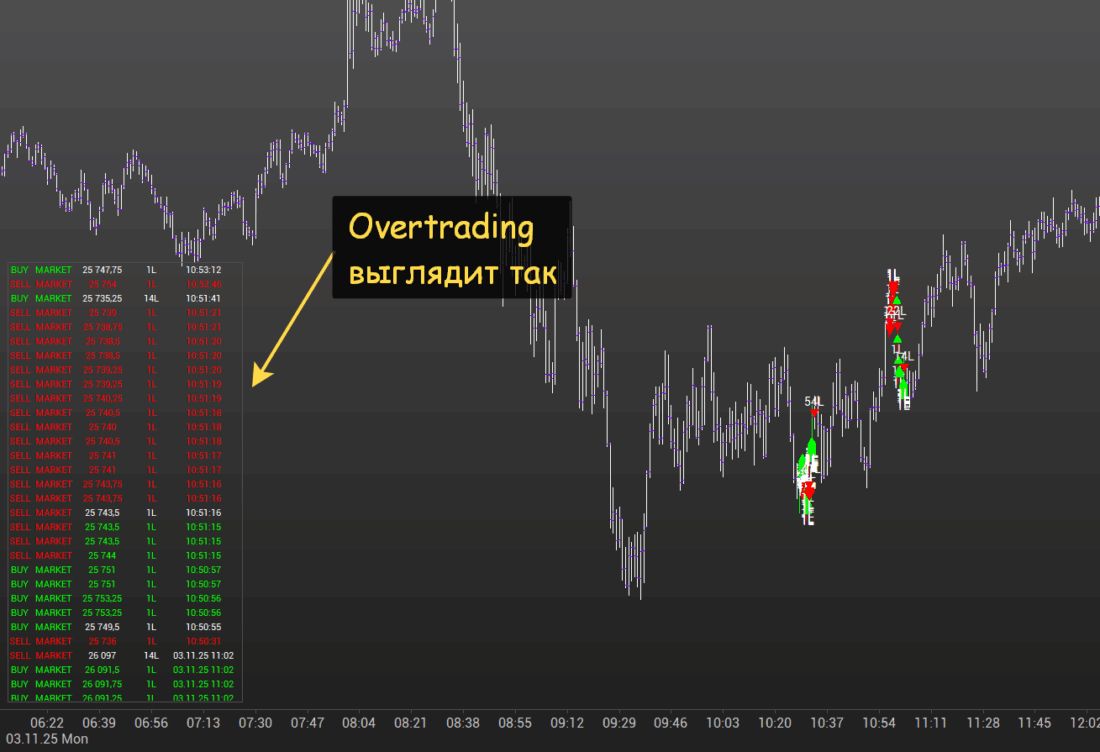
And there are also emotionally labile lovers of adrenaline swings who are attracted more by the very process of opening and closing trades than by making a profit. Such players, without realizing it themselves, are chasing not so much profit as loss: emotions in this case are much stronger.
Professional Factors in Choosing a Timeframe
Despite the common advice to begin learning trading on H4/D1, a novice trader will most likely try trading on the minutes: jump in, see the first dollars, tens, or hundreds of dollars in both directions, and jump out happy or terrified. Yes, this is scalping. Yes, this is a path to forming wrong attitudes. But this is the path followed by, if not all, then most traders. Only later can a trader, having gained experience, that child of bitter mistakes (C), switch to daily charts only to get burned on them as well (let me once again remind you about buying Russian stocks).
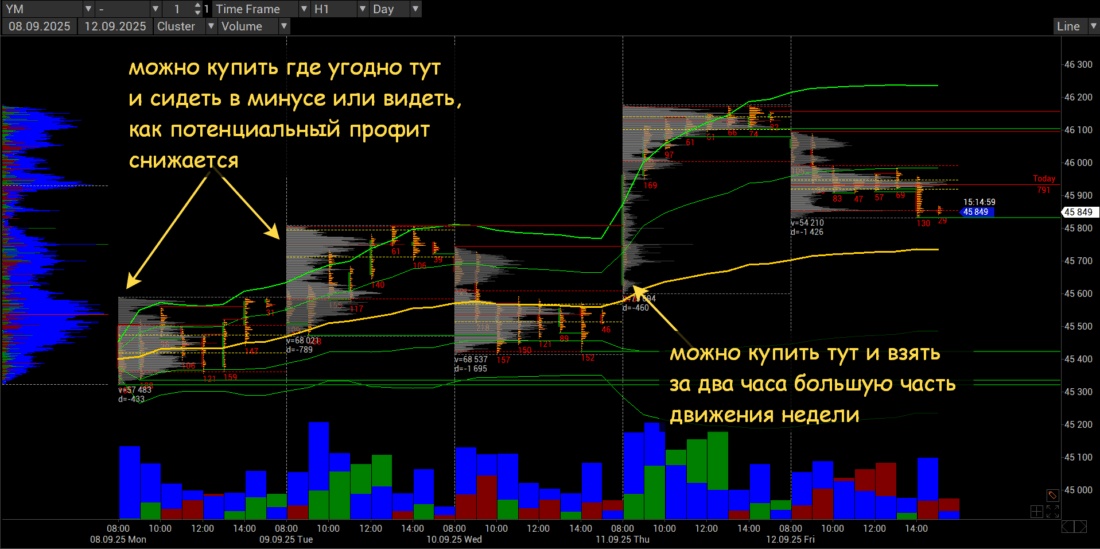
On the other hand, a calm and unhurried trader can switch to intraday trading, because many instruments trade in ranges for a long time, and there is no point in looking for long-term entries there. And 100 points once a week in a couple of hours is no worse, indeed much better than 150 points in a week. A quick trade can be waited out and made at the right time (timing), while a so-called "long-term" one can hang all week in the red or around zero, only to then give comparable profit. And which type of trading is more professional in this respect?
In this same context, one cannot fail to mention trading in prop firms, where one of the conditions is closing a trade before clearing, i.e. intraday trading. And no matter how much you personally love the long term, you have to trade only intraday.
Time for Trading
There is an opinion that students and working people trade on exchange and over-the-counter markets to receive additional income in their free time from work / study. Hence the recommendation to trade on large timeframes. It would seem that everything is correct.
But we know perfectly well that trading is a most fascinating pastime, which for some replaces a casino, for others computer games, and for some relieves loneliness. This means there is no sense in tying the choice of timeframe to one's occupation. If a person is "in the game," then neither study nor work will prevent them from looking for and finding entry points.

Thus, free time cannot be a reason for choosing a trading timeframe. You can have a job and still glance at quotes 15 hours a day, or you can enjoy life on paradise islands, living on dividends from stocks bought 10 years ago and having risen 5 times over that period. Which of these examples is closer to reality, let everyone decide for themselves.
What really matters when choosing a timeframe
Stress resistance, composure, patience
These character traits are important for both the scalper and the position trader.
They say that setups / models / patterns are cleaner on higher TFs. Maybe. But there are many of them on lower ones too, very many. Many does not mean frequent, so reliable entries must be waited for with composure, rather than jumping into the market because it seemed that some kind of pattern had formed.
Moreover, there may be no reliable entries intraday. I am talking about rock-solid entries. Within a week there are also few such short-term entries. Yes, there are more less reliable entries, and as for fifty-fifty entries, they are beyond counting. The same is true on the daily TF, by the way. Is it worth trading such deals? I think the answer to that question will be found in the trading report of both the intraday player and the daily trader. Both can buy the high and sell the low. Both will lose their deposit if they average into a position during the impulse phase against the main move.
Thus, short-term trading does not imply a large number of trades. Short-term trading is merely a game within an understandable period, i.e. a timeframe.

The same applies to stress resistance. The ability to accept losses is important regardless of trade duration. The ability to hold a position is important in any type of play: in a short-term game you must be able to wait for your 100 points, rather than exit at +10. In a long-term game, the order of price movement is simply different. Is the trader ready to hold a position upon seeing the first decent profit in a trade opened a month ago and stuck in the red zone for three of those four weeks?
Understanding market structure and timeframe nesting
Daily trading of any kind implies analysis of higher timeframes. It is also necessary to understand what phase the market is in. If we see an impulse on the daily chart, but overbought conditions are also brewing, should we look for trades with the trend or against it intraday? That depends both on the higher TF and on the game here and now. A classic situation is when, in a rising market, negative news is used for buying the dip and a sharp continuation of growth, both intraday and over the course of a month.
The same is true in position trading. The entry point is already behind us, so should we buy or not? Understanding market structure will suggest that you can buy the high on the daily TF and make a fortune in a week or a couple of months, as happened with those who bought gold in August 2025 at 3400 and closed at 4000 a month later. Or you can buy the low and get stuck for just a couple of years, if these are stocks with good potential.
Can you do without a timeframe altogether?
The answer to this question is obvious. You can, and often should.
The minimum price change occurs not in time, but in the trading process. In other words, the trade is the base. And it turns out that when choosing when and how to trade, time is secondary (in another sense, no, but that already concerns not the choice of timeframes, but timing). And if the trade is the base, then you can build charts without reference to time. Such charts include Renko, range bars, and reverse charts. Even a tick chart is a chart without reference to time (a tick is the minimum price step made in the process of executing a trade).
Each type of chart has its own pros and cons. Personally, I prefer to use a reverse chart for trading. But I will talk about that another time.
And finally. Large participants trade zones (ranges), not timeframes. They trade expectations and sentiment. And this is also not directly connected to the timeframe.

In general, if the price ends up in a tasty zone intraday, a large participant will aggressively collect liquidity there at any time that the order book can let through during that time interval. The same applies on other timeframes: month, quarter, year, and so on.
Thus, it makes sense to gradually move away from timeframes and take a closer look at timing.
What timing is and why it matters more than the timeframe
Timing on the exchange (Market Timing) is the time of entering a position. The ideal time. Or almost ideal. This concept implies entering before the start of the move with a logical and fairly short stop. By understanding timing, a position trader (long-term) can enter intraday with a short stop and hold that trade for several weeks. Moving such a trade to breakeven is possible in the best case after 15-20 minutes, but waiting a couple of days is also quite fine if we are talking about position trading.
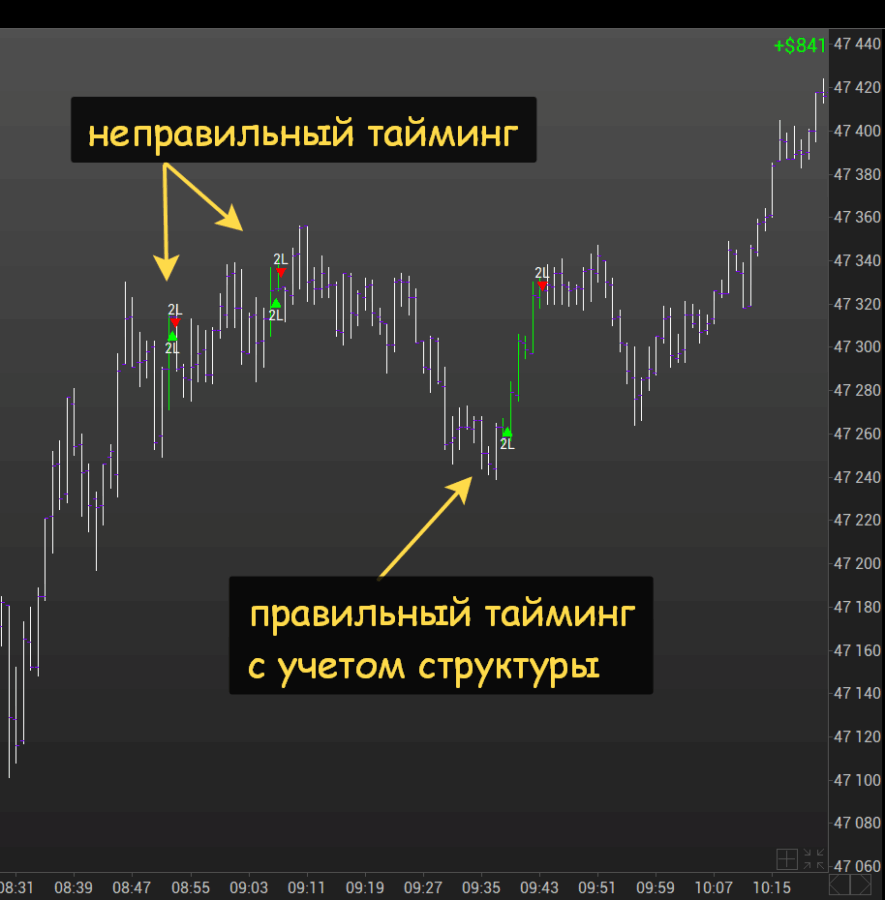
To understand timing, it is necessary to see the market structure and phase (in a certain sense, the use of timeframe nesting fits here), and also to have iron patience and nerves of steel. With an understanding of trade timing, the question of choosing a timeframe falls away by itself. One trade is interesting intraday, another is worth holding for several days.
Instead of a conclusion
In the author's opinion, the choice of a working timeframe is deeply secondary. What comes first is the trader's psychology and professional skills, which imply relying on timing, market phase and structure.
If a trader has everything listed above, then the question of choosing a working timeframe will disappear by itself.
Respectfully, Ivan Rusin
tlap.io